
ikfoundation.org
The IK Foundation
Promoting Natural & Cultural History
Since 1988

- WELCOME
- THE IK WORKSHOP SOCIETY
- THE FIELD STATION LAB
- THE DONATION ROOM
- BOOKS & ART0


- CONTACT
iFellows Sign In
Find out more about becoming an iFellow...My Basket
Items: 0Total: €0.00

18TH & 19TH CENTURY YARN WINDERS
– Textile Tools in Swedish Households
ESSAYS No: CCXXII | June 4, 2026 | By Viveka Hansen
Winding yarn into a ball is, from a Swedish perspective, the focus of this picture essay. Various tool models – yarn swifts or yarn winders – were in use across several strata of society during the 18th and 19th centuries. Artworks depicting domestic spheres and extant tools reveal diverse societies, everyday lives, and leisure activities, as well as handicrafts intertwined with the culture and household economy. Interestingly, near-exact visualisations of these wealthy interiors, with yarn prepared by servants or the lady of the household in the late 18th century, may also be compared with my own antique yarn winder, originating from a farming community, dating to some 50-100 years later. Such winders were useful for carefully handling yarn for knitting, embroidery, and other textile preparation over extended periods.
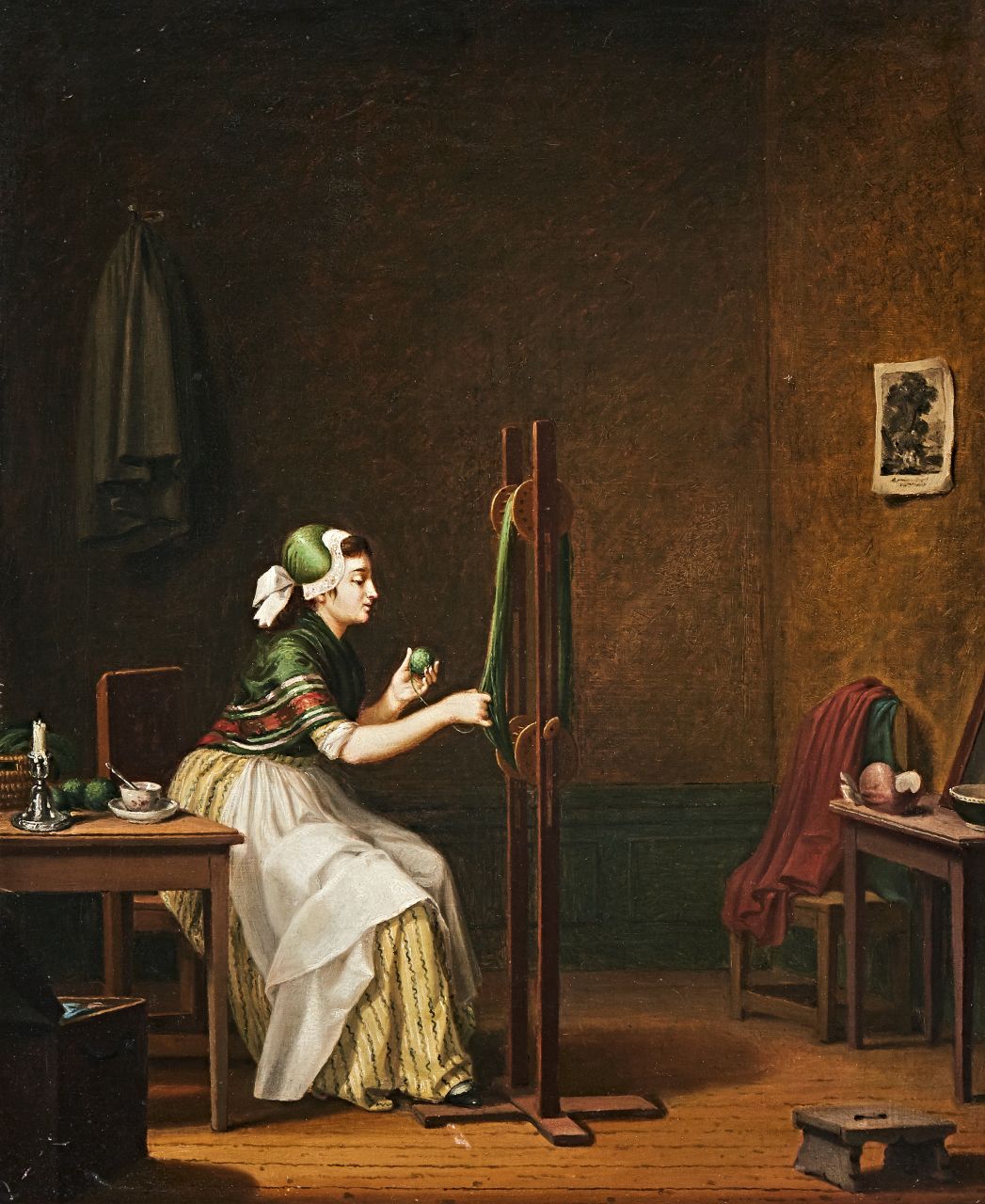 The catalogue text in a translation reads: ‘Pehr Hilleström (1733-1816). A woman who is winding. Signed Hilleström. Oil on panel. 51,5 x 42,5 cm.’ Her careful handling of the green yarn is evident as it is stretched between the two rolling wheels of this traditional wooden winder. The yarn quality was likely wool for knitting, indicated by the number of balls of the same colour visible in the picture, with two additional balls on the table and one or more skeins in the basket. Judging by the interior, the unidentified young woman was most probably intended to illustrate a daughter or servant in a wealthy household. (Uppsala Auktionsverk, sold in December 2021, unknown present owner).
 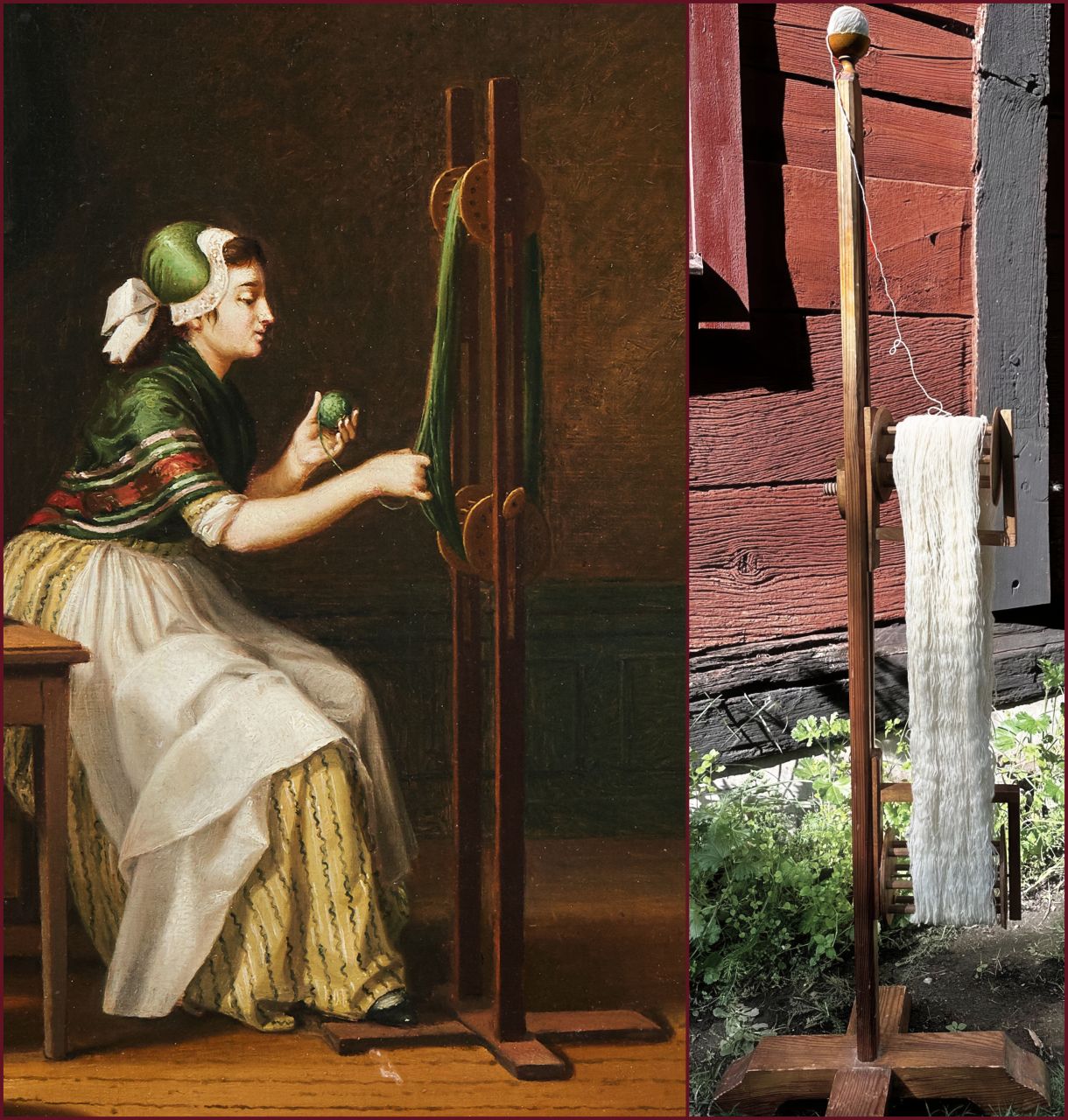 It is notable that the wool winder in the interior painting is almost the exact same model as this somewhat later 19th-century yarn winder. (Detail of Pehr Hilleström painting, above and wool winder in private collection). Photo. Viveka Hansen, The IK Foundation.
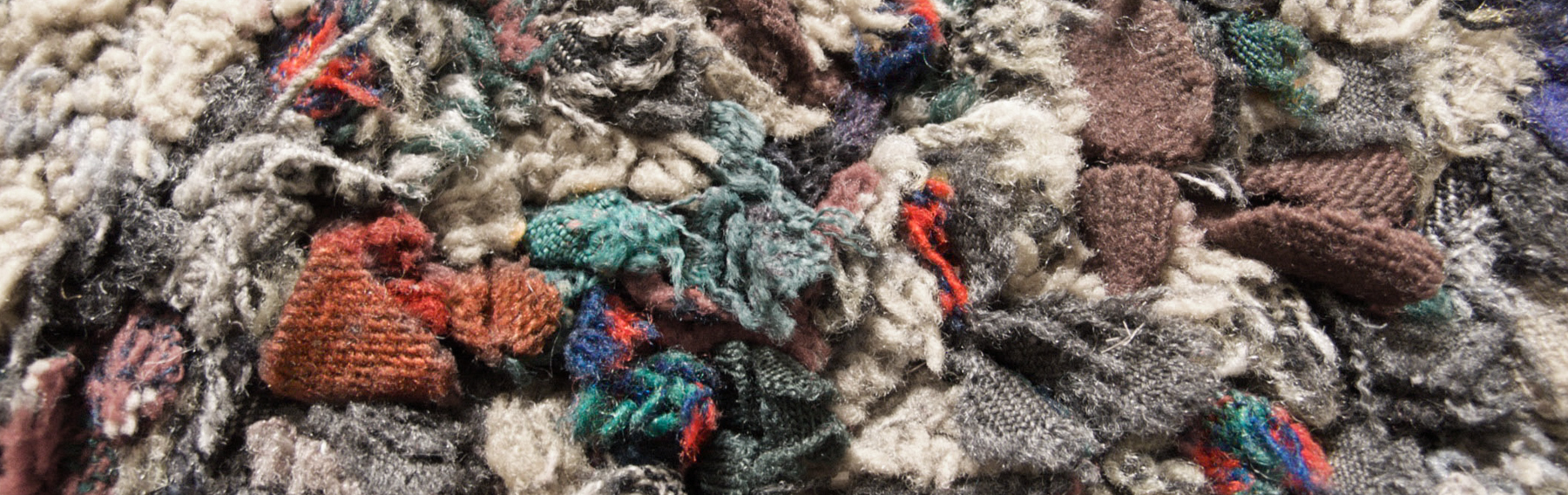
 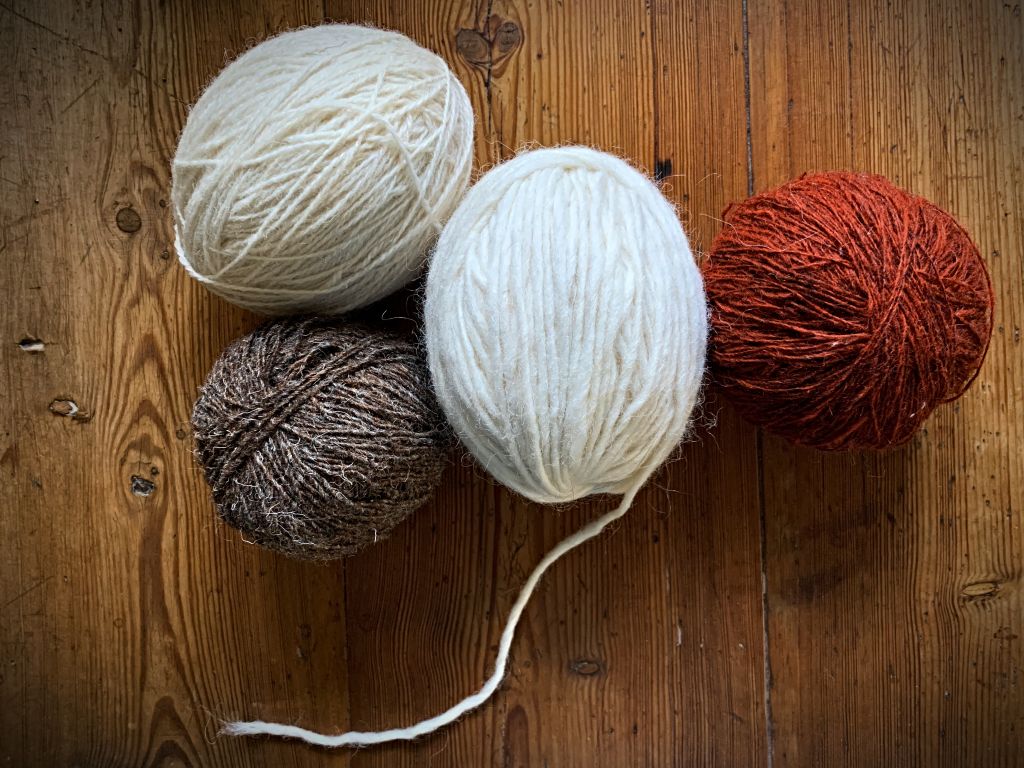 Examples of wools wound into yarn balls – made up on the 19th-century yarn winder as illustrated above. Even if most winding over time seems to have been done in the shape of round balls, oval-winded balls are another option. Machine-spun undyed single-ply wools and madder-dyed red wool, as shown here. (Private Collection). Photo. Viveka Hansen.
Before wool or linen yarn could be rolled into manageable balls (to avoid entangling) for use in handicrafts, such as embroidery or knitting, several processes were necessary: carding, spinning and winding them into skeins. Spinning, in particular, was primarily seen as women’s work, principally done in the home with a spindle or spinning wheel. How the skeins or hanks were made has nevertheless been saved for posterity via the professor of economics Anders Berch (1711-1774). Among his extensive collections, there are samples of flax and linen yarn still intact, some of them bearing the text ‘Helsinge Garn (yarn from Hälsingland) 7 strands to the lb. 16 knäpp (a certain quantity of yarn) to the Strand 100 reel layers to the Knäpp’. In other words, the way the yarn should be tied together after a certain number of knäpp on the reel, a system which had been worked out so the user would know how many ells/metres of yarn each hank/skein contained, in preparation for weaving. A measuring system, which was also applicable to other textile work.
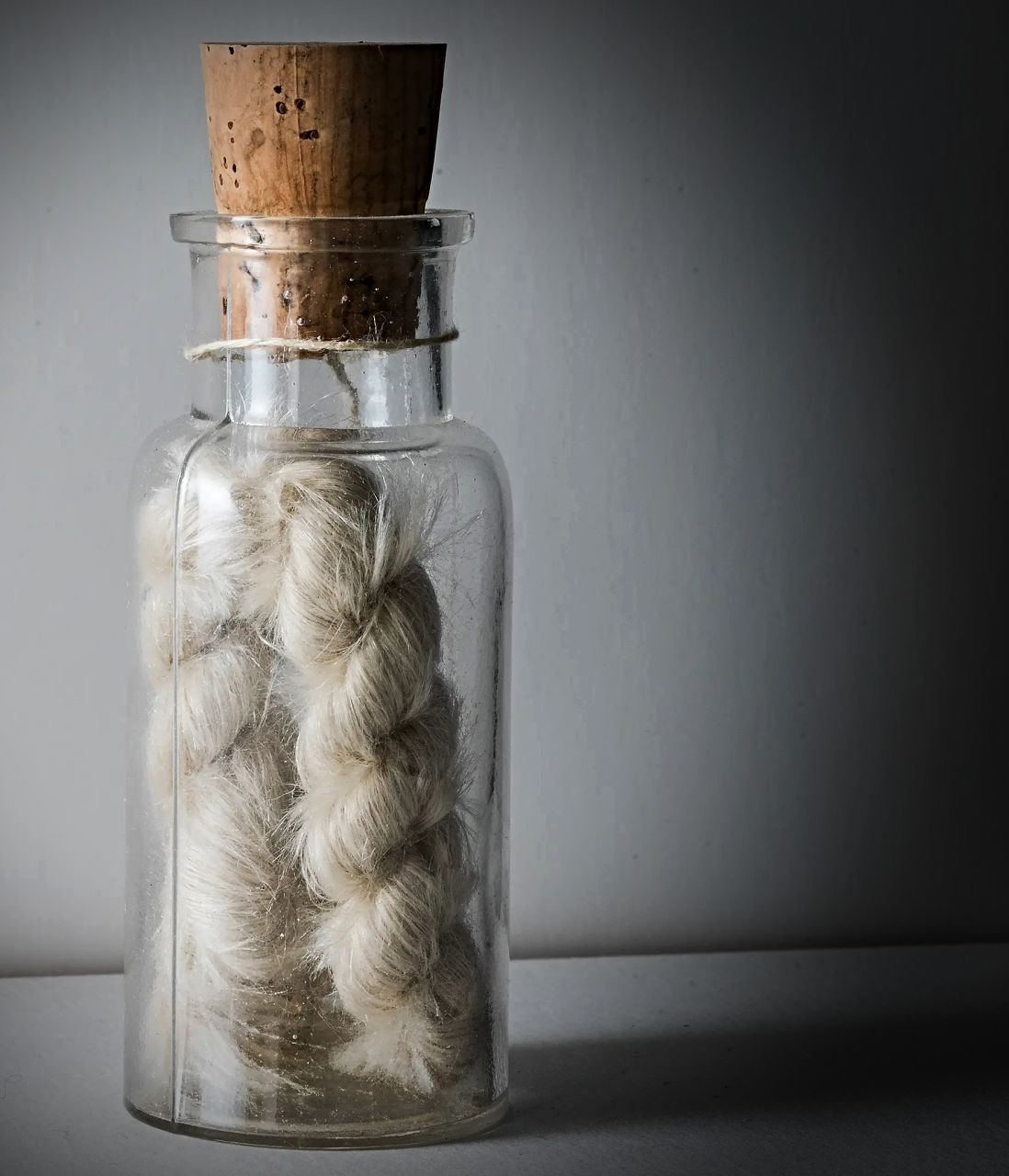 A skein of wool yarn in the sample collection gathered by economics professor Anders Berch around the 1750s-1760s can exemplify how yarn was tightly twisted into skeins after spinning. (Courtesy: The Nordic Museum, Stockholm. NM.0017648B:309. DigitaltMuseum).
As an aid to refining the complex calculations that linen weaving involved, a publication emerged in 1757 entitled Författning öfwer Lijngarn Uprännande til Lerfter (Constitution on the setting up a weave of flax yarn for linen cloth) by Olof Törnsten (1729-1787), promoted to be printed by the Manufacturcontoir of the High-ranking Four Estates of the realm. A large number of tables in it made it possible for the manufacturers, or the domestic weaver, to calculate correctly the most suitable fineness of the reed, the number of dents, widths, and number of hanks/skeins of different qualities of yarn which would be needed for each type of linen that might be thought essential for Sweden’s domestic needs. Even if these instructions, first and foremost, were linked to weaving, the same type of skeins were made up to be sold in shops or the yarn was spun at home to be used for handicrafts such as knitting or embroidery yarn. It may be noted that selling embroidery and knitting yarns in skeins was the norm within the Swedish Handicraft Organisation until the mid-20th century.
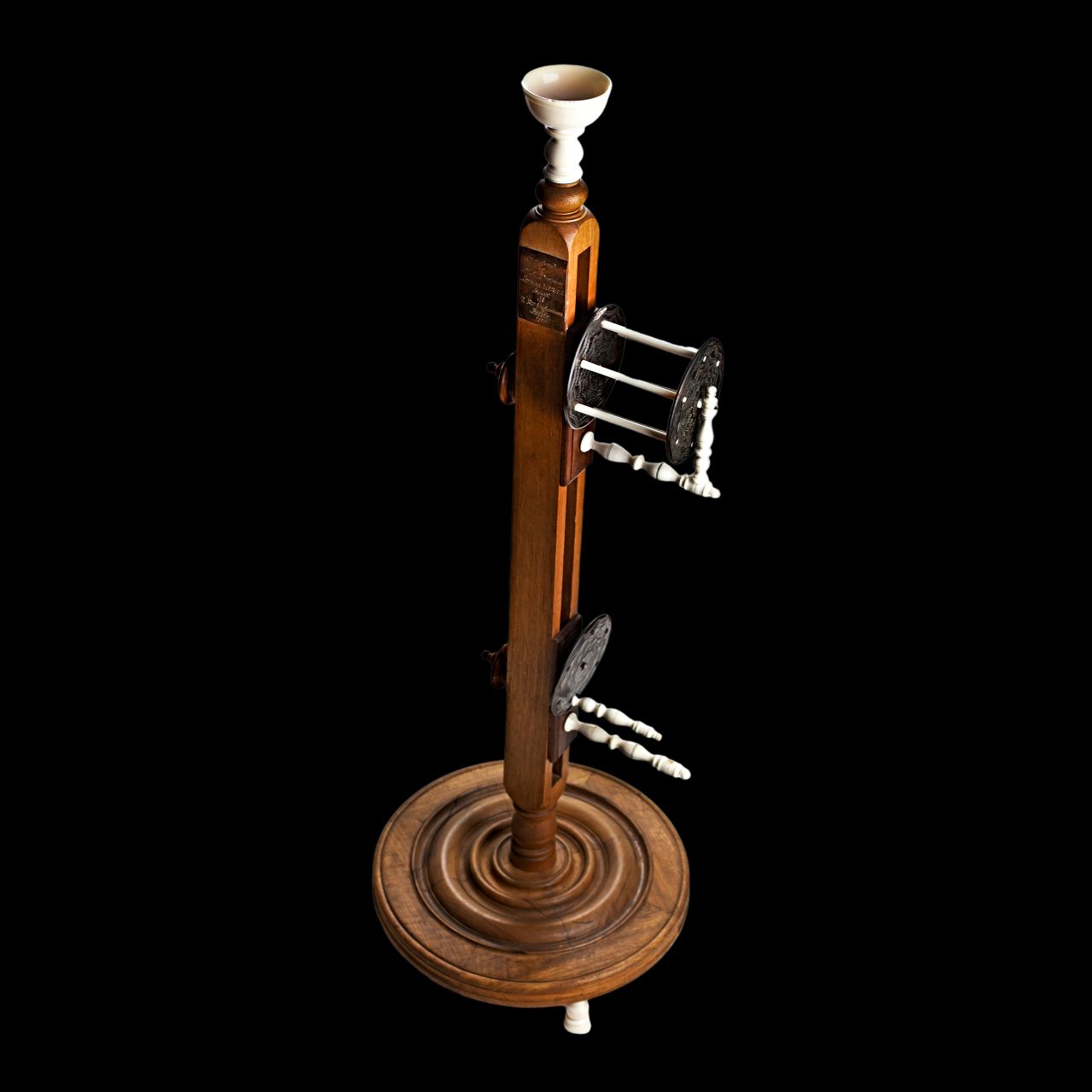 Preserved tools like winders were not only made of local woods by local carpenters in Swedish homes, as this well-preserved, elegant winder or reel (height 84 cm) – used to wind skeins of silk, cotton or wool into balls – demonstrates. It can be traced to the noble family of Nils Adam Bielke (1724-1792) and to Sturefors manor house via 18th-century inventory lists. The winder was made of walnut wood with details of ivory and tortoiseshell, and it was given as a gift to Countess Bielke in 1760 by Queen Lovisa Ulrica (1720-1782). (Courtesy: Linköping City Library, Curious Cabinet, Linköping, Lin1, 181. alvin-record. 262946. Unidentified maker of this tool).
 Household accounts can also reveal details about purchased yarn, for instance, in the wealthy family at Åkerö manor house, Count Gustaf Tessin’s (1695-1770) Cassa-Räkning, on 10th January 1762. Among fabric qualities and other accessories was listed: ‘1/2 lod black camel yarn. 1 lod red ditto’. Just as on 3rd May 1764, when the household paid more than 400 Daler Copper coins for new fabrics, which were to be sewn into garments for the Countess Lovisa Ulrika (1711-1768). Among expensive green taffeta and fine linen, ‘1 parcel of darning yarn’ was also included. In other words, it was typical to mention the weight of the goods and, on rare occasions, that the yarn was in a ‘parcel’ for protection. Such yarns for all sorts of stitching, embroidering or knitting were sold in skeins, as visualised in the artworks of this essay, but this appears to have been known to everyone and, therefore, not mentioned. In conclusion, this particular branch of textile tools is visualised in two further Pehr Hilleström interiors, but in these cases, with somewhat different yarn-winder models.
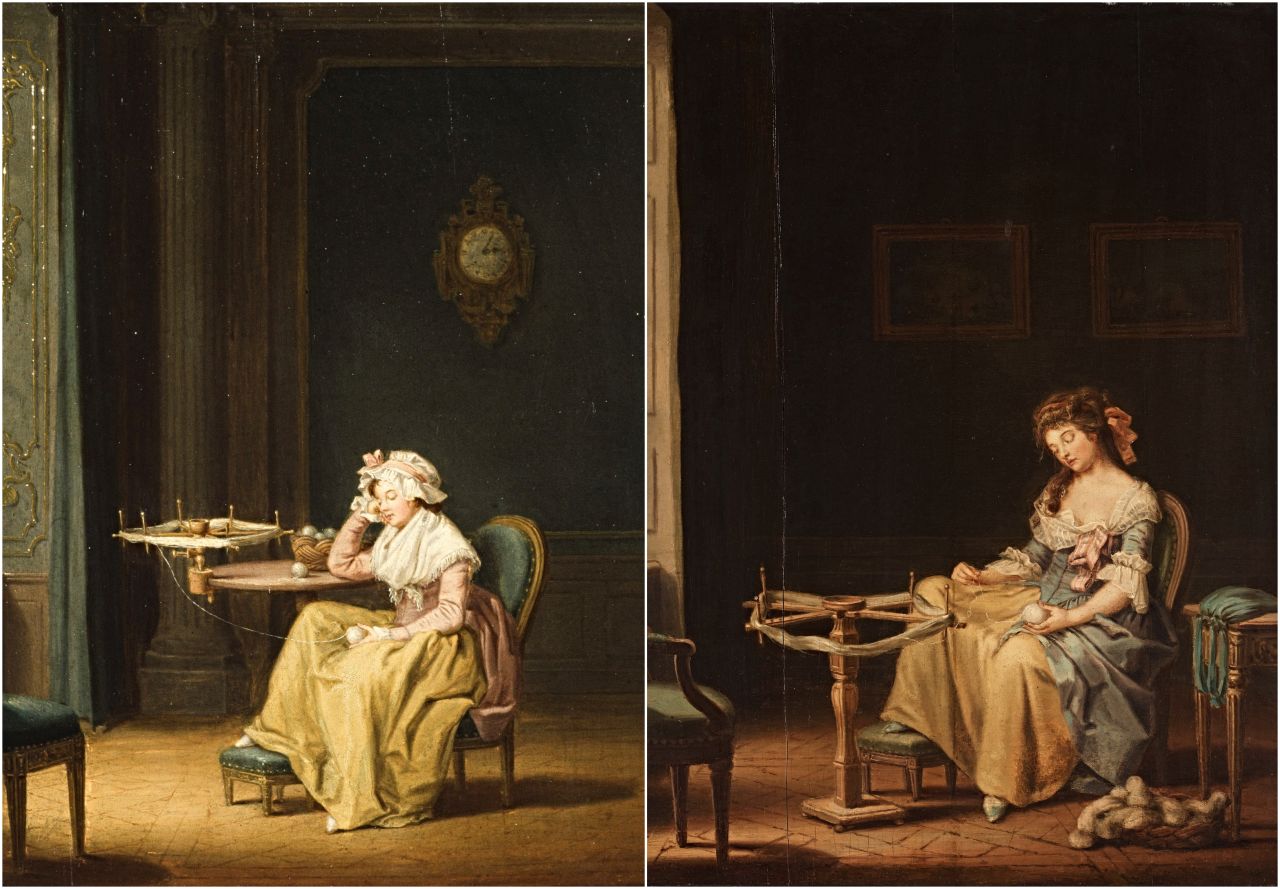 To the left: Circa 1780-90s, undated oil on panel by Pehr Hilleström. | To the right: Oil on panel, by Pehr Hilleström (1732-1816), dated 1st January 1780. (Courtesy: Left: Nationalmuseum, Sweden. NM 2453. Public Domain. | Right: Bukowskis Auction House, unknown present owner. Public Domain).
The first interesting aspect of the winding of yarn linked to Pehr Hilleström’s artistic work may be gleaned from these wealthy, serene interiors, where an impression of a servant or young lady of the house has fallen asleep or daydreamed during her work. In the left-hand painting, the many balls of yarn in the basket on the table offer some insight into the monotonous textile work over many hours. Whilst the other painting on the same subject, without doubt comfortable and low-intensity work (if not done for a living), depicts another young woman who has fallen asleep while winding yarn in a wealthy interior. Judging by the skeins in the basket on the floor, unlike in the other painting, she has just started winding the yarn into balls. However, I find it difficult to believe that it was common to fall asleep when winding yarn, when some concentration is necessary to avoid the yarn becoming entangled! This is even more so in Swedish pre-industrial times, as depicted in Hilleström’s paintings, given the amount of work that had been prepared even before the winding process. All textile raw materials, spun yarn, knitted garments, or woven fabric had a much higher value for the owner than they do today, so all handling had to be careful and diligent, which was most realistically depicted in the introductory picture of this essay.
Sources:
- Cederblom, Gerda, Pehr Hilleström som kulturskildrare, Vol. I, 1927 (picture 71).
- Geijer, Agnes & Hoffmann, Marta, Nordisk Textilteknisk Terminologi, Oslo 1974.
- Hansen, Viveka, Textilia Linnaeana – Global 18th Century Textile Traditions and Trade, London 2017 (p. 292).
- Hansen, Viveka, ‘Embroidery and other Handicraft – A Case Study of a Swedish Aristocratic Family from the 1730s to 1790s’, Textilis Essays, No: CXXXVIII | November 2, 2021.
- Kungliga biblioteket (The Royal Library), Stockholm, Sweden (Manuscript Collection: Carl Gustaf Tessin: “Cassa-Räkning” 1762-63 & 1764-66. No: SE S-HS Dep303:II: H, I).
- Nordic Museum, Stockholm, Sweden. (Anders Berch Collection. NM.0017648B:309. DigitaltMuseum).
- Nylén, Anna-Maja, Hemslöjd: Den svenska hemslöjden fram till 1800-talets slut, Lund 1969 (p. 210. Another example of a Pehr Hilleström painting, including a yarn winder in the 1760s).
- Stavenow-Hidemark, Elisabet, ed. 1700-tals Textil – Anders Berchs samling i Nordiska Museet, Stockholm 1990. (Quote p. 264)
- Törnsten, Olof, Författning öfwer Lijngarn Uprännande til Lerfter, 1757.
More in Books & Art:
Essays
ISSN 2631-4746
The iTEXTILIS is a division of The IK Workshop Society – a global and unique forum for all those interested in Natural & Cultural History.
Open Access Essays by Textile Historian Viveka Hansen
Textile historian Viveka Hansen offers a collection of open-access essays, published under Creative Commons licenses and freely available to all. These essays weave together her latest research, previously published monographs, and earlier projects dating back to the late 1980s. Some essays include rare archival material — originally published in other languages — now translated into English for the first time. These texts reveal little-known aspects of textile history, previously accessible mainly to audiences in Northern Europe. Hansen’s work spans a rich range of topics: the global textile trade, material culture, cloth manufacturing, fashion history, natural dyeing techniques, and the fascinating world of early travelling naturalists — notably the “Linnaean network” — all examined through a global historical lens.
Help secure the future of open access at iTEXTILIS essays! Your donation will keep knowledge open, connected, and growing on this textile history resource.
For regular updates and to fully utilise iTEXTILIS' features, we recommend subscribing to our newsletter, iMESSENGER.
The iTEXTILIS is a division of The IK Workshop Society – a global and unique forum for all those interested in Natural & Cultural History.
Open Access Essays by Textile Historian Viveka Hansen
Textile historian Viveka Hansen offers a collection of open-access essays, published under Creative Commons licenses and freely available to all. These essays weave together her latest research, previously published monographs, and earlier projects dating back to the late 1980s. Some essays include rare archival material — originally published in other languages — now translated into English for the first time. These texts reveal little-known aspects of textile history, previously accessible mainly to audiences in Northern Europe. Hansen’s work spans a rich range of topics: the global textile trade, material culture, cloth manufacturing, fashion history, natural dyeing techniques, and the fascinating world of early travelling naturalists — notably the “Linnaean network” — all examined through a global historical lens.
Help secure the future of open access at iTEXTILIS essays! Your donation will keep knowledge open, connected, and growing on this textile history resource.
For regular updates and to fully utilise iTEXTILIS' features, we recommend subscribing to our newsletter, iMESSENGER.
The IK Foundation & Company Promoting Natural & Cultural History
|
Subscribe to our Newsletter | IK Global iMessenger |
Translate Page |



|
© The IK Foundation & Company 2026 - a truly European organisation since 1988 |
The IK
Workshop Society
Workshop Society
The Field
Station Lab
Station Lab
How to cite & Creative Commons
You are welcome to use the information and knowledge from
The IK Workshop Society, as long as you follow a few simple rules.
LEARN MORE & I AGREE
You are welcome to use the information and knowledge from
The IK Workshop Society, as long as you follow a few simple rules.
LEARN MORE & I AGREE
