
ikfoundation.org
The IK Foundation
Promoting Natural & Cultural History
Since 1988

- WELCOME
- THE IK WORKSHOP SOCIETY
- THE FIELD STATION LAB
- THE DONATION ROOM
- BOOKS & ART0


- CONTACT
iFellows Sign In
Find out more about becoming an iFellow...My Basket
Items: 0Total: €0.00

A TRAVEL CUSHION DATED 1817
– A Case Study of Double Interlocked Tapestries in Sweden
ESSAYS No: CCXXVIII | September 24, 2026 | By Viveka Hansen
The inventory of almost 1,700 double-interlocked tapestries – rölakan – can be divided into 54 main designs, many with sub-pattern groups, and a multitude of border designs that decorate carriages, seat cushions, bedcovers, and bench covers alike. This case study will focus on a cushion in private ownership, originating in my first textile research project some 35 years ago. A single chosen textile, dated 1817, still with vibrant colours and, despite some wear and tear, several intricate details, can be revealed on this travel cushion for a carriage and a combined seating pad in a home interior. Uniquely for this particular example, it also includes distinctive characteristics comparable to a multifaceted number of similar extant Swedish textiles.
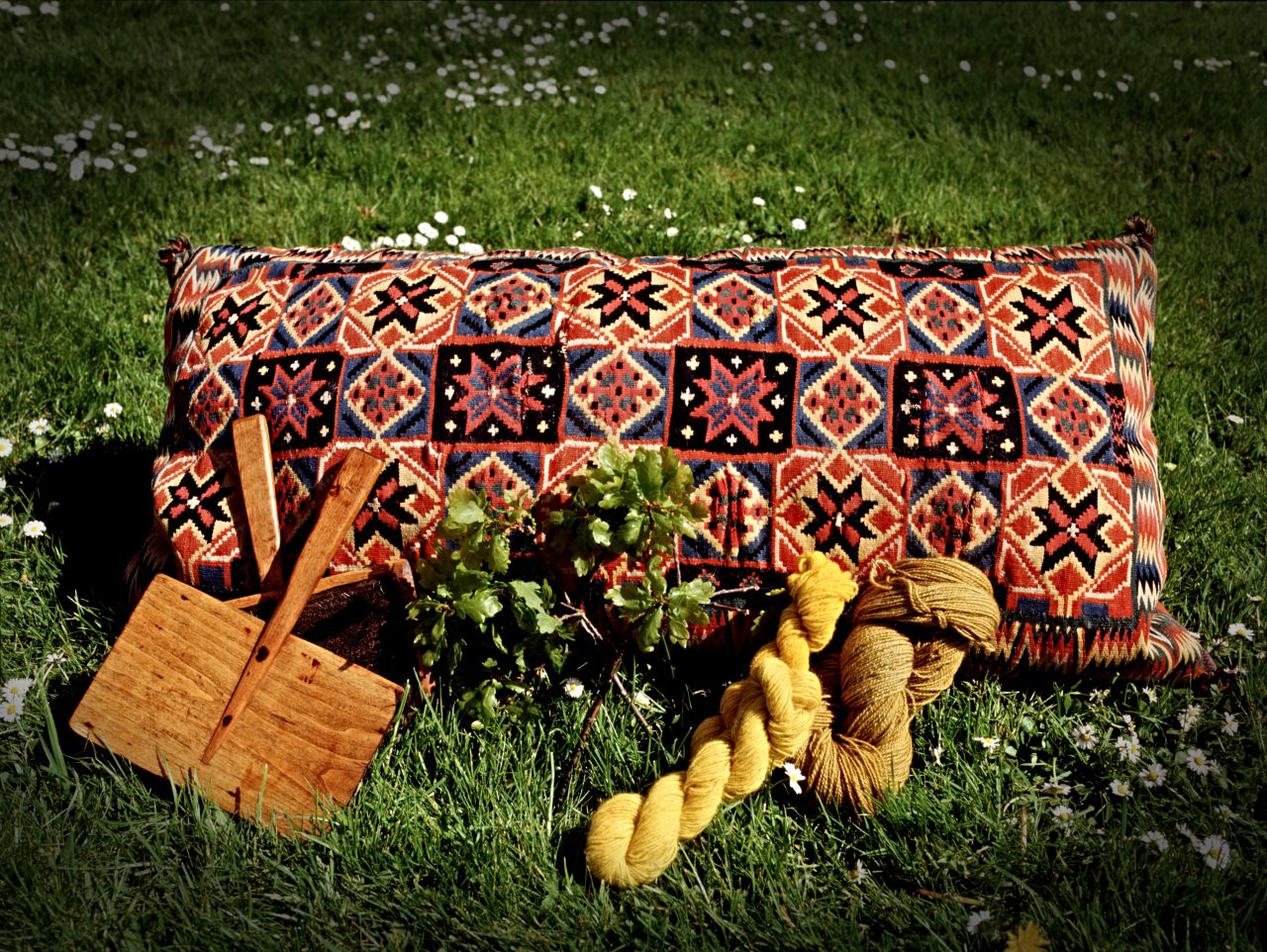 At weddings and other important festive occasions, brightly coloured seat and carriage cushions were used to sit on. These were backed, and the inside was padded. Like many other skilfully woven textiles in a home environment, the colours are surprisingly well preserved because these treasured textiles were kept in chests and cupboards for most of the years. | In the picture, wool yarn dyed in two yellow shades with oak leaves and 19th-century wool hand carders. (Private ownership). Photo: The IK Foundation.
All colours of the spectrum were produced from natural dyes, primarily from plants but also, in some cases, from various insects, first and foremost cochineal, during the second half of this period. Generally, these textiles were woven in clear, sharp, and saturated colours, often with extraordinary contrasts. Yellow and brown tones were the easiest to produce when using readily available Nordic flora. Whilst green, red, and blue carried certain limitations, these colours were therefore preferred in regions of economic prosperity, where it was possible to spend a lot of time on weaving and dyeing or to buy imported dyes. The dyeing was either done with locally grown, freshly picked plants or dried material, or with imported dyestuffs purchased in nearby towns or cities.
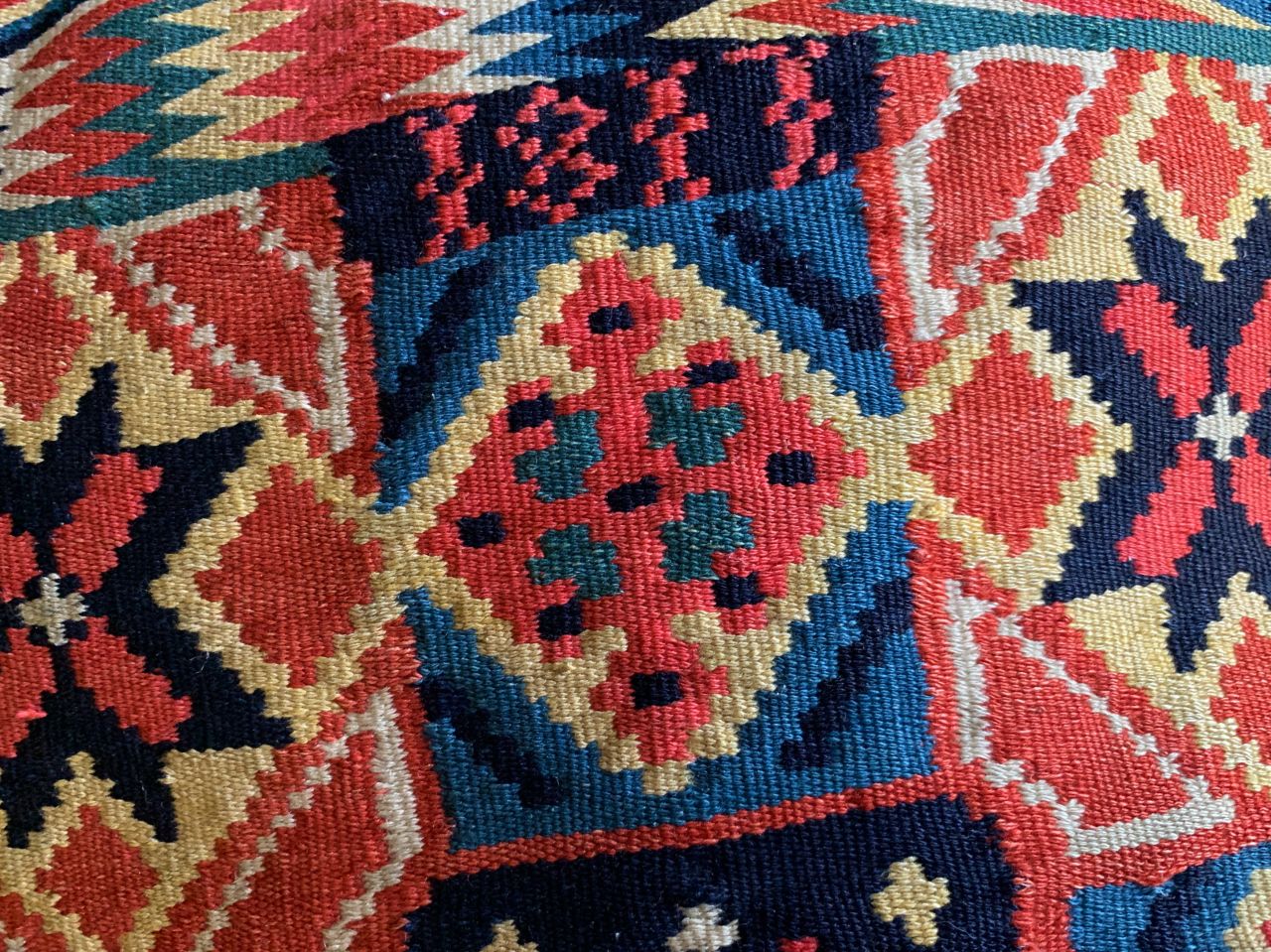 Placing one’s initials, a year, or a geographical place on possessions or produced goods is a tradition that stretches back through Nordic heritage, including many woven interior textiles for the home and the young woman’s dowry. Amongst the documented double interlocked tapestries – rölakan from this research of almost 1,700 examples – it can be stated that barely 20% of the textiles have some markings. These are positioned in various ways: on an empty background surface, alongside other smaller motifs, by replacing the motif with markings, in the borders or within a star motif. The markings are comprised of dates, names, places of birth or other details. These signatures were commonly added during weaving, but embroidered markings were also used. It is worth noticing that specific ornamentation, incredibly complex and compact weaves, had, in turn, a much higher percentage of markings. On this particular travel cushion, the year “1817” is clearly visible, with the initials ‘HD’ illustrated in the picture below. (Private ownership). Photo: The IK Foundation.
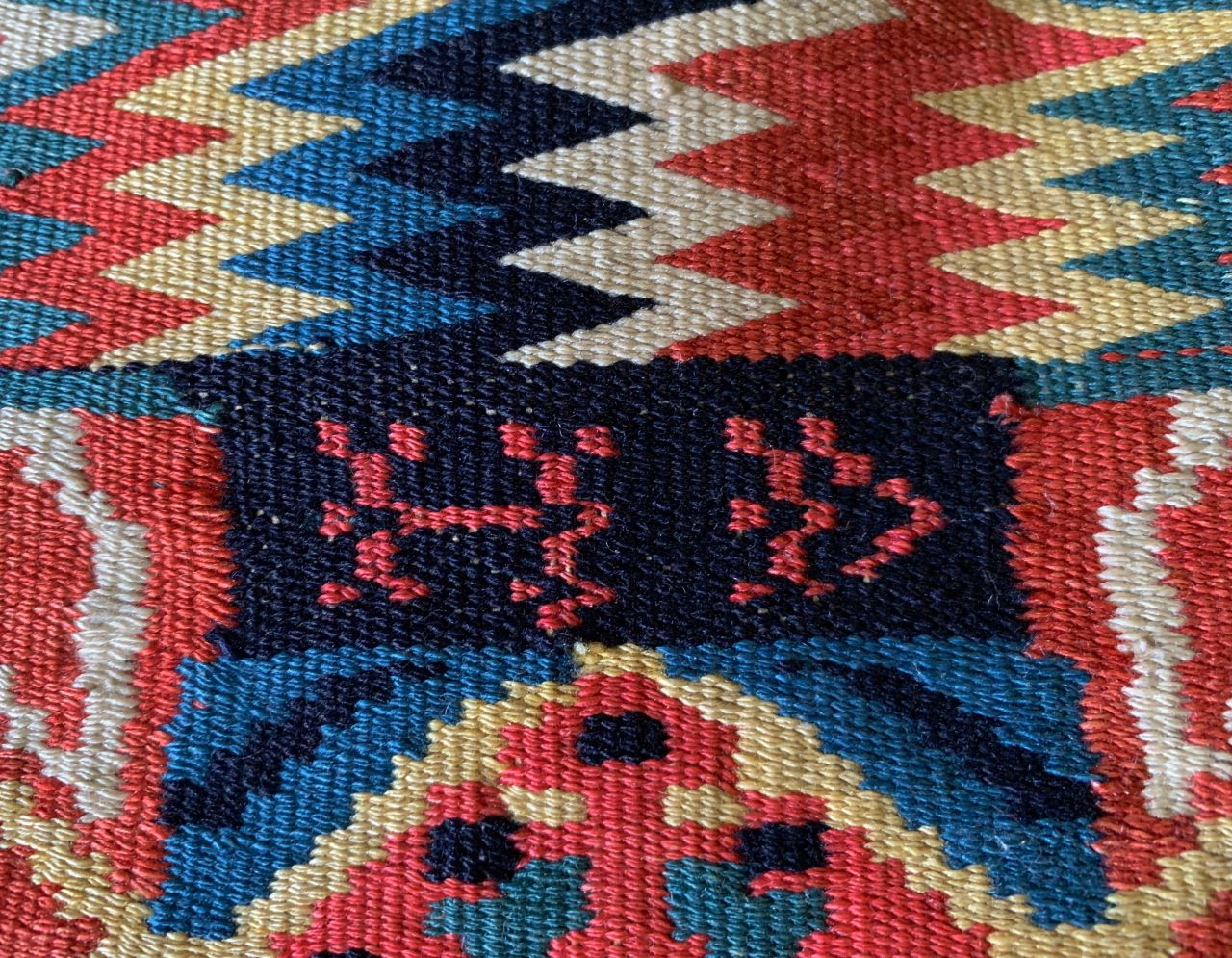 This detail of the travel cushion shows not only the initials of the probable original female weaver or owner but also perfectly symmetrical zigzag motifs – a widespread feature of these tapestries. The female weavers in the better-off farming districts produced increasingly fine examples of such zigzag designs from the 1810s to the 1850s. All these carefully selected motifs were handwoven on a horizontal loom using the double-interlocked tapestry technique – or rölakan in Swedish – on a linen warp and multicoloured woollen weft. (Private ownership). Photo: The IK Foundation.
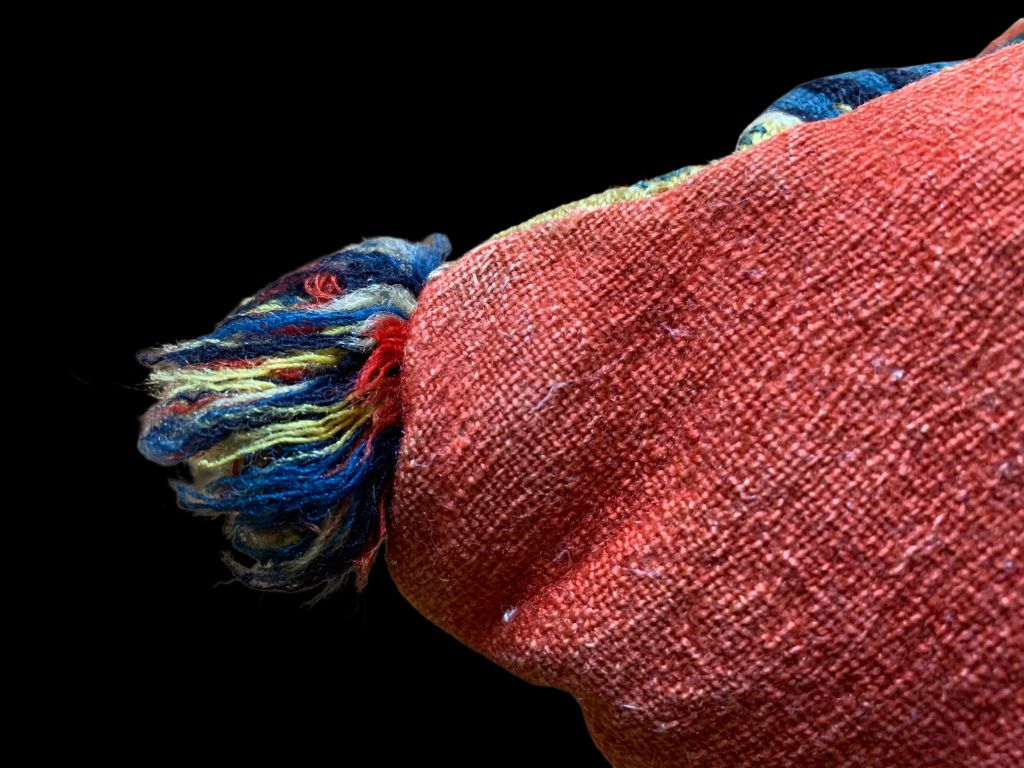 The back was not intended to be seen, and it was more robust and durable if cattle hair was mixed into the yarn. For economic reasons, the expensive red and blue colours were seldom used for the backs – but this beautiful cushion is one of the exceptions, with its madder red tabby woven broadcloth. Stronger shades were otherwise occasionally used for smaller areas and narrow stripes. Of the 1,693 inventoried textiles, 563 still have their original backs. These are mainly cushions and, to a lesser extent, bench covers. Over the years, the backs have been exposed to significant wear and tear and have sometimes worn to pieces. The rest have been thrown away. Now and then, only fragments remain on a cushion. However, this travel cushion is still well-preserved. (Private ownership). Photo: The IK Foundation.
Several techniques and materials were used for these back fabrics, but the most common was a weft-faced plain woollen quality woven in stripes and borders of different colours. A number of other techniques were also used, including dukagång, krabbasnår, halvkrabba, twill and satin weave. Leather or fur was sometimes preferred, particularly in the northeast of Skåne and in the provinces of Småland, Blekinge and Bohuslän.
Tassels and ribbons were common at the corners of seats, carriage cushions, and bench covers. These edgings were not solely decorative, as they also had a considerable strengthening effect on the most vulnerable areas of the textile. Ribbons, tassels, balls, and other trimmings combined the two essential functions of making the cushions more beautiful and more durable. Such corner decorations were made from different materials and colours, often using cut-out pieces of old clothes and other worn-out domestic textiles. The colours of the fabrics were often well-suited to the tones of the rölakan weave itself. The materials are primarily broadcloths or coarser wadmal qualities, or woollen yarn – as on this cushion, illustrated in the picture above – but also plain silks, brocaded silks, velvet, linen, stripes of leather, roller fringes, and printed pieces of cotton have been recorded.
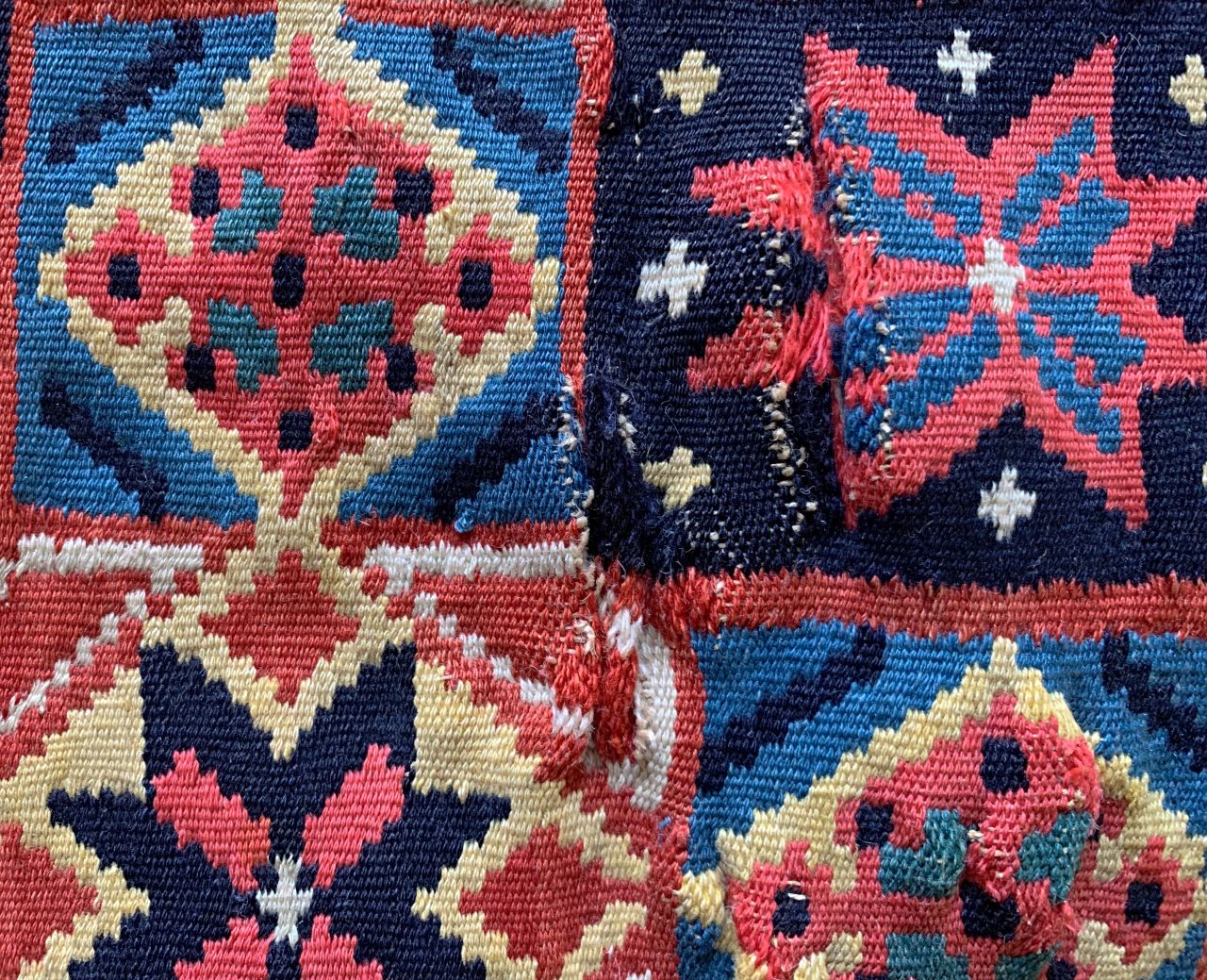 There is some minor visible wear and tear on the travel cushion, which is not unusual after more than two hundred years. Attempting to reverse such deterioration is difficult, so my choice has been to leave the damage untouched and instead keep it well protected from daylight for most of the year, as was traditional two centuries ago. (Private ownership). Photo: The IK Foundation.
Notice: For broader geographical, historical and social aspects of these colourful household textiles, please see my publications.
Sources:
- Hansen, Viveka, Textila Kubar och Blixtar - Rölakanets konst- och kulturhistoria, Christinehof 1992.
- Hansen, Viveka, Swedish Textile Art – The Khalili Collection, London 1996.
- Hansen, Viveka, Textile Squares & Zigzags: The Art and Cultural History of Double Interlocked Tapestries – Rölakan, Christinehof 1992/London 2019.
More in Books & Art:
Essays
ISSN 2631-4746
The iTEXTILIS is a division of The IK Workshop Society – a global and unique forum for all those interested in Natural & Cultural History.
Open Access Essays by Textile Historian Viveka Hansen
Textile historian Viveka Hansen offers a collection of open-access essays, published under Creative Commons licenses and freely available to all. These essays weave together her latest research, previously published monographs, and earlier projects dating back to the late 1980s. Some essays include rare archival material — originally published in other languages — now translated into English for the first time. These texts reveal little-known aspects of textile history, previously accessible mainly to audiences in Northern Europe. Hansen’s work spans a rich range of topics: the global textile trade, material culture, cloth manufacturing, fashion history, natural dyeing techniques, and the fascinating world of early travelling naturalists — notably the “Linnaean network” — all examined through a global historical lens.
Help secure the future of open access at iTEXTILIS essays! Your donation will keep knowledge open, connected, and growing on this textile history resource.
For regular updates and to fully utilise iTEXTILIS' features, we recommend subscribing to our newsletter, iMESSENGER.
The iTEXTILIS is a division of The IK Workshop Society – a global and unique forum for all those interested in Natural & Cultural History.
Open Access Essays by Textile Historian Viveka Hansen
Textile historian Viveka Hansen offers a collection of open-access essays, published under Creative Commons licenses and freely available to all. These essays weave together her latest research, previously published monographs, and earlier projects dating back to the late 1980s. Some essays include rare archival material — originally published in other languages — now translated into English for the first time. These texts reveal little-known aspects of textile history, previously accessible mainly to audiences in Northern Europe. Hansen’s work spans a rich range of topics: the global textile trade, material culture, cloth manufacturing, fashion history, natural dyeing techniques, and the fascinating world of early travelling naturalists — notably the “Linnaean network” — all examined through a global historical lens.
Help secure the future of open access at iTEXTILIS essays! Your donation will keep knowledge open, connected, and growing on this textile history resource.
For regular updates and to fully utilise iTEXTILIS' features, we recommend subscribing to our newsletter, iMESSENGER.
The IK Foundation & Company Promoting Natural & Cultural History
|
Subscribe to our Newsletter | IK Global iMessenger |
Translate Page |



|
© The IK Foundation & Company 2026 - a truly European organisation since 1988 |
The IK
Workshop Society
Workshop Society
The Field
Station Lab
Station Lab
How to cite & Creative Commons
You are welcome to use the information and knowledge from
The IK Workshop Society, as long as you follow a few simple rules.
LEARN MORE & I AGREE
You are welcome to use the information and knowledge from
The IK Workshop Society, as long as you follow a few simple rules.
LEARN MORE & I AGREE
