
ikfoundation.org
The IK Foundation
Promoting Natural & Cultural History
Since 1988

- WELCOME
- THE IK WORKSHOP SOCIETY
- THE FIELD STATION LAB
- THE DONATION ROOM
- BOOKS & ART0


- CONTACT
iFellows Sign In
Find out more about becoming an iFellow...My Basket
Items: 0Total: €0.00

BARK CLOTHS AND BARTERING TRADE
– The Endeavour Voyage in 1768 to 1771 and John Hawkesworth’s Publication
ESSAYS No: CCXXX | November 12, 2026 | By Viveka Hansen
The bark cloth, which the islanders commonly used, caught the travellers’ attention most during their stay on Tahiti and nearby islands from April to August 1769, in what is known today as French Polynesia. On that subject, several lengthy notes were made not only on its production, dyeing, ceremonial traditions and use, but also on its value as a gift. The barter trade was frequently mentioned in the journals of the naturalist Joseph Banks, the artist Sydney Parkinson and Captain James Cook – which is not surprising, given the ethnographical items evidently brought back home. The fabrics were called tapa throughout the Polynesian region. Still, bark cloth of the same kind was also produced in many parts of Africa, Asia and America under different names. This essay will look more closely into this particular trade via their travel journals, illustrative material and the editor John Hawkesworth’s contemporary publication.
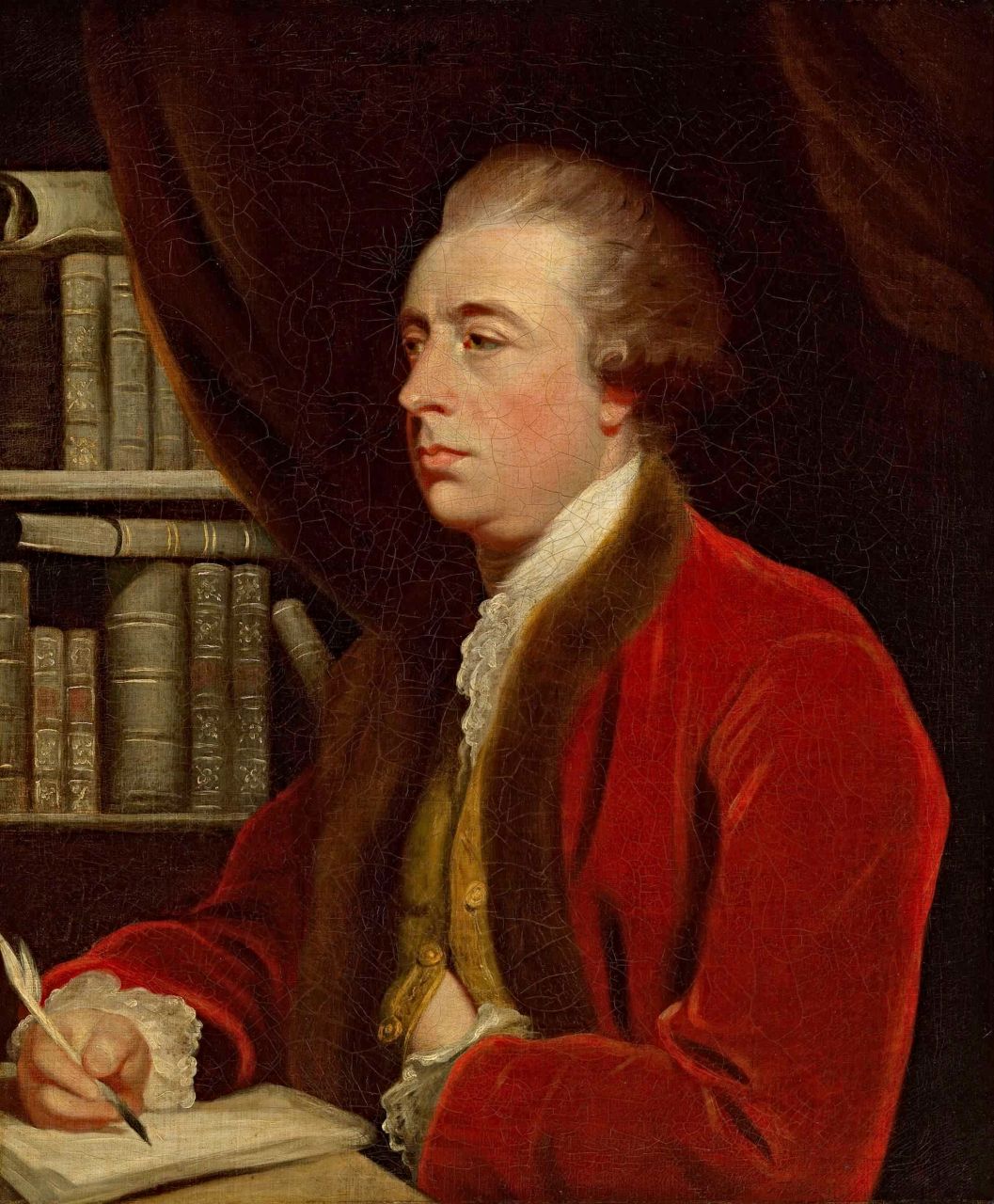 Portrait of the book editor and writer John Hawkesworth (1715-1773), c. 1770, whom the Admiralty commissioned to edit James Cook’s journal and other contemporary travel narratives. A publication that was printed in three volumes in 1773. Oil on canvas by an unknown artist after Joshua Reynolds. (Courtesy: National Portrait Gallery, Australia).
The naturalist Joseph Banks (1743-1820) recorded in his journal on 14 April 1769, after a few weeks’ sailing among the Polynesian islands, at Matavai Bay, Tahiti, that ‘…My piece of Cloth was 11 yards long a 2 wide: for this I made return by presenting him with a large laced silk neckcloth I had on and a linen pocket handkerchief, these he immediately put on him and seemed to be much pleased with’. This gives an idea of how many metres the naturalists on Endeavour could acquire in exchange for two small, fine textile items from home. Bark cloths, as well as other objects kept among their personal belongings, were also described in detail in James Cook’s (1728-1779) journal. His observations were initially published by John Hawkesworth – who did not take part in the voyage himself – in a three-volume set of books based on several men’s journals of long sea voyages, James Cook’s being the most extensive. Hawkesworth described in the foreword that he had chosen to write in the first person, which may be somewhat confusing but is therefore closer to the original manuscript. Cook’s journal included a multitude of notes about Mr Banks’ and Dr Daniel Solander’s (1733-1782) natural history work, his own work, supplies or lack of supplies on board, the purchase and barter of food, live animals, bark cloths, fresh fruit, cocoa nuts, vegetables, water, other drink etc. Hawkesworth's publication also included a number of illustrations, which further highlighted the travel company’s interest in bark cloths.
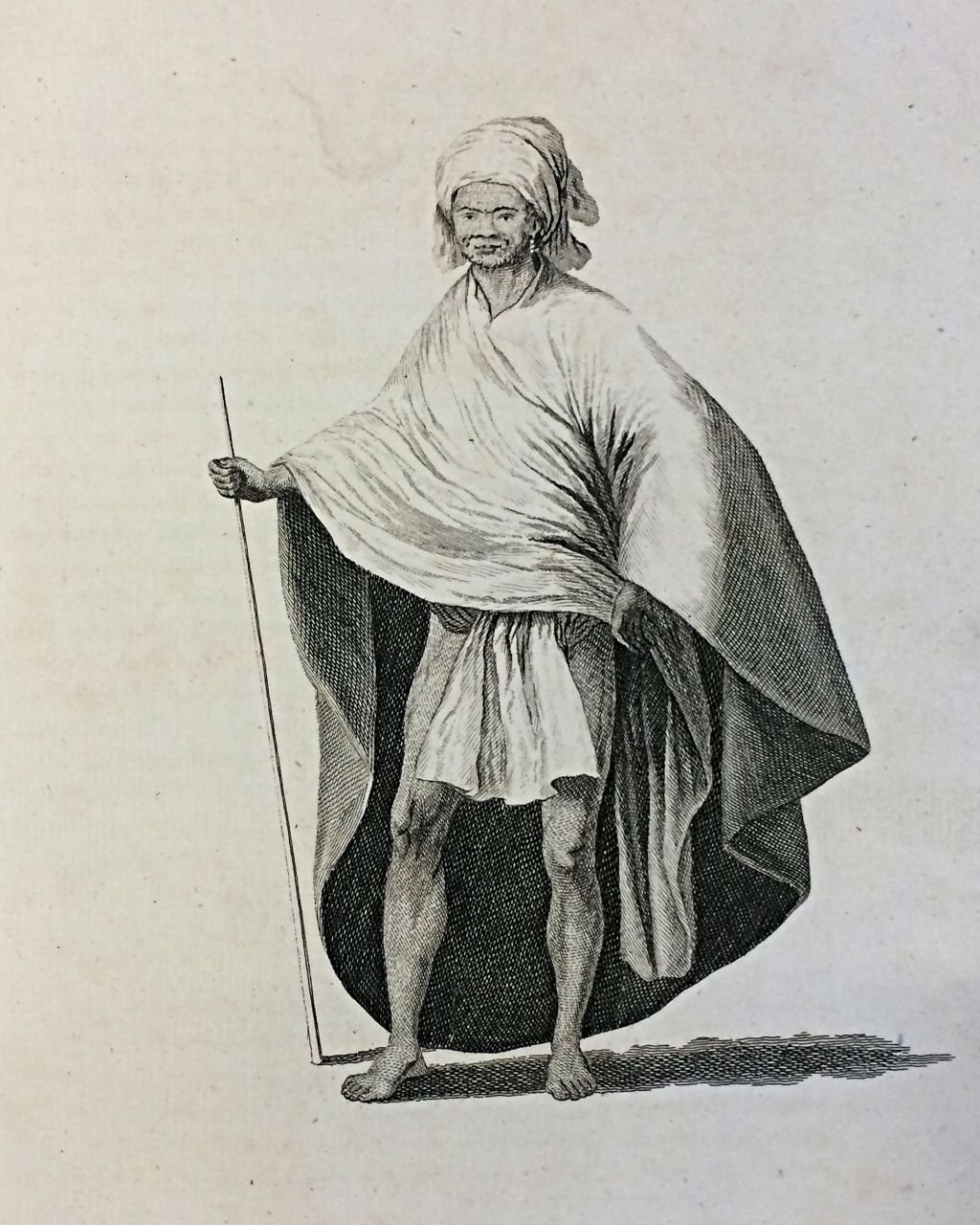 ‘A Native of Otaheite, in the Dress of his Country’. Based on Sydney Parkinson’s (1745-1771) observations and this drawing, it appears that prosperous members of the population wore several bark cloths at once; the more layers worn, the higher the wearer’s status. He also noted how the men dressed, briefly: ¨…they wore a cloth around their waists, reaching different lengths down their legs, and their heads were often wrapped in large turbans decorated with parrot feathers. Sometimes voluminous capes were wrapped around the body, possibly as rich decoration and to keep warm during chilly evenings and nights’. (Image: Hawkesworth, John, An Account of the Voyages…, 1773, vol. 2, pl 3).
James Cook’s description of the making of bark cloths was the most thorough of them all, and he recorded moreover that, ‘Dr Solander thinks it is the same plant the bark of which the Chinese make paper of ’. That was a correct observation by Solander, the paper mulberry tree being the material primarily used for the finest bark cloths. The cultivation of the tree on the island contributed to an increase in the supply of vital raw materials. The tree ought to be grown to a height of six to eight feet (ca 180-240 cm) before being harvested and the narrow stem put to soak. After being soaked for some time, the bark could easily be peeled off in long strips, resembling narrow scraps of linen. Joining the fibres together was made easier by the fact that the plant contained an adhesive juice. The wet strips of bark were then spread out on a long rectangular wooden board, which could measure as much as one metre in width and six to ten metres in length. The material was then beaten intensively with a flat wooden club in order for the strips to achieve the look of one coherent piece of cloth. If a hole happened to appear in the cloth during the process, it was easily mended by adding another piece of bark over the hole and continuing the beating. The eye could initially be deceived into believing that the cloth was woven, seeing its lengthwise stripes; the finest kinds could qualitatively be compared even with a fine cotton cloth. To produce a coarser cloth two pieces of thin cloth were placed on top of each other on the wooden board and then worked together. The production of the fabrics for clothing fell entirely on the women, who were also extremely skilled at plaiting mats from palm leaves in the finest and most beautiful patterns. Parkinson added that those kinds of plaited fabrics were also made into clothes for wearing in rainy weather. The draughtsman’s opinion vaguely contradicted that of Cook’s on two points, namely that he recorded the production of bark cloth being only mostly done by women and the finished fabrics resembling paper.
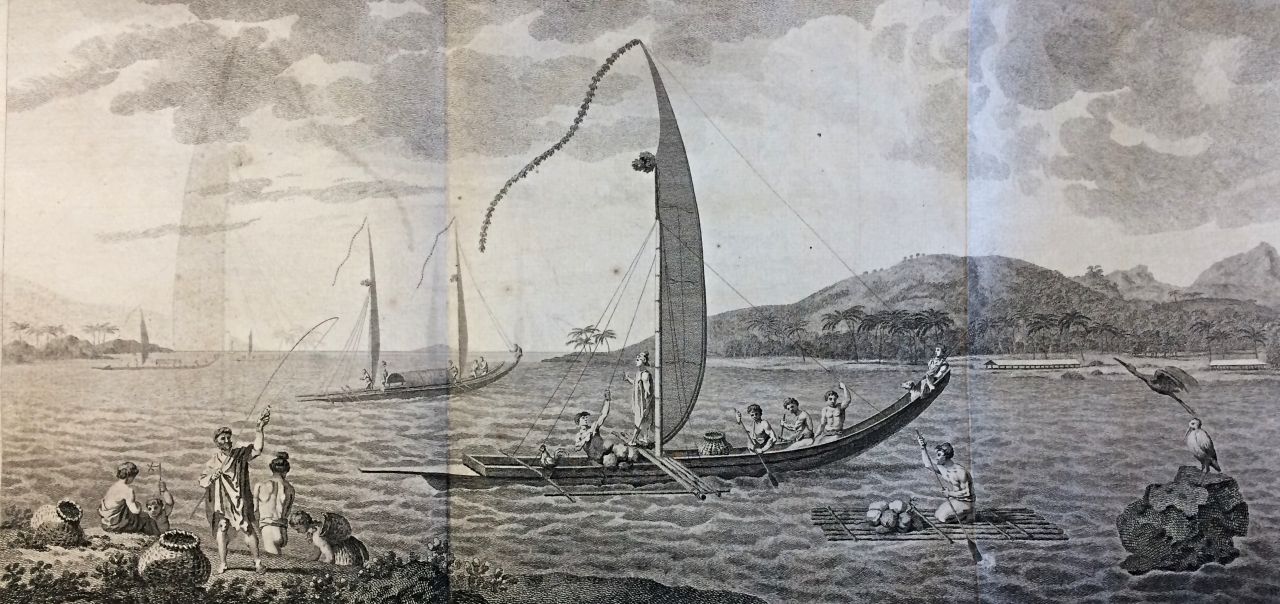 This is another illustrative example – with a touch of “Europeanisation”, as they saw it at the time – that shows various garments made of bark cloth, so painstakingly described by Banks, Cook and Parkinson across the entire Polynesian region. (Image: Hawkesworth, John, An Account of the Voyages…, 1773, vol. 2, pl. 4).
Joseph Banks repeatedly stressed that the bark cloths served the native inhabitants as a valuable bartering commodity. ‘This morn several Canoes came on board among which were two in which were people who by their dress and appearance seemed to be of a rank superior to those whom we had seen yesterday. These we invited to come on board and on coming into the Cabbin each singled out his friend, one took the Captn and the other me, they took off a large part of their cloths and each dress’d his friend with them he took off; in return for this we presented them with each a hatchet and some beads.’ On the same day, it was also recorded that the travellers were beginning to get acquainted with the islanders, but in the process Solander, among others, had his snuff-box stolen. He and Banks, with the assistance of the village chief, tried to recover it, but were instead offered a large quantity of bark cloth as compensation for the loss. They tried to explain that they wanted the stolen items back, not cloths, and the negotiation eventually succeeded. A woman still offered Solander a piece of cloth to further demonstrate her friendly attitude to the strangers. Beads were otherwise the best currency for Europeans to use in barter, but on one occasion a shirt was instead given in exchange for a piece of bark cloth.
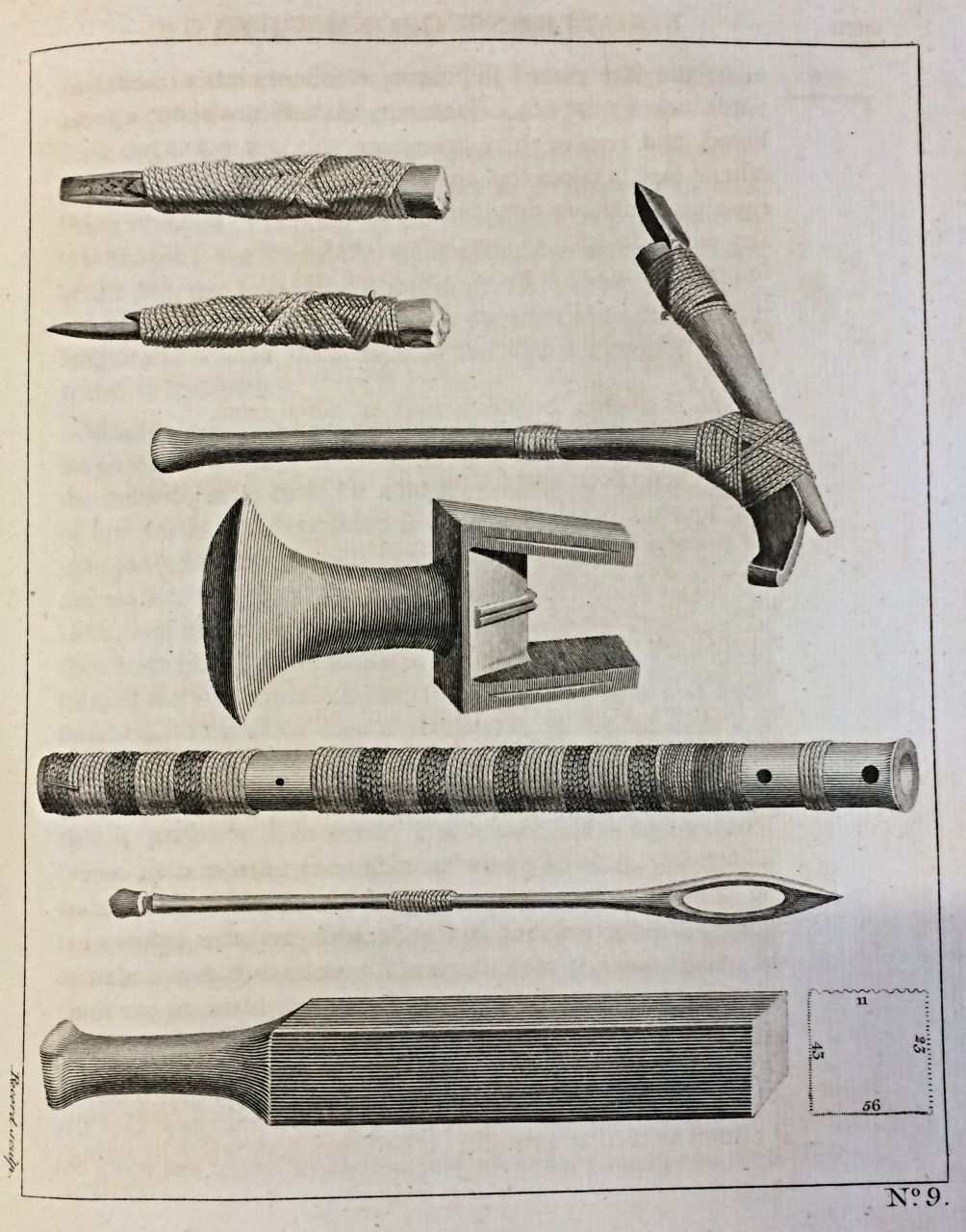 The beater for bark cloth at the bottom of the picture, along with other tools used locally on Otaheite [Tahiti] and nearby islands, was also depicted by the artist Sydney Parkinson during the period April-August 1769, accompanied by Carl Linnaeus’ apostle and naturalist Daniel Solander et al. on James Cook’s first voyage. This tool is one of many hundreds of ethnographic items collected during Cook’s voyages, which, after their return to Europe and England, initially ended up in collectors’ own hands, in other private ethnographic collections, in early museum collections, or in scientific natural history cabinets in Europe. In the 19th century and into the next, the objects were gradually sorted, sold, re-arranged, or donated to museums and institutions in Europe as well as on other continents. Today, ethnographic objects from those voyages can be seen and studied at the Pitt Rivers Museum, Oxford, and several other museums in England; the Museum of Ethnography, Stockholm, Sweden; Georg-August University of Göttingen, Germany; the Museum of New Zealand; and the National Museum Australia, etc. (Image: Hawkesworth, John, An Account of the Voyages, 1773, vol. 2, pl. 9).
Both James Cook and Sydney Parkinson also recorded the method of dyeing those fabrics. Cook was of the opinion that most of them were red, brown or yellow, without describing the process in any detail, whereas Parkinson had the opportunity to study how the dyeing was done. Firstly, the whole piece of fabric was not dyed, as was customary when dyeing textiles; instead, the bark cloth was decorated like a painting according to the following method: ‘She took the young leaves of a Convolvulus unfoliated, and then broke off the tops of a small fig, of a reddish hue and squeezed out of it a milky fluid, which she spread on a leaf, rubbing it gently to mix it with the juice of the leaf, and then it became red, this she soaked up with the leaf of a solanum, and then daubed it upon some cloth: the colour is good, but whether it will stand, I am unable to determine.’ The colour was probably quite hardy against sun and water, but if it faded it could easily be decorated again. Moreover, there was not the same need for durability in the dyestuff used on bark cloths compared to other textile materials. When wool, cotton, linen or silk yarn was dyed and then woven into fabrics, the idea was for the beautiful colours to endure for a long time. A faded striped woven fabric could not be dyed again with the same ease.
Joseph Banks also provided a detailed account of the production of bark cloth, which complements both Cook’s and Parkinson’s notes from Tahiti, and offered the following summary of his new information. The soaking of the bark continued for some days, after which the women brought the bark down to the river, where they scraped off the outer parts, leaving only the fine inner fibres. Banks also noted the great care taken as the bark was spread out, ensuring that the future cloth would have the same thickness across its entire breadth as well as its length. That stage was likely the most decisive, as the mistress of the house herself kept an eye on the process, while for the rest of the work the women servants were in charge of producing the material. The bark cloths were not produced in only one fine and one coarse thickness; the process had been developed to great refinement and was described as follows: ‘Of this thin cloth they have as many different sorts almost as we have of Linen, distinguishing it into different finenesses and the different materials of which it is made ’. The cloths also improved with time: as they were washed, the material gradually softened and became more comfortable to wear. One disadvantage, however, was its fragility. He stated from his own experience that the bark cloth was only suited to a warm climate, as it could in no way be compared to the warming properties of European fabrics for the cool nights on the islands.
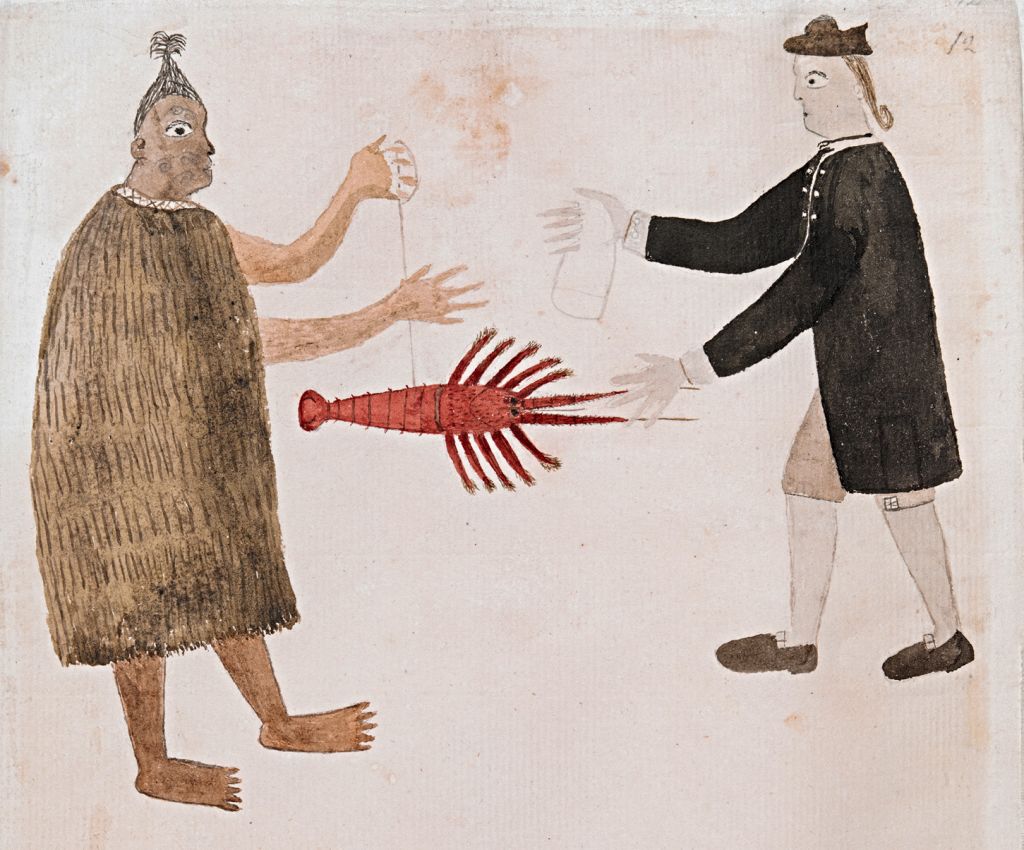 ‘Maori trading a crayfish with Joseph Banks’ in 1769, by the artist, navigator and priest Tupaia [Tupia], who joined the Endeavour crew at the Society Islands earlier the same year. He became a competent additional member due to his navigational skills and as an interpreter of local languages. This artwork offers a good representation of the frequent bartering trade in New Zealand between an indigenous man and Banks – in this case, a desirable specimen for the naturalists, who, as it appears, handed over a piece of bark cloth in return. Furthermore, cloaks as worn by the Maori man were another item the Europeans collected via bartering trade on several occasions during their stay in the New Zealand area. Tupaia, as an assistant on board, was also repeatedly mentioned in the journals of Banks, Sydney Parkinson and James Cook. Cook noted, for instance, on 9 October 1770: ‘We then went again to the riverside having Tupia, Mr Green and Dr Monkhouse along with us. Tupia spoke to them in his own language and it was an agreeable surprise to us to find that they perfectly understood him.’ Sadly, all three men died later in the voyage: the surgeon William Monkhouse on 5 November 1770, Tupaia on 26 December 1771 and the astronomer Charles Green on 29 January 1771 – as well as many others in the crew of Endeavour. (Courtesy: British Library, Add MS 15508, f.12. Public Domain).
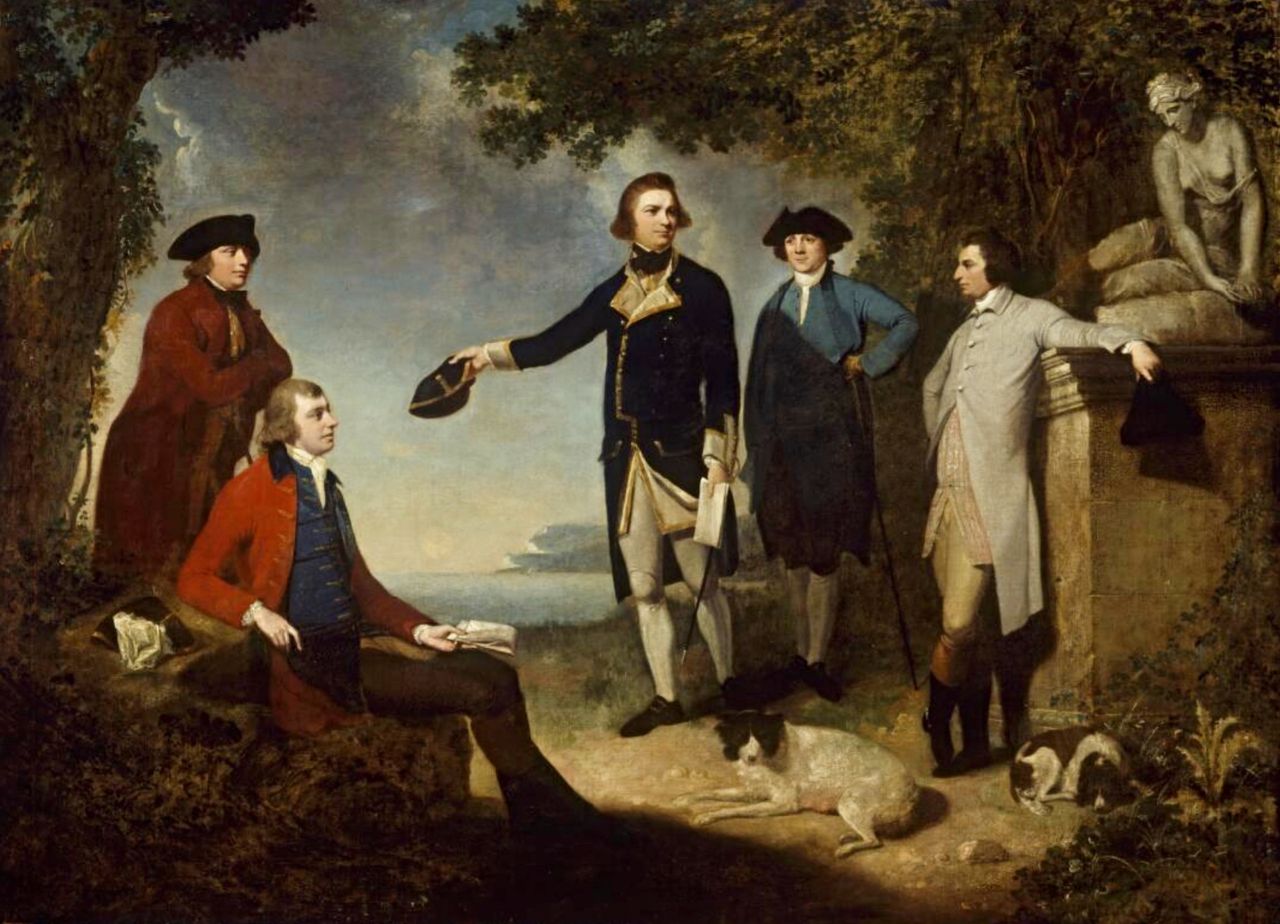 A concluding group portrait depicts some of the central individuals involved in the Endeavour voyage – believed to have been painted shortly after the almost three-year-long voyage, following the return to England in the summer of 1771. Three of them had taken part in the circumnavigation itself, whilst the other two men had a connection to the British Admiralty. From the right: the Swedish naturalist Daniel Solander, Sir Joseph Banks (seated), Captain James Cook pointing towards the sea, and the editor and writer John Hawkesworth, who two years later edited and published Cook’s travel writings together with the First Lord of the Admiralty, John Montagu, 4th Earl of Sandwich (1718-1792). Bark cloths are among the many “discoveries”, fascinations and natural history observations from their European perspective. | Oil on canvas by John Hamilton Mortimer (1740-1779). (Courtesy: The National Library of Australia).
Sources:
- Banks, Joseph, The Endeavour Journal of Joseph Banks – 1768-1771. Edited by J. C. Beaglehole, 2 vol., Sydney, 1963. (Vol. One. p. 253).
- Cook, James, A Voyage towards the South Pole and Round the World, performed in His Majesty’s Ships the Resolution and Adventure. In the years 1772, 1773, 1774 and 1775, two volumes, London 1779. (9 October 1770).
- Hansen, Lars, ed. The Linnaeus Apostles – Global Science & Adventure, Volume Eight, London & Whitby 2012. (Vol. Seven: Daniel Solander and the Endeavour Voyage 395-456).
- Hansen, Viveka, Textilia Linnaeana – Global 18th Century Textile Traditions & Trade, London 2017 (Daniel Solander’s chapter pp. 202-226).
- Hawkesworth, John, An Account of the Voyages undertaken by the order of his present Majesty for making Discoveries in the Southern Hemisphere..., three volumes, London 1773. (James Cook’s First Voyage, Vol. Two, pp. 217- & Vol. Three).
- Parkinson, Sydney, A Journal of a voyage to the South Seas in His Majesty’s ship The Endeavour, London, 1784.
More in Books & Art:
Essays
ISSN 2631-4746
The iTEXTILIS is a division of The IK Workshop Society – a global and unique forum for all those interested in Natural & Cultural History.
Open Access Essays by Textile Historian Viveka Hansen
Textile historian Viveka Hansen offers a collection of open-access essays, published under Creative Commons licenses and freely available to all. These essays weave together her latest research, previously published monographs, and earlier projects dating back to the late 1980s. Some essays include rare archival material — originally published in other languages — now translated into English for the first time. These texts reveal little-known aspects of textile history, previously accessible mainly to audiences in Northern Europe. Hansen’s work spans a rich range of topics: the global textile trade, material culture, cloth manufacturing, fashion history, natural dyeing techniques, and the fascinating world of early travelling naturalists — notably the “Linnaean network” — all examined through a global historical lens.
Help secure the future of open access at iTEXTILIS essays! Your donation will keep knowledge open, connected, and growing on this textile history resource.
For regular updates and to fully utilise iTEXTILIS' features, we recommend subscribing to our newsletter, iMESSENGER.
The IK Foundation & Company Promoting Natural & Cultural History
|
Subscribe to our Newsletter | IK Global iMessenger |
Translate Page |
| © The IK Foundation & Company 2026 - a truly European organisation since 1988 |
|




The IK
Workshop Society
Workshop Society
The Field
Station Lab
Station Lab
How to cite & Creative Commons
You are welcome to use the information and knowledge from
The IK Workshop Society, as long as you follow a few simple rules.
LEARN MORE & I AGREE
You are welcome to use the information and knowledge from
The IK Workshop Society, as long as you follow a few simple rules.
LEARN MORE & I AGREE
