
ikfoundation.org
The IK Foundation
Promoting Natural & Cultural History
Since 1988

- WELCOME
- THE IK WORKSHOP SOCIETY
- THE FIELD STATION LAB
- THE DONATION ROOM
- BOOKS & ART0


- CONTACT
iFellows Sign In
Find out more about becoming an iFellow...My Basket
Items: 0Total: €0.00

PROTECTIVE TEXTILE MATERIALS
Reflections by 18th-Century Long-Distance Travelling Naturalists
ESSAYS No: CCXXIX | October 15, 2026 | By Viveka Hansen
The significance of fabric in various qualities, as well as textile raw materials when used as protective articles, has been examined more closely in this case study. In particular, the study focuses on the handling of natural history objects, storage, and events linked to practical everyday life aboard sailing ships and in the trade in goods. These conclusions are mainly based on personal accounts of the Linnaeus Apostles, who travelled to more than 50 countries from 1746 to 1799, and on other individuals in their scientific networks, supported by published advice in books, correspondence, and preserved physical objects. These 18th-century primary sources offer unique insights into this interdisciplinary, relatively small branch of textile history. Observations of interest have been traced primarily through reflections on East India voyages, in West Africa, the North American colonies, southernmost Africa, Egypt, and England.
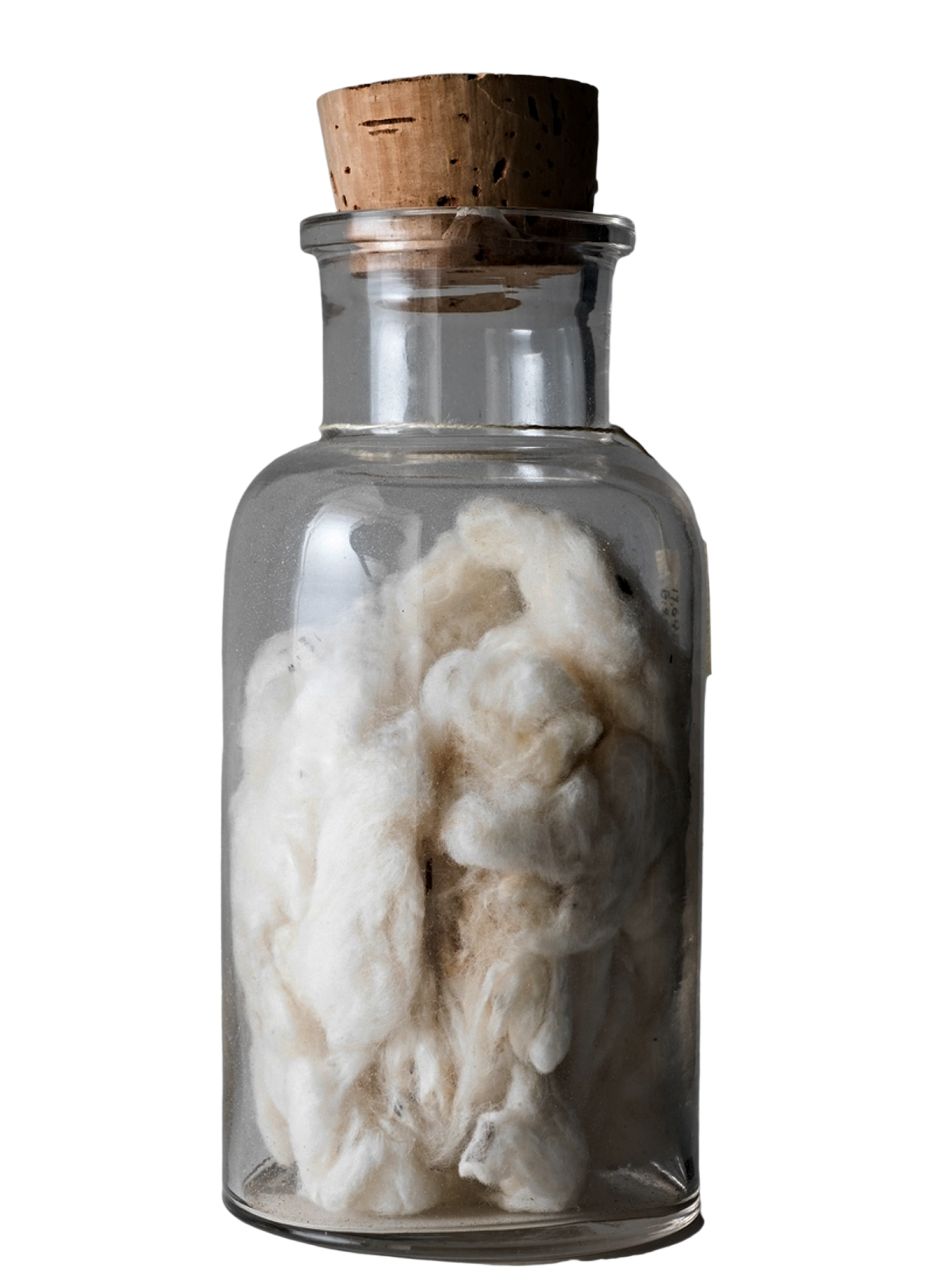 One of many samples of unspun cotton was included in the educational collection of the economist Anders Berch (1711-1774) in Uppsala. (Courtesy: The Nordic Museum, Stockholm. Anders Berch Collection. No: NM.0017648B-244. Public Domain).
A note from Carl Peter Thunberg’s (1743-1828) journal shows that such carded or unspun cotton was wrapped around a Medusa’s head, which was to be sent to Europe from the Cape, indicating that many natural history and ethnographic objects needed to be well protected from bumps during lengthy transports. Cotton was an ideal material for that and was moreover available in many of the warm regions visited. His primary aim was to ensure it arrived undamaged for display in a European cabinet. He also noted from the Cape in 1773: ’The Medusa’s head (Asterias caput-medusae), one of the most singular and curious animals in nature, was sometimes caught in the ocean off the Cape. It is but rarely that it is found thrown dead upon the shore.’ Further on, during his nine-year-long voyage, on 9 November in 1777, he mentioned a totally different protective material. This took place in Ceylon [Sri Lanka], where Thunberg described woollen sacks, not as trading commodities in their own right but (along with cow hides) intended as watertight and airtight sacks for the precious cinnamon which was exported to Europe. In-depth combined studies of these long-distance travelling naturalists’ journals and other writings point to the fact that in a hot country like Ceylon sheep’s wool was not needed for warm clothes, but the raw material could happily be used for other purposes such as sacking.
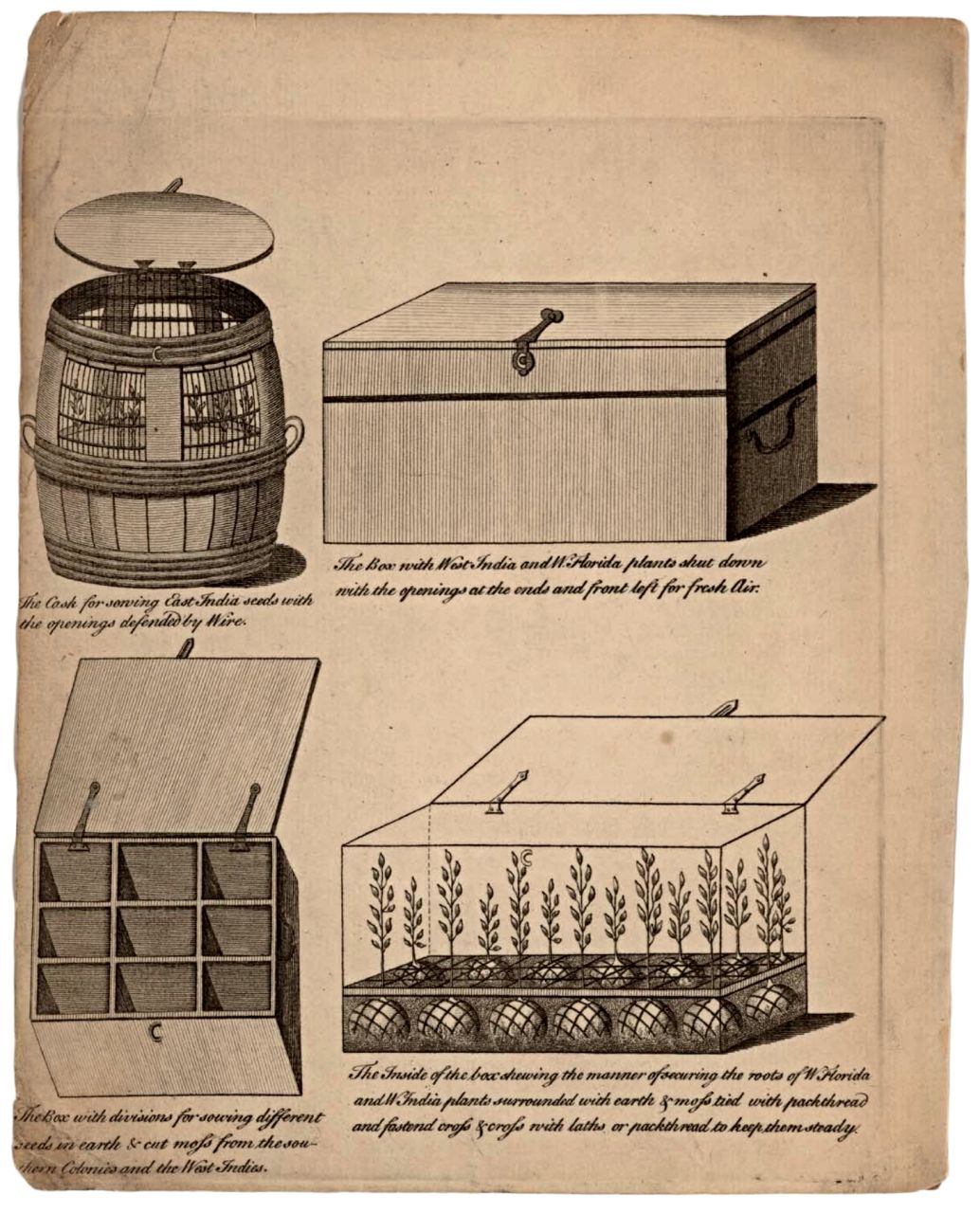 Other textile aspects are revealed in the naturalist John Ellis’ (c.1710-1776) book ‘Directions for Bringing over Seeds and Plants, from the East Indies and Other Distant Countries…’, printed in 1770, which includes a detailed depiction of transporting seeds in boxes over land and sea. The book, among many references, mentions his correspondence with Carl Linnaeus (1707-1778) ‘some years ago’ and the Swedish botanist’s advice on how to keep seed moisture at the best possible level. As Ellis was a naturalist – a member of the Royal Societies in London and Uppsala – as well as a linen merchant, one might assume linen would be mentioned in the book, but it is not. Paper, fine sand, salt, wet moss and beeswax were primarily recommended for the preservation of seeds. He also mentioned: ‘Dip some square pieces of cotton cloth in melted wax…’ as an assisting material. (From: John Ellis’ book, 1770).
Detailed advice written in English from the 1770s to the 1790s by an unknown individual bears many similarities to John Ellis’ publication above, as well as to the Linnaeus Apostles’ observations and even to some additional notes on calico and flannel. Henry Smeathman (1742-1786) travelled in West Africa 1771-75, or Adam Afzelius (1750-1837) travelled in Sierra Leone in 1792-93 and 1794-96, or someone else during their travels in Africa may have made this description, as the original document is kept together with some of their correspondence. Four methods are mentioned, of which numbers one and four include textile material – see transcription below.
‘Methods of preserving Seeds during long Voyages thro’ warm Climates
1: Dip pieces of Calico in melted wax, and while it is soft & almost cold, strew the surface of each piece over with each sort of seeds, then roll them up tight and enclose each roll in some soft beeswax, wrapping up each of them in a piece of paper with the name of the seed on it, then pack them up tight in a Box. The seeds of the small succulent plants may be brought to Europe by pressing them together, squeezing out their watery juices, and drying them in small cakes gradually, till they become quite hard, and then wrapt up in white paper quite dry, if it is spongy, it will attract and retain the moisture, a covering of wax instead of the paper is better, if convenient to be got.
4: The best mode of packing up seeds is in the manner of the Dutch, which is in flannel bags, each sort to be put in separate bags, properly labelled and then tied with a piece of packthread to a basket well fastened down & sealed and suspended in the roundhouse or any other place, where it can have a through the air, without either the sun or damp getting to it.’
The plant collector and physician John Fothergill (1712-1780) also sent a letter to Linnaeus, at an unknown date, containing a printed illustrated instruction titled ‘Directions for taking up Plants and Shrubs, and Conveying Them by Sea’. This one-page piece of advice recommended that boxes be stretched with wires on the top, covered with flaps of sailcloth, so that dogs and cats could not reach the plants, yet still allow the plants to have fresh air and not mould so easily on board a ship. ‘For each Box so hooped and netted, provide a Canvas Cover, which may when put on entirely protect it; and to prevent the Cover from being lost or mislaid, nail it to one Side, and fix Loops or Hooks to the other, by which it may occasionally be fastened down.’
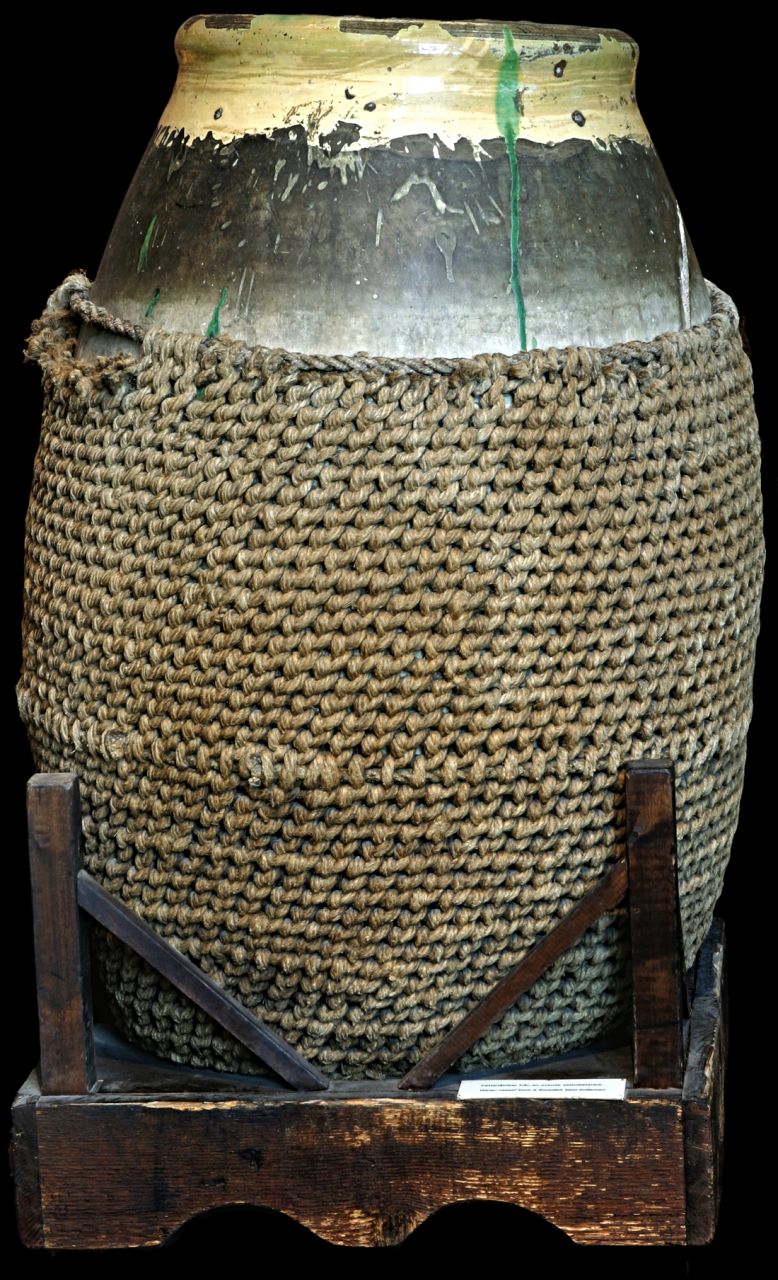 This large water barrel was placed in a hold lined with a plaited “basket” made of coarse, twisted hemp threads, to be soaked in water to keep the water in the barrel as cold and fresh as possible. It was originally used on a Swedish East India Company ship. (Courtesy: The Maritime Museum, Göteborg, Sweden).
Several former students of Carl Linnaeus served as part of the crew on these voyages, either as ship’s chaplains or as physicians, often in conjunction with their work in natural history. None of them recorded any notes about a hemp-plaited cover for water barrels. However, the very first of Linnaeus’ apostles, Christopher Tärnström (1711-1746), made several observations about these freshwater barrels on the East India ship Calmar. On 18 March 1746, during a stopover at Port Marie in Cadiz Bay, he wrote a particularly enlightening note in his travel journal: ‘We tied up by two lavishly fitted out waterworks which were of hewn stone and constructed on the shore so that one could moor the boats right next to the wall and fill the water barrels without removing the barrels from the hold. For there were five or six metal pipes through the wall, out of which freshwater ran constantly. To these, a small pipe of strong canvas was attached, and all the vessels were thus filled without any trouble. About four pieces of copper coins were, however, paid to the town for each barrel of water.’ One barrel contained (≈ 50 kannor ≈ 2,67 litres/kanna), that is to say, about 133 litres of water.
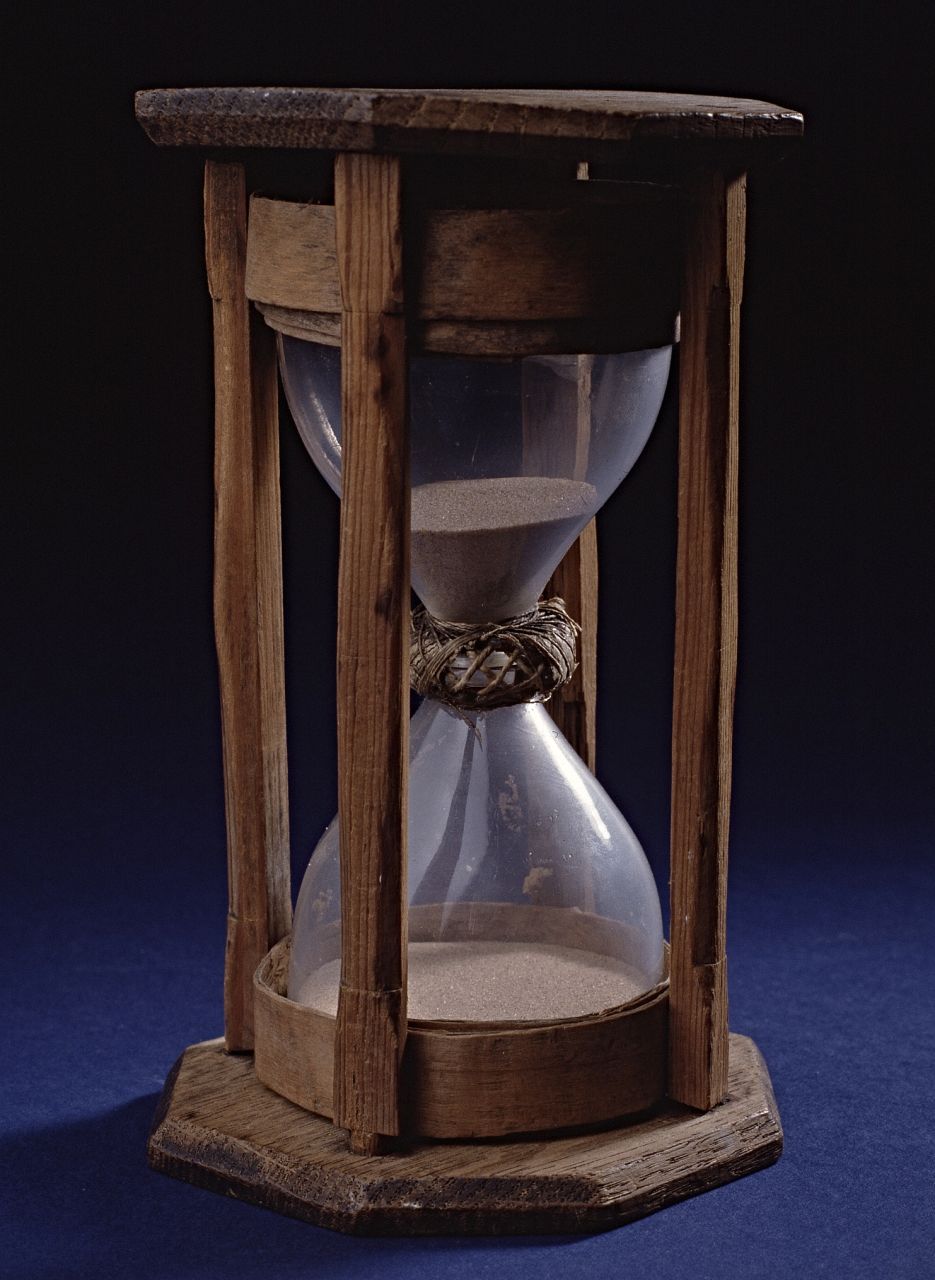 A well-preserved 18th-century half-hour sandglass, in a model, twisted around the central part with hemp yarn to keep the two glasses together. The most important use of this tool was to keep time during the changing of watch on board the Swedish East India ships, which took place after eight such glasses had run down – in other words, after four hours. (Courtesy: The Maritime Museum, Stockholm, Sweden).
The naturalist Pehr Kalm (1716-1779), who travelled in the North American colonies, noted a tree in Canada that the French called Tilia. According to old traditions, Native Americans boiled the bark of this tree and then beat the material to soften the fibres, which looked like coarse hemp. The raw material was mainly used for weaving coarse sacks for storing food. Knowledge of how to treat flax and hemp was also more widespread in Canada and in the northern parts of what later came to belong to the USA. This indicates that those areas were still more isolated and had, in the same way, not had the possibility to benefit from the trade in fabrics from England, shipped into the major ports on the east coast at the time of Kalm’s visit from 1748 to 1751. On other occasions, during his journey by horse and boat in America, he also bought: ‘Linen for a sack to carry this and that on the back of the horse ’ and ‘3 ells coarse linen for bags for my seeds’, according to his travelling accounts.
A few other rare examples of protective textile materials used on these long-distance journeys were noted by Peter Forsskål (1732-1763), a member of Den Arabiske Rejse (The Royal Danish Expedition to Arabia), at the seaport of Suez in Egypt. He observed the indispensable sheepskin sacks in August 1762, sewn together with a fine, close seam so that not a drop of water was spilt during their travels through the desert. Furthermore, Daniel Solander’s (1733-1782) travelling companion, Joseph Banks (1743-1820), noted a kind of sack plaited from grass for storing sundry possessions among the people along the Australian coast. The journals and other primary sources show, in other words, that any material could be used except silk, which was far too precious and delicate for storage and other protective purposes.
Sources:
- Banks, Joseph, The Endeavour Journal of Joseph Banks – 1768-1771. Edited by J. C. Beaglehole, 2 vol., Sydney 1963.
- Ellis, John, Directions for Bringing over Seeds and Plants, from the East Indies and Other Distant Countries…, London 1770.
- Hansen, Lars, ed., The Linnaeus Apostles – Global Science & Adventure, eight volumes, London & Whitby 2007-2012.
- Hansen, Viveka, Textilia Linnaeana – Global 18th Century Textile Traditions & Trade, London 2017.
- Kalm, Pehr, Travels into North America, Vol. 1: Warrington 1770 & Vol. 2-3: London 1771.
- Kalm, Pehr, Pehr Kalms Amerikanska reseräkning, published by Svenska Litteratursällskapet in Finland, Helsingfors 1956.
- The Linnean Society of London: Linnean Collections, Undated letter: L0000 (including printed instruction in English) from John Fothergill to Carl Linnaeus.
- Thunberg, Carl Peter, Travels in Europe, Africa and Asia, performed between the years 1770 and 1779. vol I-IV., London 1793-1795.
- Uppsala University Library, Sweden. |Document: ‘Methods of preserving seeds during long voyages thro’ warm climates’ (published in a complete transcription in Hansen, L. ed., Vol. One, pp. 359-60).
More in Books & Art:
Essays
ISSN 2631-4746
The iTEXTILIS is a division of The IK Workshop Society – a global and unique forum for all those interested in Natural & Cultural History.
Open Access Essays by Textile Historian Viveka Hansen
Textile historian Viveka Hansen offers a collection of open-access essays, published under Creative Commons licenses and freely available to all. These essays weave together her latest research, previously published monographs, and earlier projects dating back to the late 1980s. Some essays include rare archival material — originally published in other languages — now translated into English for the first time. These texts reveal little-known aspects of textile history, previously accessible mainly to audiences in Northern Europe. Hansen’s work spans a rich range of topics: the global textile trade, material culture, cloth manufacturing, fashion history, natural dyeing techniques, and the fascinating world of early travelling naturalists — notably the “Linnaean network” — all examined through a global historical lens.
Help secure the future of open access at iTEXTILIS essays! Your donation will keep knowledge open, connected, and growing on this textile history resource.
For regular updates and to fully utilise iTEXTILIS' features, we recommend subscribing to our newsletter, iMESSENGER.
The iTEXTILIS is a division of The IK Workshop Society – a global and unique forum for all those interested in Natural & Cultural History.
Open Access Essays by Textile Historian Viveka Hansen
Textile historian Viveka Hansen offers a collection of open-access essays, published under Creative Commons licenses and freely available to all. These essays weave together her latest research, previously published monographs, and earlier projects dating back to the late 1980s. Some essays include rare archival material — originally published in other languages — now translated into English for the first time. These texts reveal little-known aspects of textile history, previously accessible mainly to audiences in Northern Europe. Hansen’s work spans a rich range of topics: the global textile trade, material culture, cloth manufacturing, fashion history, natural dyeing techniques, and the fascinating world of early travelling naturalists — notably the “Linnaean network” — all examined through a global historical lens.
Help secure the future of open access at iTEXTILIS essays! Your donation will keep knowledge open, connected, and growing on this textile history resource.
For regular updates and to fully utilise iTEXTILIS' features, we recommend subscribing to our newsletter, iMESSENGER.
The IK Foundation & Company Promoting Natural & Cultural History
|
Subscribe to our Newsletter | IK Global iMessenger |
Translate Page |



|
© The IK Foundation & Company 2026 - a truly European organisation since 1988 |
The IK
Workshop Society
Workshop Society
The Field
Station Lab
Station Lab
How to cite & Creative Commons
You are welcome to use the information and knowledge from
The IK Workshop Society, as long as you follow a few simple rules.
LEARN MORE & I AGREE
You are welcome to use the information and knowledge from
The IK Workshop Society, as long as you follow a few simple rules.
LEARN MORE & I AGREE
