
ikfoundation.org
The IK Foundation
Promoting Natural & Cultural History
Since 1988

- WELCOME
- THE IK WORKSHOP SOCIETY
- THE FIELD STATION LAB
- THE DONATION ROOM
- BOOKS & ART0


- CONTACT
iFellows Sign In
Find out more about becoming an iFellow...My Basket
Items: 0Total: €0.00

TAPESTRIES & ARTWORKS
– A Symbiosis between Collecting, Depicting and Natural History
ESSAYS No: CCXXIV | July 13, 2026 | By Viveka Hansen
Artworks in the 16th and 17th centuries often included all sorts of animals for various reasons, and long before that, depictions of animals in cave paintings are known to be humanity’s oldest art form. Besides the more scientific natural history documentation, artists aimed to reflect curiosity about unknown species, cruelty or fighting, exotic animals in romanticised settings, religious motifs, theatrical milieus or dressed-up monkeys, pastoral scenes, domesticated dogs and parrots in harmony, still lifes, at times with shells and corals. This essay will look more closely into the traditions of depicting exotic shells and birds in various media, with a tapestry design known as Les Ports de Mer [Seaports] as a focal point. Together with written observations by 18th-century travelling naturalists, contemporary etchings, paintings, and gathered shells as part of natural history collections.
 This ‘Les Ports de Mer’ tapestry in wool and silk dates to the late 17th- to early 18th century – a design initially inspired by the exotic animals at Versailles’ Menagerie. Whilst the original owner history of this particular wall hanging is unknown, it was woven at the Beauvais workshop by either Philippe Behagle or Noel Antoine de Merou after a design by Adrien Campion and Joseph van den Kerchove. (Sold at Sotheby's, London auction in 2020. Previous collection: S. Frances, London. Unknown present ownership. Picture in Public Domain).
Some years ago, I came across one of these magnificent tapestries at an exhibition at the Design Museum in Denmark and became intrigued by its history and chosen foreground motifs. This particular tapestry (illustrated in two details below), just like the other examples in the series of the same design, was all woven at the well-established Beauvais tapestry manufacturer in France for the luxury market and often sold to wealthy foreign customers. The decorative wall hangings were extravagantly expensive and had to be preordered years before such displays of wealth could enrich the domestic sphere of royalty, nobility and affluent merchants. Such beautiful tapestries not only kept drafts out, but the colourful visual effects also gave the owner’s family and guests an experience of fashionable woven designs in private homes.
Tapestry weaving was an extraordinarily slow process, with the cartoon placed behind the woollen warp. The same cartoons were used repeatedly, together with an array of naturally dyed colours of wool and silk that had to be rolled up on small spools in order to achieve the desired gradations of nuances on the tapestry weave, while the skilful weaver then pushed the weft together with a comb-like tool or stick. This particular design, in various sizes and interpretations, was manufactured over at least a forty-year period – from circa 1695 to 1737. The backdrop always seems to have been a town scene, added with an arrangement of figures in a harbour scene with a foreground focal point including a natural setting with trees, flowers, exotic animals, mussels and shells.
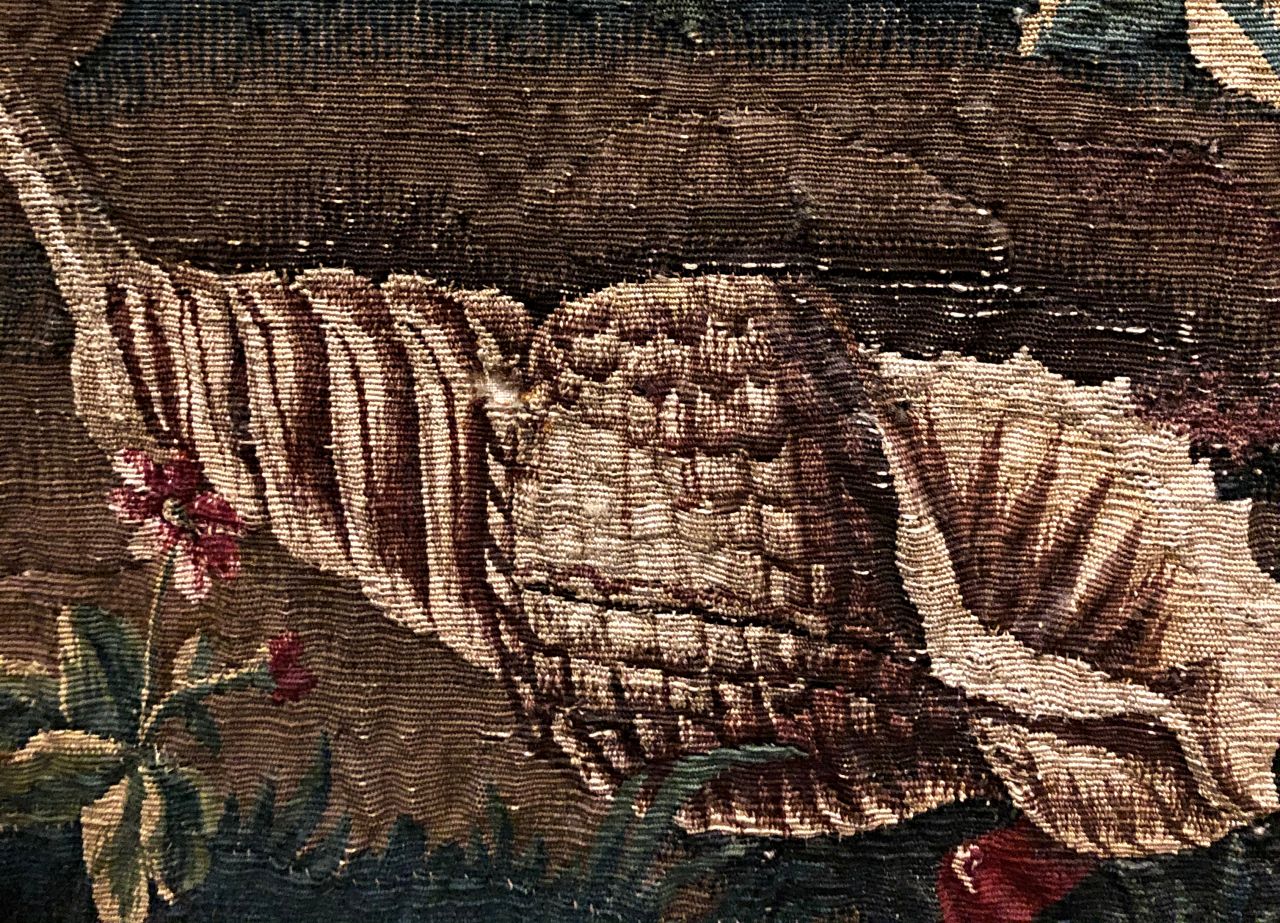 Seaport | ‘Les Ports de Mer’. Wool and silk on the wool warp. Beauvais workshop and signed BEHAGLE, that is to say under the directorship of Philippe Béhagle in the period 1684 to 1705.| Workshop of Josse Kerchove and Adrian Campion, cartoon by Simon III du Pape. 308 x 153 cm. Detail of a conch shell. (Collection: Design Museum Danmark, København. Exhibition 2019. No: B 44/1911, part of). Photo: Viveka Hansen, The IK Foundation.
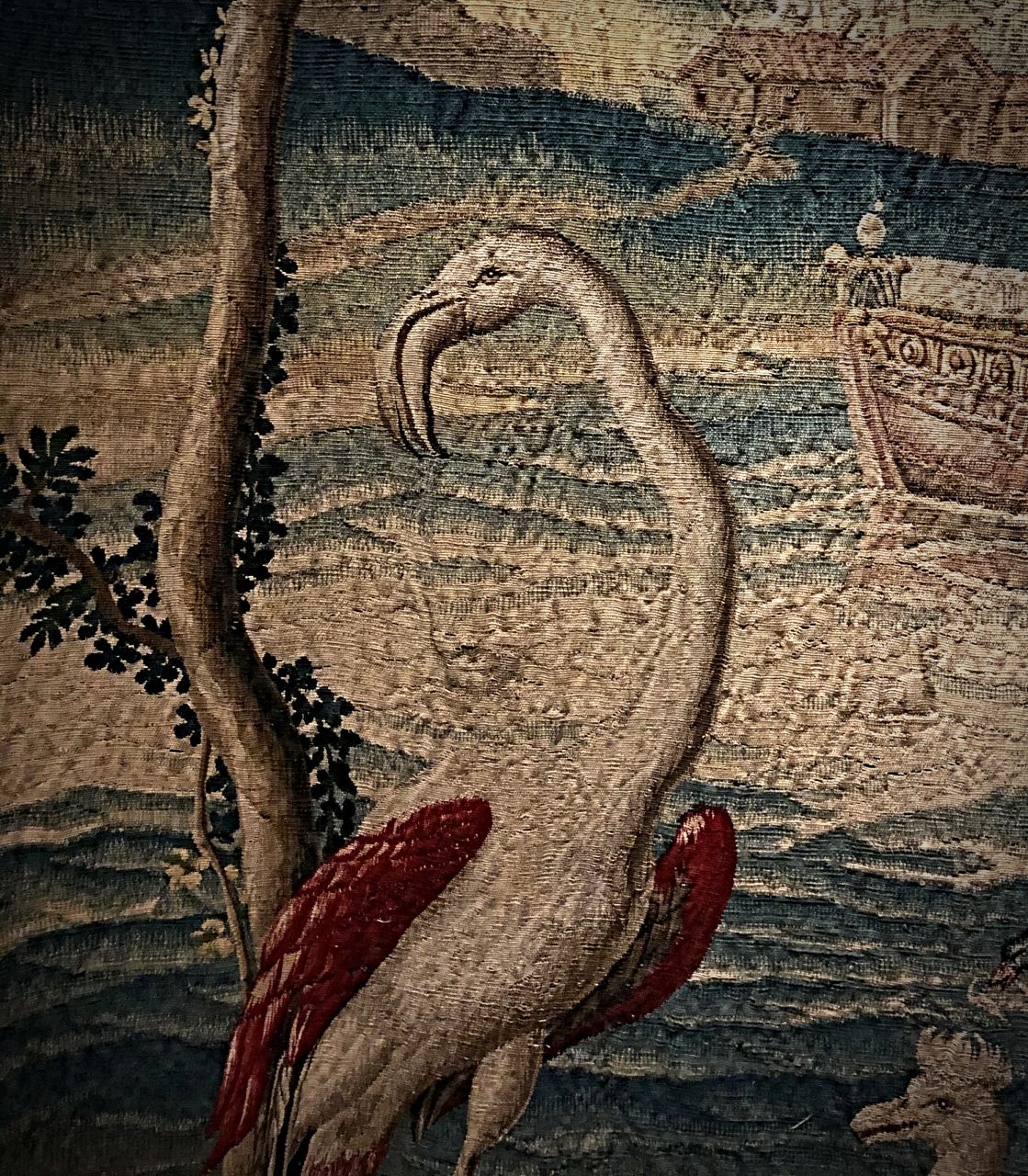 A second detail from the same Seaport tapestry, ‘Les Ports de Mer’, of wool and silk on a woollen warp, featuring a large flamingo-like bird. The history of the design will be explored a bit further below. (Collection: Design Museum Danmark, København. Exhibition 2019. No: B 44/1911, part of). Photo: Viveka Hansen, The IK Foundation.
Several wall hangings in this tapestry series have been possible to trace via extant textiles, auction catalogues, 18th century correspondence and other contemporary primary sources. Some of the intertwined histories have been revealed in a publication, including tapestries in the ownership of the Design Museum of Denmark. The author stresses the popularity and admiration of this particular design, not only in France via King Louis XIV in the 1690s, but also at an early stage entangled with an order from a Swedish count:
- ‘Les Ports de Mer is already mentioned in 1695 in connection with a commission for the eminent Swedish nobleman Count Carl Piper. That the order, which was part of a large purchase in Paris, was placed on behalf of Piper by Daniel Cronström, Swedish envoy to France, is evident from some interesting correspondence between the latter and the architect Nicodemus Tessin the Younger. According to Cronström Les Ports de Mer along with Beauvais’ Grotesques, were “les plus jolies tentures qu’on puisse jamais voir de ces prix la”. The tapestries are still at the manor of Björnstorp in Scania [Skåne province, in southernmost Sweden] and differ from the other known ones in having imaginative borders with various conches and other shellfish, apparently done especially for Piper’s series.’ (Woldbye, 2006, p. 72).
It is also stressed that these desired cartoons at the Beauvais workshop were almost worn out in 1723, but even so, the series continued to be woven until 1737. The Design Museum’s tapestry was woven at an unknown date between 1684 and 1705 and was acquired as a bequest from Colonel Verner Hans Frederik Abrahamsen after his death in 1911 (the museum had been founded in 1890).
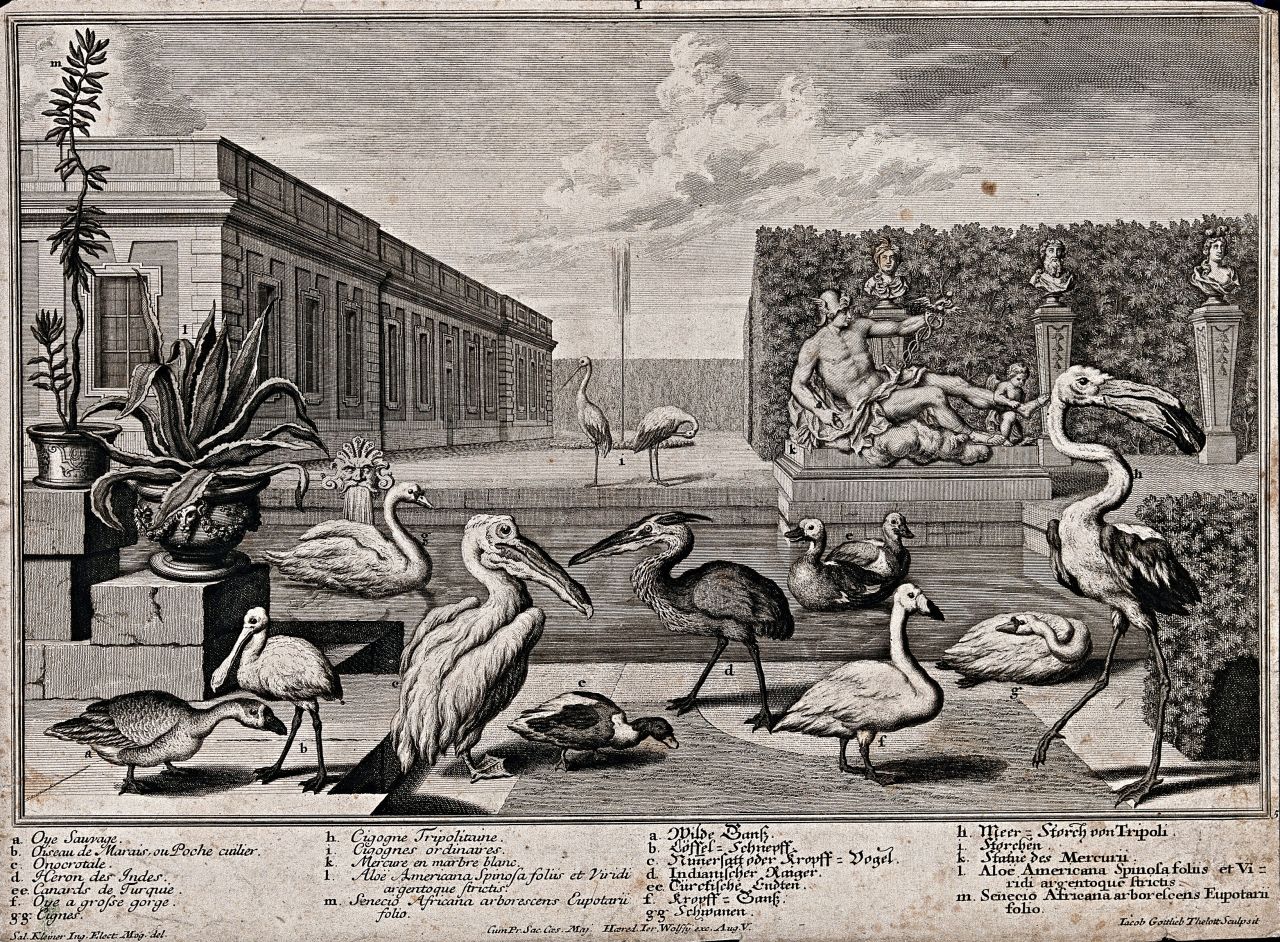 The amazement and interest in flamingos – comparable to the tapestry above – and other exotic birds are visible in several contemporary artworks. This etching with engraving, by Salomon Kleiner (1700-1761) and Jacob Gottlieb Thelott (1708-1760), depicting a garden pond with nine large exotic birds, probably from the Versailles menageries, is a good example. In particular, with that thought in mind, the ‘Les Port de Mer’ tapestries were regarded as having been influenced by the exotic animals kept in this Royal menagerie founded in 1663. (Courtesy: Wellcome Library no. 26641i. Originally included in an undated, 18th-century publication printed in Augsburg).
 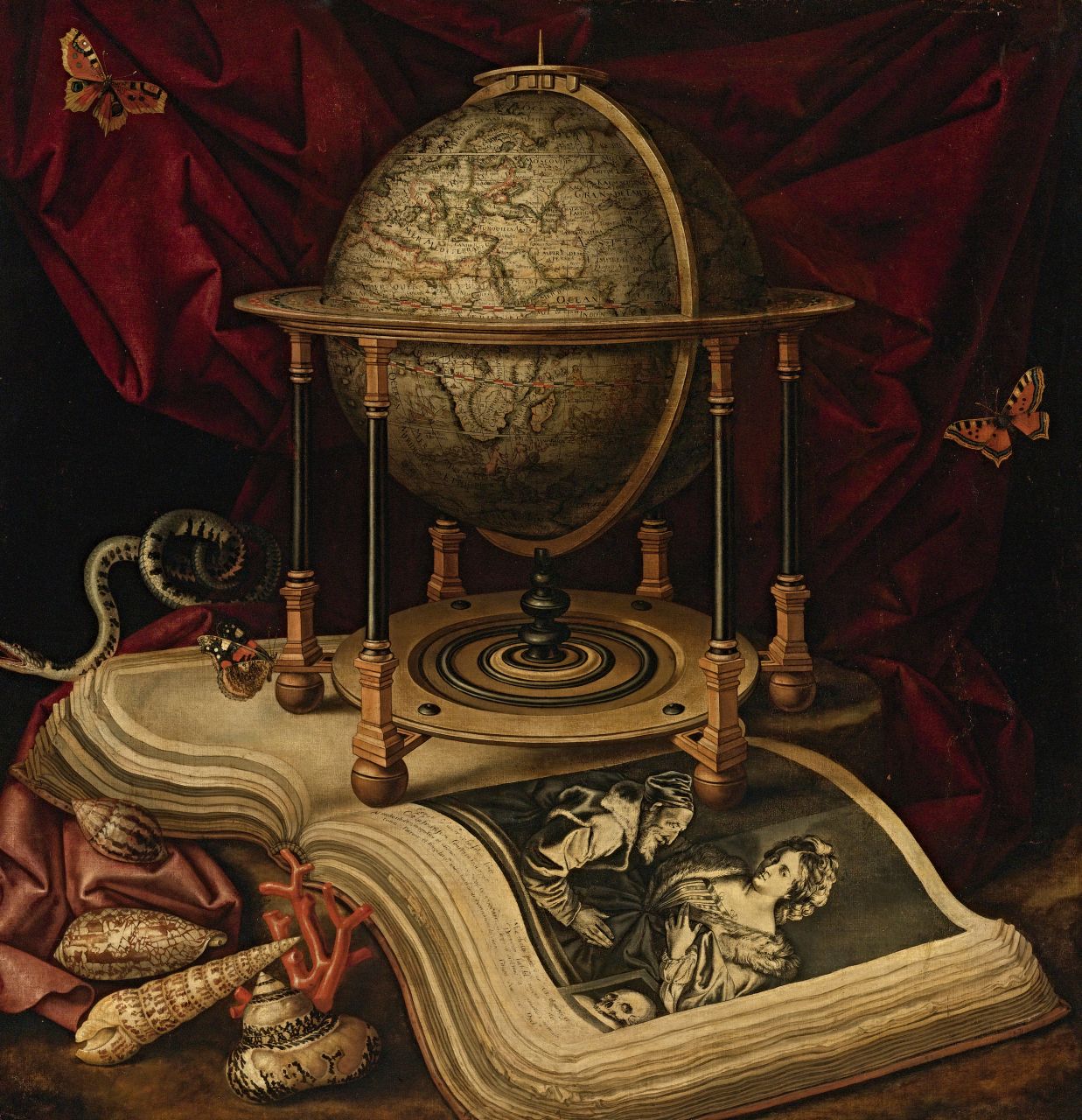 ‘Whilst an interesting example of learned natural knowledge, including exotic shells in the front left corner, is clearly visualised on this oil on canvas, dating to circa 1640-1658. That is to say, about a hundred years prior to the peak of the 18th century, Linnaean network’s interest in shell collections and shells in general from all sorts of interdisciplinary perspectives.| The painting is named: ‘Vanitas Still Life with Celestial Globe, a Book, Shells, a Snake and Butterflies’ by Frans Luycx (1604-1668). (Sold at Sotheby’s in New York in 2012. Unknown present ownership. Public Domain).
Shells collected during far-flung naturalist voyages were not only interesting from a scientific point of view for 18th-century naturalists. Their exotic nature, rarity and large size compared to shells in European waters were also much admired for beauty and longevity. A shell could be kept in pristine condition for the rest of your life, whilst most other natural history objects were much more complex to preserve and to alter in appearance, even under the best possible circumstances, when pressed, stuffed, or put in spirit-filled glass jars. Sorting the final results from shorter or longer natural history journeys was often a time-consuming and long-term project. Hands-on skills were needed, like sorting and classifying, glueing plant specimens onto herbarium sheets, drawing maps, writing clean copies of a journal, financing the printing of various publications or arranging ethnographical objects, and stuffing birds and shells into a cabinet.
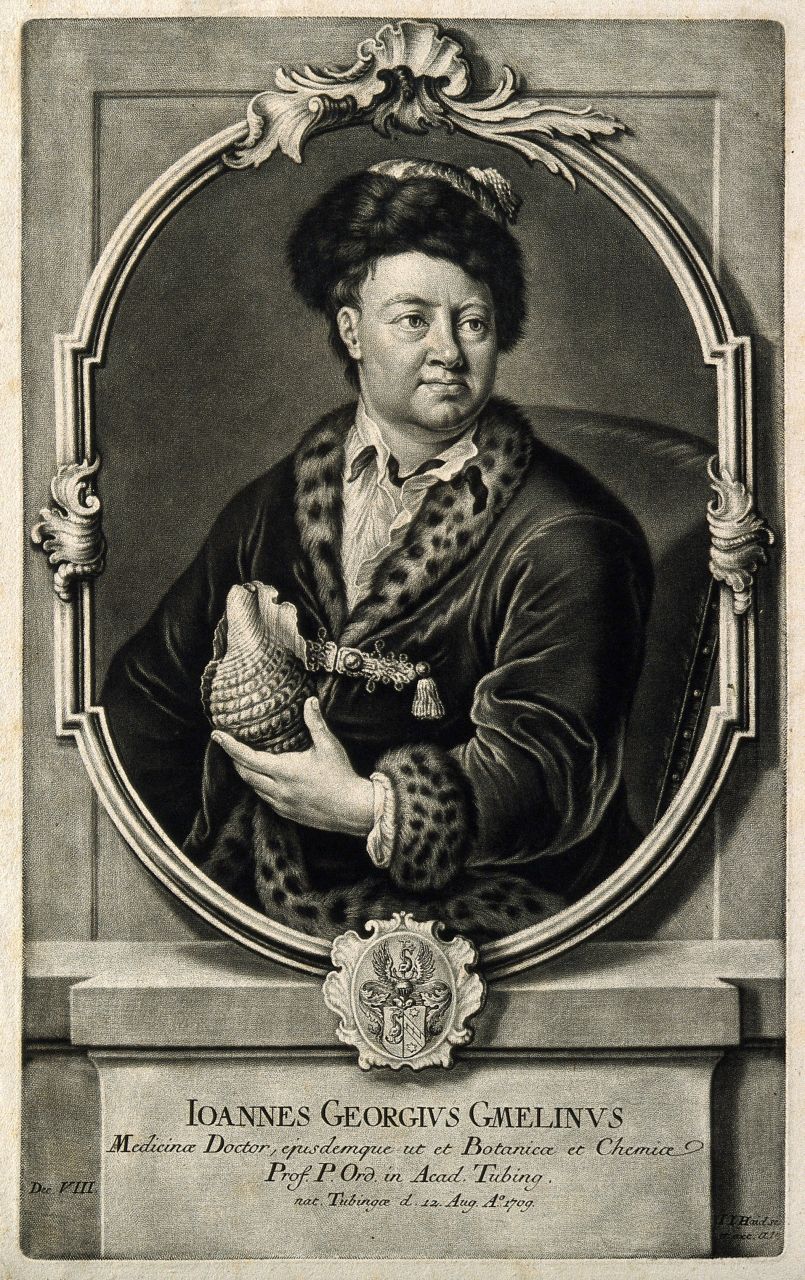 One of Carl Linnaeus’ (1707-1778) many contacts was the German naturalist and geographer Johann Georg Gmelin (1709-1755). In this depiction, his interest and ambition in collecting were demonstrated – with a focus on a large seashell – portrayed after his ten-year period from 1733 to 1743 with the Great Northern Expedition in Russia. As early as 1723, at age 13, when he was enrolled at the university in Tübingen and accompanied by his father, he collected fossils and, in general, expanded his knowledge of other natural history interests. Upon his arrival in St. Petersburg following his student years in 1727, he presented his collection at the Kunstkammer. Furthermore, Gmelin became a student of the same Academy and, a few years later, in 1731, professor of natural history and chemistry. After the return from his long-lasting Russian expedition, he also had frequent correspondence with Carl Linnaeus about botanical matters and publications from 1744 to 1750 – initially during his time in St. Petersburg and from 1747 in Tübingen. There are no indications, however, that his vast collection of natural history specimens was arranged as a museum or cabinet of curiosity at his death in 1755 – which was true for most of the travellers. | Mezzotint from 1760 by Johann Jakob Haid after oil on canvas 1744 by Wolfgang Dietrich Majer. (Courtesy: Wellcome Library no. 3603i).
 Whilst the naturalist and former student of Linnaeus, Carl Peter Thunberg (1743-1828), on several occasions in his extensive journal, spanning a nine-year period in the 1770s, referred to shells among his other wide range of natural history observations. A few selected quotes will emphasise the importance he put on exotic shells and corals during the voyage – a theme which was especially notable from observations in Paris, Nagasaki and London.
- Paris 14 December 1770: ‘I viewed the convent of St. Genevieve, its library, the cabinet of natural history, and fine gardens…The library is open on Mondays, Wednesdays, and Fridays, from two to five in the afternoon, and books may be borrowed from it. The cabinet of antiquities, and that of natural history, is contiguous to the library and contains several amphibious animals and fishes stuffed, mummies, minerals, shells, and corals, but especially a great number of antiquities, all locked up within wire-work. The garden is neat, and is prettily ornamented with box cut in different forms.’
- Paris, February 1771: ‘The botanic garden (Jardin royal), which is under the able direction of M. Thouin, is extensive and divided into two long partitions, inclosed within hedges, and the beds or subdivisions are bordered with box. Towards the street stands the cabinet of natural history, which contains several apartments; in the first of these, different sorts of woods, barks, seeds, roots, and fruits, are kept in bottles, with the names affixed to them in French, the bottles being inclosed in cases with glass doors. In the second room is a fine collection of fossils in cases, placed on inclined planes: here are also various petrefactions, and specimens of polished marble. The third chamber contains birds in glass-cases of three different sizes; their eggs and nests are placed on the lowest shelves: here likewise occur some corals and shells, with insects in square glass-cases. To the ceiling of the fourth apartment amphibious animals were suspended: here I saw a stuffed zebra, the skin of which had been brought from the Cape by M. De la Caille; also amphibious animals, fishes, insects, &c. preserved in spirits of wine. The room destined for anatomical preparations was not yet quite finished. This collection is exhibited to the public from two to five, on Tuesdays and Thursdays. In every room, there is a sentinel, who gives admission to people of a genteel appearance.’
- On a return from the Court towards Nagasaki in 1776: ‘On the 26th of May, before we left this place, we made a purchase of several elegant, but small, boxes of shells, which were laid up very neatly and curiously on carded cotton. These are generally bought by the Dutch, either to sell again, or to send to Europe to their friends and relations, as rarities from so distant a country. Although the shells were all fastened to the cotton with glue made of boiled rice, in order that they might not fall off, I picked out as many as were not before known in Europe, or at least very scarce, and which are now kept amongst other collections of the academy at Upsal.’
- London October 1778: ‘Professor Forster, senior, whom I waited upon one day, received me with much friendship, and not only procured me the pleasure to see the plants and shells, which he had collected during his voyages in the Pacific Ocean, but was farther pleased to present me with a whole Collection of them, which has entitled him to my sincerest gratitude and eternal acknowledgements.‘
![Carl Peter Thunberg returned back home to Uppsala in March 1779, where he continued to work for the rest of his life and brought back extensive collections of everyday objects, textiles, books, etc. In particular, a Japanese collection that this woodcut covers two pages of, illustrating shells and haiku – a Japanese verse form – is one example from the series ‘Treasures of the Sea’. Additionally, the collection also includes five books named ‘Nihon sank meibutsu zue’, numbered 1 to 5, illustrating Japanese local life and craftsmanship in the 18th century. Bound volumes, which, according to the catalogue information by Uppsala University Library, were probably brought to Sweden by Thunberg in 1776. Among the 21 illustrations in the third volume – no: 9 – is a depiction of the gathering of shells in Sumiyoshi, Osaka (no: 91777) by the artist and engraver Mitsunobu Hasegawa (1721-1755) from Osaka. (Courtesy: Uppsala University Library. | Ryusui Katsuma (1711-1796), Umi no sachi, part 2, u.o. [1762], Alvin-record: 97283. Public Domain).](https://www.ikfoundation.org/uploads/image/7-a-thunberg-japanese-shells-1280x960.jpg) Carl Peter Thunberg returned back home to Uppsala in March 1779, where he continued to work for the rest of his life and brought back extensive collections of everyday objects, textiles, books, etc. In particular, a Japanese collection that this woodcut covers two pages of, illustrating shells and haiku – a Japanese verse form – is one example from the series ‘Treasures of the Sea’. Additionally, the collection also includes five books named ‘Nihon sank meibutsu zue’, numbered 1 to 5, illustrating Japanese local life and craftsmanship in the 18th century. Bound volumes, which, according to the catalogue information by Uppsala University Library, were probably brought to Sweden by Thunberg in 1776. Among the 21 illustrations in the third volume – no: 9 – is a depiction of the gathering of shells in Sumiyoshi, Osaka (no: 91777) by the artist and engraver Mitsunobu Hasegawa (1721-1755) from Osaka. (Courtesy: Uppsala University Library. | Ryusui Katsuma (1711-1796), Umi no sachi, part 2, u.o. [1762], Alvin-record: 97283. Public Domain).
Carl Peter Thunberg returned back home to Uppsala in March 1779, where he continued to work for the rest of his life and brought back extensive collections of everyday objects, textiles, books, etc. In particular, a Japanese collection that this woodcut covers two pages of, illustrating shells and haiku – a Japanese verse form – is one example from the series ‘Treasures of the Sea’. Additionally, the collection also includes five books named ‘Nihon sank meibutsu zue’, numbered 1 to 5, illustrating Japanese local life and craftsmanship in the 18th century. Bound volumes, which, according to the catalogue information by Uppsala University Library, were probably brought to Sweden by Thunberg in 1776. Among the 21 illustrations in the third volume – no: 9 – is a depiction of the gathering of shells in Sumiyoshi, Osaka (no: 91777) by the artist and engraver Mitsunobu Hasegawa (1721-1755) from Osaka. (Courtesy: Uppsala University Library. | Ryusui Katsuma (1711-1796), Umi no sachi, part 2, u.o. [1762], Alvin-record: 97283. Public Domain).Much had changed in Uppsala, though, after a nine-year voyage across three continents, especially since Carl Linnaeus had passed away the year before, in 1778. Carl Peter Thunberg entered upon employment as a “Botanices demonstrator” and was appointed Professor of botany in 1781. Three years later, he was appointed to the botanical professor’s duty, “the Chair of botany,” after the death of Linnaeus’ son, Carl Linnaeus the Younger (1741-1783), an appointment Thunberg held for the rest of his life, up to 1828.
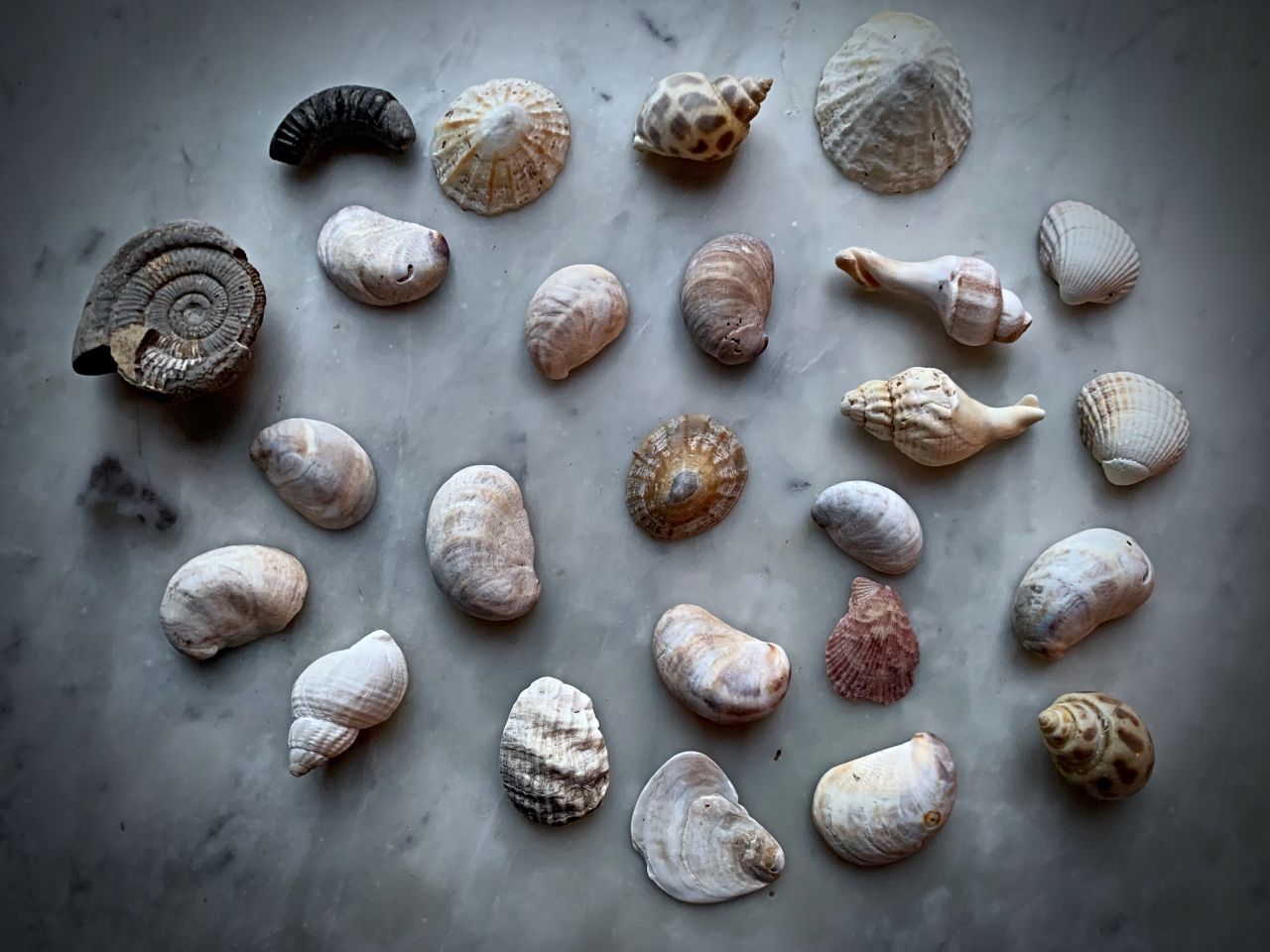 On a final note, part of my own insignificant, but precious shell and fossil collection has been treasured for many years – collected in several countries by my family members. The fact that shells can be kept in pristine condition for the rest of your life or over several generations makes them so desirable, beautiful, and easy to maintain. So far, shells have not been included in my own tapestry weaving or as inspirational designs for other handicraft projects, though maybe in the future. (Private Collection: Photo: Viveka Hansen).
Sources:
- Design Museum Danmark, København. (Exhibition in 2019: a study of the tapestry illustrated in Figures 2 and 3 of this essay).
- Diderot, Denis, ed., Encyclopédie, ou dictionnaire raisonné des sciences, des arts et des métiers, volume des Planches 8, (1771), Paris, 1751-1772.
- Geijer, Agnes, Ur textilkonstens historia, Stockholm 1994.
- Gmelin, Johann Georg, Reise durch Sibirien von dem Jahr 1733 bis 1743, 4 vol., Göttingen 1751-1752.
- Goodman, David & Russell, Colin A. Ed., The Rise of Scientific Europe 1500-1800, Kent 1991.
- Hansen, Lars, ed., The Linnaeus Apostles – Global Science & Adventure, eight volumes, London & Whitby, 2007-2012.
- Hansen, Viveka, Textilia Linnaeana – Global 18th Century Textile Traditions & Trade, London 2017.
- Lindblom, Jack, Vävda tapeter, Stockholm 1979.
- Löwegren, Yngve, Naturaliekabinett i Sverige under 1700-talet – Ett bidrag till zoologiens historia, Lund 1952 (pp. 54-68).
- Sotheby's, London auction in 2020 (Quote from the online info about the tapestry: picture 1 of this essay).
- Thunberg, Carl Peter, Travels in Europe, Africa and Asia, performed between the years 1770 and 1779. vol I-IV., London 1793-1795.
- Uppsala University Library, Sweden; Image from Thunberg’s Japanese collection & Linnaean Correspondence. 29 letters: from Johann Georg Gmelin to Carl Linnaeus, 1744 to 1750 & 17 from Carl Linnaeus to Johann Georg Gmelin, 1744 to 1751).
- Woldbye, Vibeke, European Tapestries: 15th-20th Century, The Danish Museum of Art & Design 2006 (pp. 72-73).
More in Books & Art:
Essays
ISSN 2631-4746
The iTEXTILIS is a division of The IK Workshop Society – a global and unique forum for all those interested in Natural & Cultural History.
Open Access Essays by Textile Historian Viveka Hansen
Textile historian Viveka Hansen offers a collection of open-access essays, published under Creative Commons licenses and freely available to all. These essays weave together her latest research, previously published monographs, and earlier projects dating back to the late 1980s. Some essays include rare archival material — originally published in other languages — now translated into English for the first time. These texts reveal little-known aspects of textile history, previously accessible mainly to audiences in Northern Europe. Hansen’s work spans a rich range of topics: the global textile trade, material culture, cloth manufacturing, fashion history, natural dyeing techniques, and the fascinating world of early travelling naturalists — notably the “Linnaean network” — all examined through a global historical lens.
Help secure the future of open access at iTEXTILIS essays! Your donation will keep knowledge open, connected, and growing on this textile history resource.
For regular updates and to fully utilise iTEXTILIS' features, we recommend subscribing to our newsletter, iMESSENGER.
The iTEXTILIS is a division of The IK Workshop Society – a global and unique forum for all those interested in Natural & Cultural History.
Open Access Essays by Textile Historian Viveka Hansen
Textile historian Viveka Hansen offers a collection of open-access essays, published under Creative Commons licenses and freely available to all. These essays weave together her latest research, previously published monographs, and earlier projects dating back to the late 1980s. Some essays include rare archival material — originally published in other languages — now translated into English for the first time. These texts reveal little-known aspects of textile history, previously accessible mainly to audiences in Northern Europe. Hansen’s work spans a rich range of topics: the global textile trade, material culture, cloth manufacturing, fashion history, natural dyeing techniques, and the fascinating world of early travelling naturalists — notably the “Linnaean network” — all examined through a global historical lens.
Help secure the future of open access at iTEXTILIS essays! Your donation will keep knowledge open, connected, and growing on this textile history resource.
For regular updates and to fully utilise iTEXTILIS' features, we recommend subscribing to our newsletter, iMESSENGER.
The IK Foundation & Company Promoting Natural & Cultural History
|
Subscribe to our Newsletter | IK Global iMessenger |
Translate Page |



|
© The IK Foundation & Company 2026 - a truly European organisation since 1988 |
The IK
Workshop Society
Workshop Society
The Field
Station Lab
Station Lab
How to cite & Creative Commons
You are welcome to use the information and knowledge from
The IK Workshop Society, as long as you follow a few simple rules.
LEARN MORE & I AGREE
You are welcome to use the information and knowledge from
The IK Workshop Society, as long as you follow a few simple rules.
LEARN MORE & I AGREE
