
ikfoundation.org
The IK Foundation
Promoting Natural & Cultural History
Since 1988

- WELCOME
- THE IK WORKSHOP SOCIETY
- THE FIELD STATION LAB
- THE DONATION ROOM
- BOOKS & ART0


- CONTACT
iFellows Sign In
Find out more about becoming an iFellow...My Basket
Items: 0Total: €0.00
Home > The IKWS > iTextilis > THE STORY No. 10 | FIELDWORK – THE LINNAEAN WAY
How to cite & Creative Commons

THE STORY No. 10 | FIELDWORK – THE LINNAEAN WAY
Plant, Seed, Insect and Bird Collections
ESSAYS No: CCXX | May 4, 2026 | By Viveka Hansen
This Essay is part of the long-term research and publicise project
THE STORY | FIELDWORK THE LINNAEAN WAY
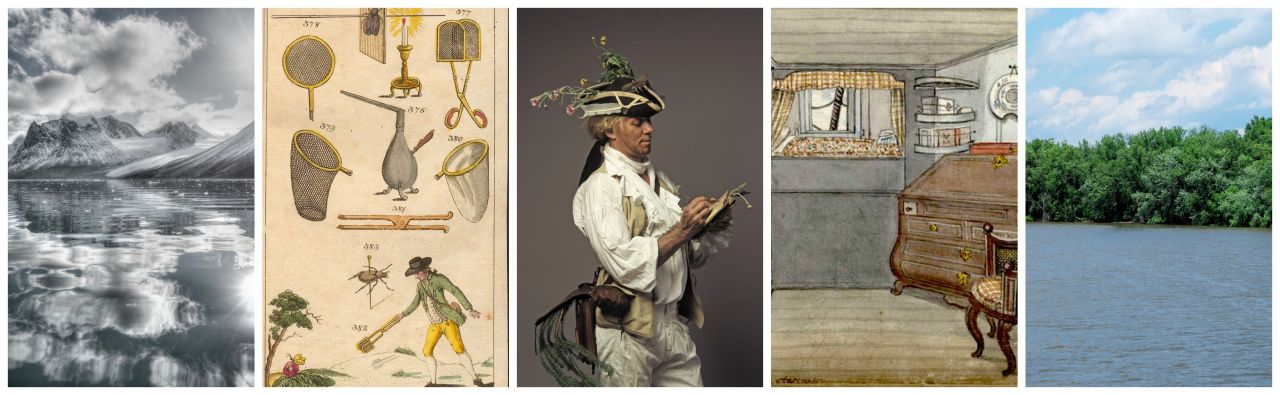 The global multidisciplinary project in Natural & Cultural History.
During his early years on the first provincial tour to Lapland in 1732, Carl Linnaeus made drawings of leaves, flowers, insects, clothing, and other subjects throughout his diary alongside the text to reinforce his memory of the written observations. It does not appear to have been possible to send collections back to Uppsala during this journey, as he primarily travelled through sparsely populated areas or smaller towns, a situation also common for many later travellers in other parts of Europe. This essay will examine such collections within the Linnaean network. Many aspects connect gathering strategies, trade realities, and efforts to expand knowledge of natural history from local, national, and global viewpoints.
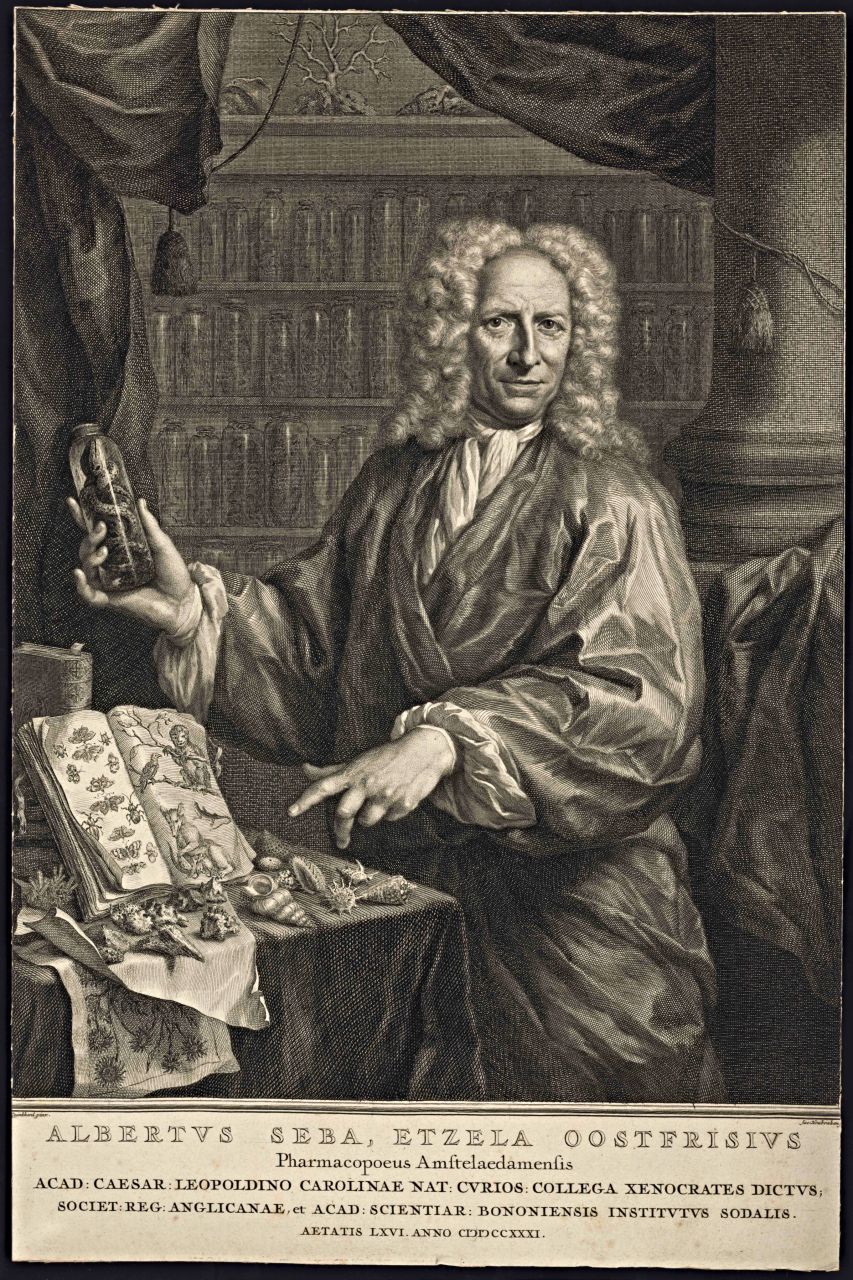 The zoologist, pharmacist, and collector Albertus Seba (1665–1736) is depicted here in 1731 demonstrating some of the zoological rarities in his cabinet of curiosities in Amsterdam, one of the largest such collections in Holland at this time (Courtesy: Uppsala University Library, No: 95729/Alvin online source).
Albertus Seba was born in 1665, initiating his collecting work around 1700 and publishing his long-term studies in a Thesaurus of animal specimens in 1734. He must be regarded as one of the senior individuals within the extended Linnaean network. He had professional contacts with Georg Clifford III (1685-1760), Frederick Gronovius (1690-1760) and Adrian van Royen (1704-1779) – junior collectors of natural history in his own country. His contemporary Hans Sloane (1660-1753) in London, as well as the about 40 years younger Swedes Peter Artedi (1705-1735) and Carl Linnaeus (1707-1778). During his 1735 stay in Amsterdam, Linnaeus also visited Seba at least twice and gained access to his vast collections and accumulated knowledge over the years. Seba was a wealthy man, primarily due to his role as an intermediary in the trade of natural history specimens and pharmaceutical drugs. His location in Amsterdam was also advantageous, as he had frequent opportunities to order desired items for his collection via the Dutch East India Company ships. His wealth was probably likewise extended through his go-between in trade for the Russian court in St. Petersburg.
Notes, drawings, dried plants, seeds and his own recollections were the primary sources of information when Carl Linnaeus, in the coming years, put together the theories, Flora Lapponica (Iter Lapponicum), etc., even though the Lappland travel journal was never published during his lifetime. Interestingly, a few years later, during his Foreign Travel, his diary notes included an observation of his insect collection, presented to Mr Sprekelson, who, in turn, showed Linnaeus his botanical library and garden in Hamburg on 6 May 1735. An editorial reference (Linnaeus… 1953) further reveals that Linnaeus, according to Professor Koul, whom the young traveller also visited in Hamburg, ‘it consisted of 1000 numbers, partly from his travels through Lapland and Dalarna, in fact, on paper sheets, cleanly glued insects.’ This indicated that all species were glued to paper, as in a herbarium; a few decades later, it became customary to use pins for insects. Bringing one’s previously collected naturalia was a viable option when staying away for some time, which could be beneficial in more than one way. For example, demonstrating knowledge for the learned individuals who, in turn, could assist in one’s own work or compare or add with new species from the newly visited area. Linnaeus travelled from Sweden, via Lübeck and Hamburg, to Holland by sleigh, carriage and boat – because of these modes of travel, he could bring a reasonable amount of luggage, evidently including his collection of insects.
-658x1280.jpg) This somewhat later illustration (circa the 1790s) by the natural history writer and pastor Gottlieb Tobias Wilhelm (1758-1811) of Augsburg offers fascinating insights into insect collecting in the 18th century. It includes the method of arranging insects on pins, various designs of functional landing and butterfly nets, the importance of candlelight when preparing insects on dark evenings, and, especially, the naturalist in fieldwork dress using a forceps net (a tool that was probably invented in the 1750s) to catch a butterfly. (From: Wilhelm…1810-11. Vol. Three, Pl. L).
This somewhat later illustration (circa the 1790s) by the natural history writer and pastor Gottlieb Tobias Wilhelm (1758-1811) of Augsburg offers fascinating insights into insect collecting in the 18th century. It includes the method of arranging insects on pins, various designs of functional landing and butterfly nets, the importance of candlelight when preparing insects on dark evenings, and, especially, the naturalist in fieldwork dress using a forceps net (a tool that was probably invented in the 1750s) to catch a butterfly. (From: Wilhelm…1810-11. Vol. Three, Pl. L). Fact-gathering strategies seem to have been well developed by Linnaeus at quite an early stage, not only for impressing his patrons with a systematically arranged insect collection but also to be able to add new scholarship to his work via notebooks, travel journals, ongoing correspondence with a large number of individuals – exchange via other naturalists on almost a daily basis became hugely significant for his expanding work. An essential part of such a commitment was to share, receive, return in favour, distribute seeds and so on, so that both correspondents, over time, were equally favoured with new natural history knowledge of their interest. One may even assume that he had already, during his student years, particularly during his lengthy stay on the Continent and in England from 1735 to 1738, developed such a strict routine that he also had to handle correspondence and other writing duties during many dark hours. Even to a greater extent during the 1740s to 1760s, with the intense ongoing work by the so-called apostles and others in the Linnaean network, during travels as well as after such journeys. Information and the sending of botanical specimens from “all corners” of the World had a considerable impact on his continuous publishing, annotated books, other writings and general growth of knowledge. The newly learned details via regular written communication he had with the early naturalists were of special significance – Pehr Kalm (1716-1779), Pehr Osbeck (1723-1805), Christopher Tärnström (1711-1746), Olof Torén (1718-1753), Pehr Löfling (1729-1756) and Fredrik Hasselquist (1722-1752). Some plants and seeds that he received from them were previously unknown to Linnaeus and were included, along with descriptions learned from the travellers’ correspondence and messages, in his two-volume work, Species Plantarum, in 1753. His former students Kalm, Hasselquist, Osbeck and Löfling were mentioned in the initial text for ‘The Reader’ [Lectori] as well as placed at the top of the list of naturalists who had assisted with botanical work over the years. The fact that Linnaeus rarely refers to his former students regarding individual plant species classified into genera known at the time does not mean he regarded the findings as a “collective” effort. Rather, due to that, these young men’s travel journals had still not been published in May 1753, and with few exceptions, he referred to published works only below each of the 5,940 names of plants. In all cases where he had been assisted by previously learned knowledge, besides his own publications et al., botanical works by Hans Sloane, Georg Clifford III, Frederick Gronovius, Adrian van Royen and Johann Georg Gmelin (1744-1792), published between 1725 and 1750, were repeatedly referenced.
Carl Linnaeus’ correspondence, which began in his younger years, became very extensive throughout his life, up to old age – for obvious reasons, natural history matters were usually in focus. Like the sending of seeds or live plants, questions about herbaria, insect specimens, contacts with students or former students on their travels, pure discussions of a scientific or economic nature, publishing projects or as an intermediary for all sorts of botanical and zoological enquiries. This immense body of written material will be exemplified to give a glimpse of the extraordinary variety of subjects across geographical space and time, as the complex network of naturalists became increasingly intertwined during the 1750s to 1770s. Another aspect was that it was not only that the correspondents were numerous, but also that some of them, who were active during the same period, maintained such written contact for several decades.
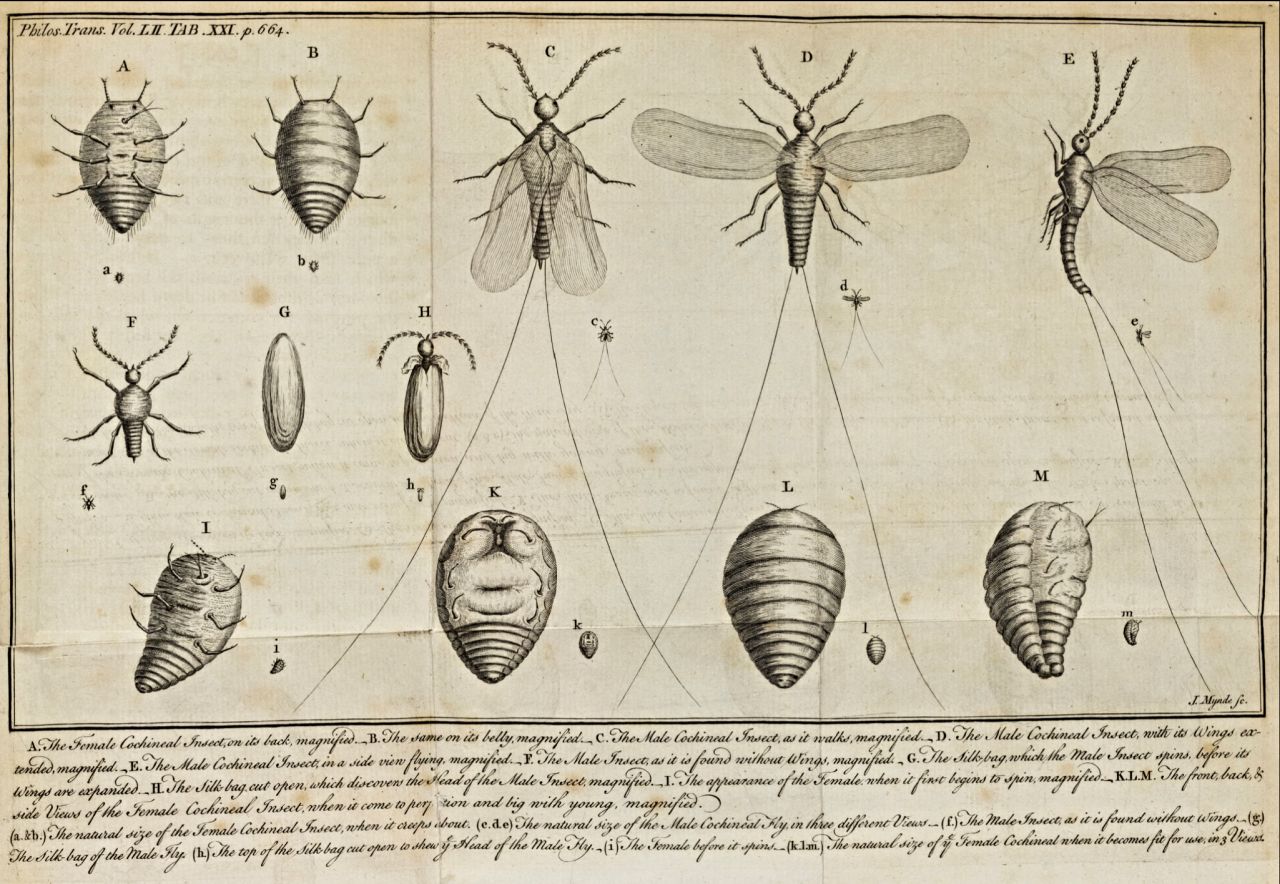 The British naturalist and linen merchant John Ellis (c.1710-1776), born three years after Linnaeus and died two years before him, was one of the naturalists who kept in contact over decades with Linnaeus. At least 42 letters have survived from Ellis to Linnaeus, dating from 1756 to 1771, including in-depth information about sending plants, preparations, discussions about books, translations, etc. and how Daniel Solander (1733-1782), during several years in the 1760s, assisted Ellis in botanical matters. Some letters in the length of articles, like an account of the male and female cochineal insects published in Philosophical Transactions, including this beautiful illustration. (From; Ellis, John, An account of the male and female cochineal insects, that breed on the Cactus Opuntia…1762).
Exceptionally detailed, Ellis also described his North American contacts and included news from plant collectors whom he thought would interest Linnaeus. An enlightening example of their correspondence appears in a letter from Ellis to Linnaeus on 19 August 1768, which includes a description of Daniel Solander’s and Joseph Banks’ (1743-1820) participation in the forthcoming first voyage with James Cook (1728-1779) – sailing a week later from Plymouth. The letter also covers the library on board, how to catch insects, fish, etc., and, most importantly, the importance of Linnaeus’ classification system for use on the voyage.
The somewhat senior gardener Peter Collinson (1694-1768) was another of Linnaeus’ regular and trusted long-term correspondents – over almost thirty years (1739 to 1767). They sent books, exchanged seeds and bulbs, recorded prices and delays whilst sending specimens, and commented on various individuals’ work and health within their mutual network. Some of his apostles were also part of this knowledge-sharing. For instance, in a letter from Collinson on 20 April 1754, when he had thoughts on Pehr Kalm’s journal in Swedish for future translations, and not surprisingly observed that: ‘In England, books of voyages and travels, written in English, sell best.’ Whilst in a letter from 2 September 1762, it was noted that Daniel Solander had been a guest in his house and in the following letter on 16 November, Solander’s possible future position in St Petersburg was pondered upon, which never became realised, though, as he decided to stay in London. A few years later (1 May 1765), Collinson was sorry that Peter Forsskål (1732-1763) had died but “glad” that the young apostle had lived long enough to have had time to send Linnaeus an Opobalsamum, a plant which the two correspondents had had different opinions about. Such comments demonstrate how much it meant to these men to know as much as possible about single plants and to be able to classify them correctly within botany. It is also worth noting that not everything written in these letters was entirely true, as Linnaeus, in a letter to Collinson on 19 October 1756, supposed that Pehr Löfling was in ‘Mexico and other countries out there,’ but that he had not heard from his former student for a year and a half. The truth was that Löfling never reached Mexico as he had already passed away eight months earlier in Venezuela, but it was a constant reality and worry that news travelled slowly over long distances. Four concluding illustrations, connected to this naturalist network, aim to further illustrate their fieldwork from various angles.
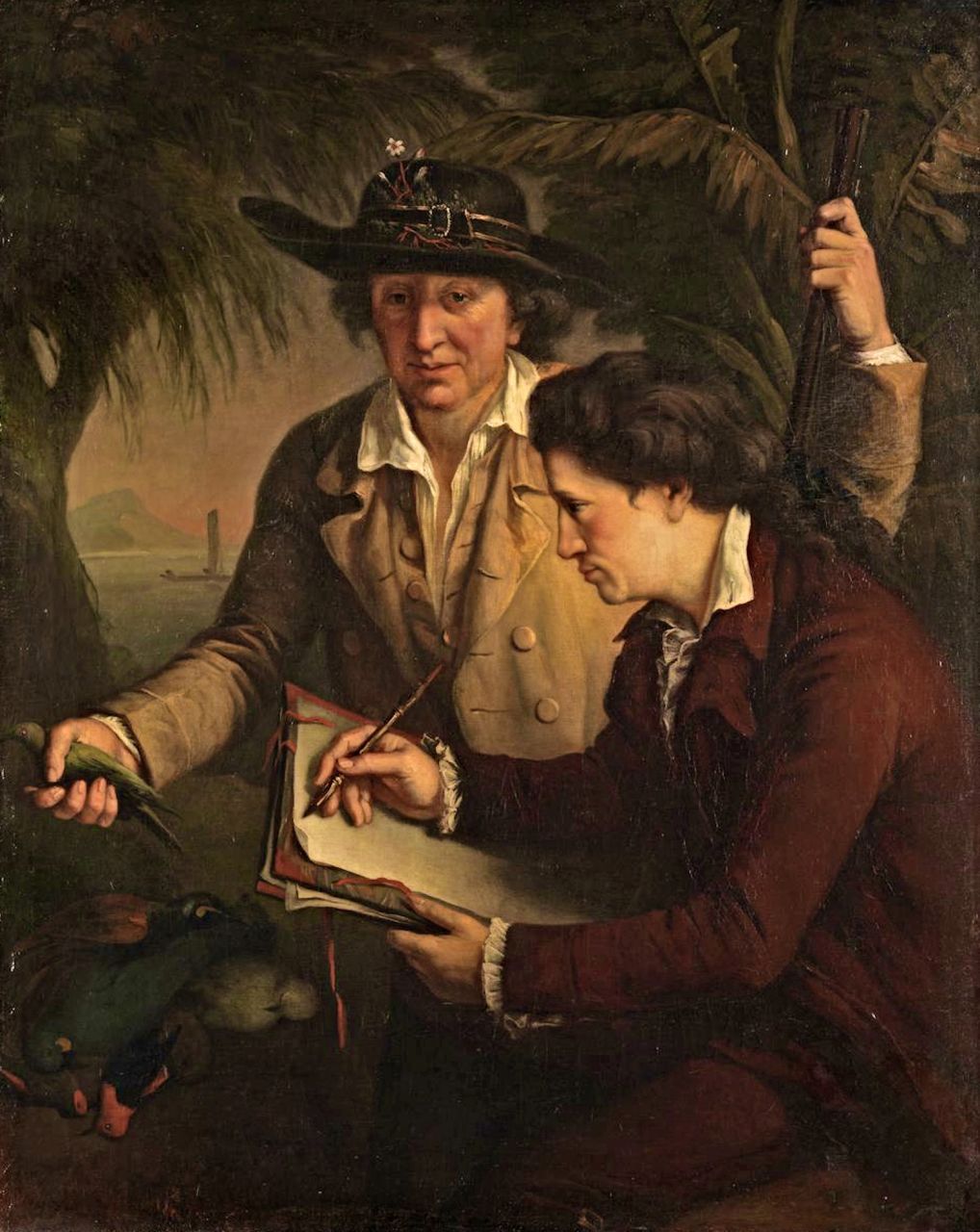 An illustration from James Cook’s second voyage depicts Johann Reinhold Forster (1729-1798) and his son, Georg Forster (1754-1794), conducting botanical observations in Tahiti in fieldwork attire, commissioned around 1780. However, one must note that the artist did not participate in the voyage, and the artwork is dated approximately six to seven years after the visit to Tahiti. Father and son Forster also persuaded the Linnaeus apostle Anders Sparrman (1748-1820), whom they met during a stopover at the Cape, to accompany them as a paid assistant botanist. The ship set sail on 22 November 1772 and did not return to the Cape until 22 March 1775. |By John Francis Rigaud (1742-1810). (Courtesy: National Portrait Gallery, Australia).
-1024x1280.jpg) Another instance referencing the naturalist Anders Sparrman is this illustration, published in London in 1801 by J. Wilkes. It depicts various species of cimex, including number ’10. Cimex paradoxus, the leaf-insect described above, from Dr Sparrman’ in 1777. (Courtesy: Wellcome Collection 578678i. Coloured etching by J. Pass in 1801).
Another instance referencing the naturalist Anders Sparrman is this illustration, published in London in 1801 by J. Wilkes. It depicts various species of cimex, including number ’10. Cimex paradoxus, the leaf-insect described above, from Dr Sparrman’ in 1777. (Courtesy: Wellcome Collection 578678i. Coloured etching by J. Pass in 1801).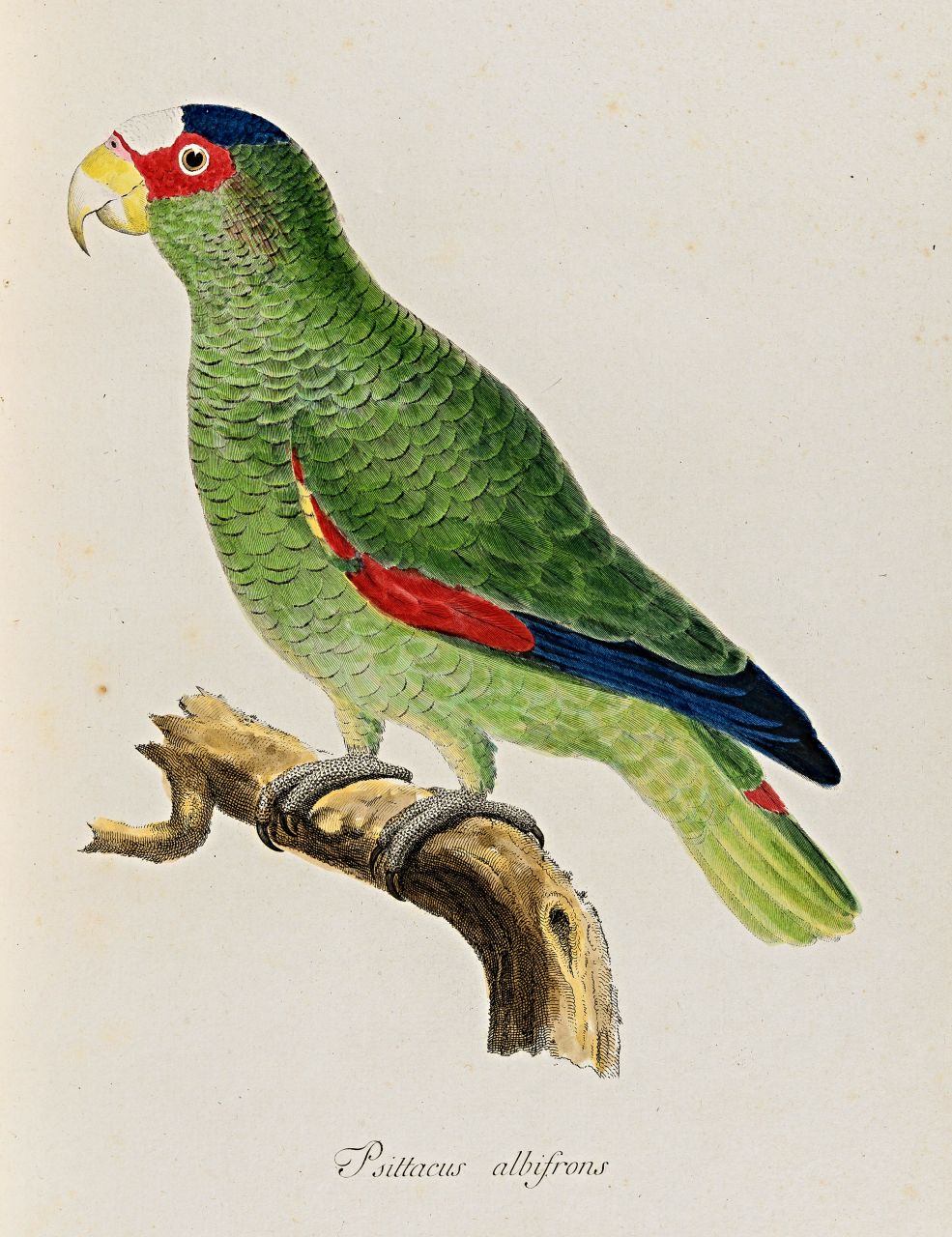 In his travel journal, Anders Sparrman also recorded hundreds of bird observations from his three-and-a-half-year natural history journey in Europe, Southern Africa, Oceania, Antarctica, and South America during the 1770s. Detailed bird studies also became a sustained interest over the years, as is visible in his book ‘Museum Carlsonianum, in quo novas et selectas aves´, printed in 1788 as volume three of four with hand-coloured plates (a fifth book was planned but never printed). (Courtesy: Lund University Library, Sweden. alvin-record:267717).
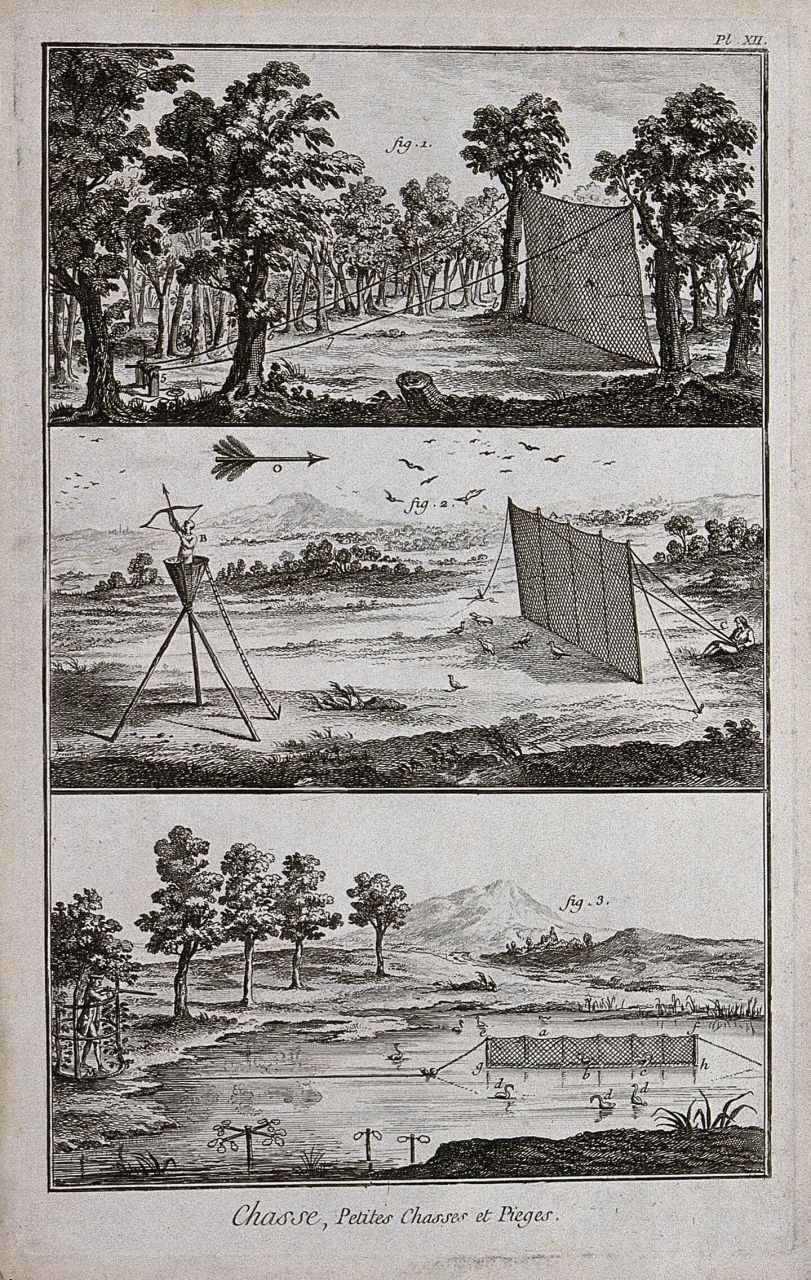 The capture of birds with nets was also described by several of the Linnaeus Apostles in their journals. For instance, Pehr Kalm wrote that swallows were caught with nets over lakes in the Nordic countries, and Fredrik Hasselquist noted in his journal that the Damiatick Duck ‘they are caught with nets alive’ on land along the sea coast of Egypt, both in the early 1750s, techniques which this contemporary illustration visualises. | Hunting: nets and hides for catching ground birds. (Courtesy: Wellcome Collection, 493419i. Engraving, c.1762, by B.-L. Prevost, Paris).
Sources:
- Blundt, Wilfrid, The compleat naturalist, A life of Linnaeus, London 1971.
- Ellis, John, ‘CVII. An account of the male and female cochineal insects, that breed on the cactus opuntia, or Indian fig, in South Carolina and Georgia: In a letter from John Ellis, Esq; to Peter Wych, Esq’, Philosophical Transactions, 1762, pp. 661-667.
- Ellis, John, Directions for Bringing over Seeds and Plants, from the East Indies and Other Distant Countries…, London 1770.
- Engel, H., ‘The Life of Albert Seba’, Svenska Linnésällskapets Årsskrift 1937, pp. 75-100.
- Fara, Patricia, Sex, Botany & Empire, UK 2003.
- Goodman, David & Russell, Colin A. Ed., The Rise of Scientific Europe 1500-1800, Kent 1991.
- Hansen, Lars, ed., The Linnaeus Apostles – Global Science & Adventure, eight volumes, London & Whitby, 2007-2012 (The journals of the Linnaeus Apostles).
- Hansen, Viveka, Textilia Linnaeana – Global 18th Century Textile Traditions & Trade, London 2017.
- Howgego, Raymond John, Encyclopedia of Exploration to 1800, Australia 2003.
- Linnaeus, Carl, Linnés Dalaresa – Iter Dalecarlicum, (ed. Arvid HJ. Uggla) Stockholm 1953. (pp. 330 & 361 note according to editor Arvid HJ. Uggla).
- Linnaeus, Carl, Iter Lapponicum – Lappländska resan 1732. Published after the manuscript by A. Hellbom, S. Fries and R. Jacobsson. vol. I., Umeå 2003.
- Manning, Patrick & Rood, Daniel, ed., Global Scientific Practice in an Age of Revolutions, 1750-1850, Pittsburgh 2016.
- Richardson, John, The Annals of London –A Year-by-Year Record of a Thousand Years of History, UK 2000 (pp. 194-212).
- Sparrman, Anders, Museum Carlsonianum, in quo novas et selectas aves…part 3, Stockholm 1788.
- The Linnaean Correspondence. (In-depth studies of letters connected to other individuals mentioned in this text).
- Uggla, Arvid H.J., ‘Petrus Forsskåls stamböcker’, Svenska Linnésällskapets årsskrift 1940, pp. 86-96.
- Wilhelm, Gottlieb Tobias, Unterhaltungen aus der Naturgeschichte / Die Insecten. Wien, 1810-11. Vol. Three.
More in Books & Art:
Essays
ISSN 2631-4746
The iTEXTILIS is a division of The IK Workshop Society – a global and unique forum for all those interested in Natural & Cultural History.
Open Access Essays by Textile Historian Viveka Hansen
Textile historian Viveka Hansen offers a collection of open-access essays, published under Creative Commons licenses and freely available to all. These essays weave together her latest research, previously published monographs, and earlier projects dating back to the late 1980s. Some essays include rare archival material — originally published in other languages — now translated into English for the first time. These texts reveal little-known aspects of textile history, previously accessible mainly to audiences in Northern Europe. Hansen’s work spans a rich range of topics: the global textile trade, material culture, cloth manufacturing, fashion history, natural dyeing techniques, and the fascinating world of early travelling naturalists — notably the “Linnaean network” — all examined through a global historical lens.
Help secure the future of open access at iTEXTILIS essays! Your donation will keep knowledge open, connected, and growing on this textile history resource.
For regular updates and to fully utilise iTEXTILIS' features, we recommend subscribing to our newsletter, iMESSENGER.
The iTEXTILIS is a division of The IK Workshop Society – a global and unique forum for all those interested in Natural & Cultural History.
Open Access Essays by Textile Historian Viveka Hansen
Textile historian Viveka Hansen offers a collection of open-access essays, published under Creative Commons licenses and freely available to all. These essays weave together her latest research, previously published monographs, and earlier projects dating back to the late 1980s. Some essays include rare archival material — originally published in other languages — now translated into English for the first time. These texts reveal little-known aspects of textile history, previously accessible mainly to audiences in Northern Europe. Hansen’s work spans a rich range of topics: the global textile trade, material culture, cloth manufacturing, fashion history, natural dyeing techniques, and the fascinating world of early travelling naturalists — notably the “Linnaean network” — all examined through a global historical lens.
Help secure the future of open access at iTEXTILIS essays! Your donation will keep knowledge open, connected, and growing on this textile history resource.
For regular updates and to fully utilise iTEXTILIS' features, we recommend subscribing to our newsletter, iMESSENGER.
The IK Foundation & Company Promoting Natural & Cultural History
|
Subscribe to our Newsletter | IK Global iMessenger |
Translate Page |



|
© The IK Foundation & Company 2026 - a truly European organisation since 1988 |
The IK
Workshop Society
Workshop Society
The Field
Station Lab
Station Lab
How to cite & Creative Commons
You are welcome to use the information and knowledge from
The IK Workshop Society, as long as you follow a few simple rules.
LEARN MORE & I AGREE
You are welcome to use the information and knowledge from
The IK Workshop Society, as long as you follow a few simple rules.
LEARN MORE & I AGREE
