
ikfoundation.org
The IK Foundation
Promoting Natural & Cultural History
Since 1988

- WELCOME
- THE IK WORKSHOP SOCIETY
- THE FIELD STATION LAB
- THE DONATION ROOM
- BOOKS & ART0


- CONTACT
iFellows Sign In
Find out more about becoming an iFellow...My Basket
Items: 0Total: €0.00
Home > The IKWS > iTextilis > THE STORY No. 12 | FIELDWORK – THE LINNAEAN WAY
How to cite & Creative Commons

THE STORY No. 12 | FIELDWORK – THE LINNAEAN WAY
Paper Books, Boxes, Pins, etc., for keeping Collections Safe
ESSAYS No: CCXXIII | June 25, 2026 | By Viveka Hansen
This Essay is part of the long-term research and publicise project
THE STORY | FIELDWORK THE LINNAEAN WAY
 The global multidisciplinary project in Natural & Cultural History.
In this third essay on keeping collections safe, a few more individuals will be introduced, along with the long-distance-travelling naturalists. Peter Jonas Bergius (1730-1790) became a student of Carl Linnaeus (1707-1778) in 1749, and took his exams as a Medical Doctor in 1754. Bergius travelled to Gotland as a young man but never abroad. Nevertheless, his herbarium became extensive, especially after he received a herbarium from Michael Grubb (1728-1808), the director of the Swedish East India Company, in 1767, and he continually added samples from Linnaeus and others during his lifetime. By the time of his death in 1790, his collection included around 9,000 species. Additionally, Bergius published a short article in the Royal Swedish Academy of Sciences’ New Documents in 1786, discussing his extensive experience with herbaria and insect-related issues. Notably, among other matters, he provided a detailed description of the history of how botanical specimens were organised in paper books.
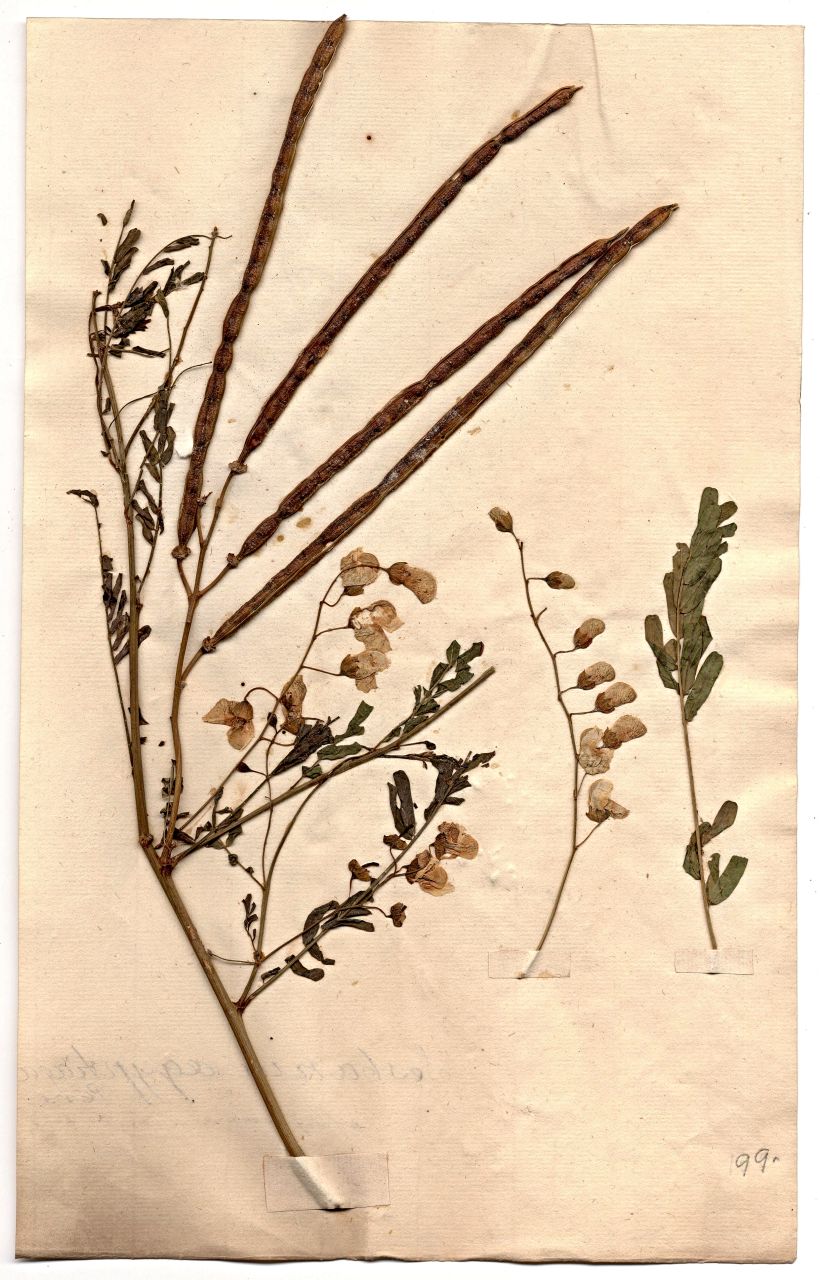 Numerous herbarium sheets, including botanical specimens evidently collected by individuals in the Linnaean network, have been preserved to the present day, but this particular sheet, with linked sources, reveals more original documentation than usual. (Courtesy: The Bergius Herbarium, Stockholm, Sweden (electronic source) no. 2.4.1.99).
Interestingly, the earlier students of Linnaeus and other individuals in the working-age network before 1750 appear to have used the older herbarium system, with paper books described by Peter Jonas Bergius. Pehr Kalm’s (1716-1779) travel account is the most thorough source, providing details such as that he, several times during the long journey, bought ‘paper books’. He regularly paid for the paper used for pressing specimens, making cones for seeds, boxes, and much more, linked to the all-important exercise of pressing plants in the best way possible and keeping seeds dry along the route. These purchases already began during his waiting time for the ship in Göteborg in October and November 1747, when ‘cartridge paper’ was needed on three occasions. Furthermore, at the stopover at Christiansand along the Norwegian coast, he bought ‘A box of Christian Månson, for the keeping of many natural history specimens’ on 23 January 1748. However, it was during his time in England in 1748, and particularly in the last month before leaving for the Atlantic crossing to Philadelphia, that he bought a large number of paper qualities to be kept among his personal belongings for the forthcoming work on his collections.
In the North American colonies, there are regular entries of the purchase of linen for pouches, used for the collecting of seeds. On 31 August 1750, he bought, for example: ‘One Ell of linen for pouches, 1 Sh. 1d,’, ‘Thread, 9d.’, and 6d. had further been paid for ‘the making up of Pouches’. The expense of thread, appearing repeatedly in the accounts, would presumably also have been needed for the collected botanical and zoological material, as well as for mending clothes. Silk was listed several times, and colour was often mentioned, maybe a sort of system, when tying different colours around paper cones, etc. There is some uncertainty about this strategy, but the colours may have indicated different kinds of seeds or if they should be delivered to other individuals. During Kalm’s years in North America, a great variety of items were needed, and the ongoing expenses were included in his accounts. It is also enlightening to observe the costs of land transport and the various individuals involved in safekeeping or assistance. This extracted list not only revealed details about the naturalist Pehr Kalm and his assistant, but simultaneously a multitude of facts for the needs of natural historians in general during the 18th century. However, financial limitations or lack of paper or other necessities in some geographical areas made the purchases more limited for some travellers. It was without a doubt common to utilise whatever discarded, fragmented papers were at hand, such as newspapers, bills, receipts, letters, etc., as wrappers, as long as these papers were regarded as less valuable than the seeds. Such a custom of seed transfer or safekeeping can be traced to several present-day herbarium collections, where a couple of seeds are still folded in a reused letter. This practice was not registered by Kalm, who seems to have aimed to buy the best new quality paper for each and every possible need of his natural history work.
On his return sailing, Kalm’s main concern was to keep all his collections safe and plan for transport via a new ship to Sweden. In March and April 1751, he purchased boards for boxes, nails for boxes and barrels, and paid 1 Sh. 10d. for ‘Transport of seeds from the Customhouse down to Wapping, and for them who carried it on land.’ He even had expenses for ‘small earthen vessels to give the opossum and guinea pigs water to drink from’, giving evidence that he brought live animals. The opossum was all the way from America, whilst the guinea pigs were probably offered to him during his time in London. After a very favourable sailing, taking four days only from Yarmouth to Göteborg, the care of his collections continued. At this place as well as during the coming two months along the road towards and at the arrival in Stockholm, he needed more coarse paper for cones, cartridge paper and, in particular, to pay for various sendings of seeds.
Analysing Pehr Kalm’s travelling account also gives a general idea of 18th century practices. To the greatest extent, specimens were pressed between various coarse papers and cartridge paper – either kept in a book of papers or, over time, more commonly in between loose sheets. Another of Linnaeus’ former students who mentioned a book of paper used for pressing plants was Adam Afzelius (1750-1837) in a letter to an unknown friend on 5 August 1779. It includes these enlightening details: ‘If you at any time like to see the rare herbs, as I at the departure [prior to January 1778] received by Prof. Linnaeus, so the specimens avoided being ruined if it not already had happened. The herbs are placed in my book cupboard, in the undermost cartridge-paper book and in the last half of it.’ Printed books could also be used for pressing such examples, especially large-sized and heavy books being best suited. Finding actual proof of any natural history books owned by someone in the Linnaean network that were originally used for pressing specimens and still exist today is rare.
In a letter written by Fredrik Hasselquist (1722-1752) in Smyrna – 22 September 1751 – to Carl Linnaeus, it was observed: ‘I here send enclosed, the flowers of Æschynomene Sesban (bastard sensitive plant) which is used for hedges around plantations, and affords an agreeable prospect.’ According to his journal, the plant was picked in Damiata, Egypt, on 19 March of the same year; it must thereafter have been pressed, taken along on the journey among his personal belongings, and included in a letter to Linnaeus during his stay in Smyrna a few months before his untimely death at this place. The specimen sent to him was exchanged to one of his other students, Peter Jonas Bergius. The plant – flower, leaf, stem and seed – was arranged on a herbarium sheet and added with a note in Bergius handwriting ‘Æschynomene Sesban, Ex orient. Hasselqu.’ It may also be noted that 18th-century collectors often took great care to make the herbarium sheet as aesthetically pleasing as possible when presenting it to their friends and colleagues. Just as in this example illustrated above, kept at The Bergius Herbarium, it was best achieved by mounting the specimen (or sometimes two or more samples) on the front and keeping factual details such as plant name, collector, and provenance on the reverse. Some other museum collections have unfortunately chosen to glue or affix additional catalogue information, barcodes, copyright signs, etc., on the front; even if they do not damage the sheets, they alter the original aesthetic purpose of thousands of such 18th-century herbarium sheets.
One of Carl Linnaeus' herbarium cabinets is still kept at the Linnean Society of London. The idea behind this particular cabinet was to manage his day-to-day practical work on the growing collections, as mentioned in his 1751 publication Philosophia Botanica. ‘A wooden cupboard, which can be closed by two long folding doors, nicely corresponding to a vertical partition’. It may be assumed that he had it constructed sometime after this year, during the 1750s, in the slim, tall design. The wooden cabinet, built to fit the ceiling height, had adjustable shelves to maximise space for sheets of herbaria as well as paper books, including pressed specimens.
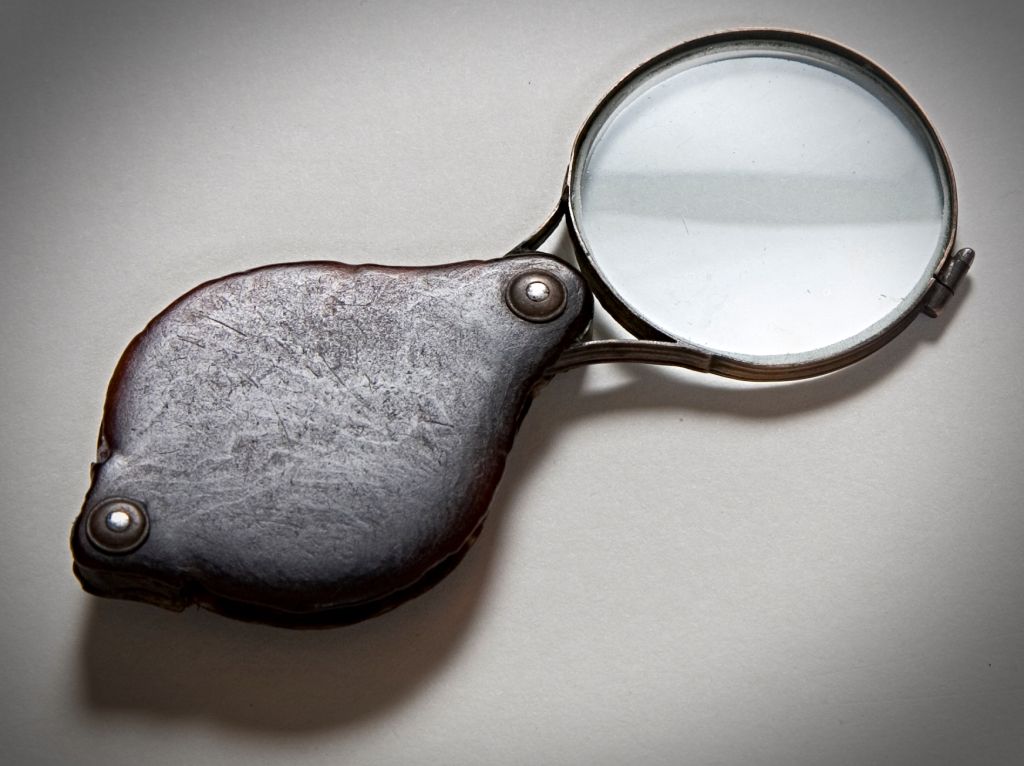 The magnifying glass was one of the botanist’s most important pieces of field equipment for examining plants. This well-preserved object was used by Carl Linnaeus during his work. (Collection: Svenska Linnésällskapet, Uppsala, Sweden). Photo: The IK Foundation, London.
-1280x1205.jpg) The importance of hats in warm climates was interestingly also illustrated in Carl Bernhard Wadström’s book:’A Hat with 3 Valves in the Crown, which is very useful for those who live in hot Climates’. The three square-shaped holes in the crown of the wide-brimmed hat were thought to give some extra ventilation in the intense heat. (Uppsala University Library, No: 97671/Alvin online source, Wadström… Fig. 1 of Plate I).
The importance of hats in warm climates was interestingly also illustrated in Carl Bernhard Wadström’s book:’A Hat with 3 Valves in the Crown, which is very useful for those who live in hot Climates’. The three square-shaped holes in the crown of the wide-brimmed hat were thought to give some extra ventilation in the intense heat. (Uppsala University Library, No: 97671/Alvin online source, Wadström… Fig. 1 of Plate I). Even if the aim of collecting as many rare plants, insects, etc., as possible often was the same for numerous individuals, cultural differences, of course, existed when naturalists visited various countries. In Japan, for instance, Carl Peter Thunberg (1743-1828) had to request permission to collect plants during his time in the country. Due to these strict rules, he also developed an unusual but necessary contact with the Japanese authorities, and, furthermore, he continued correspondence with the interpreters after leaving Japan to further strengthen his knowledge of Japanese flora and receive sought-after ‘books and glasses, including insects…’. A few years earlier, in the Cape province (Journal note in August 1772), Thunberg provided himself with the necessary belongings for several months-long expeditions into the countryside. He purchased cartridge paper for drying plants, cotton and boxes for stuffing and keeping birds in, boxes and bags for collecting roots and seeds, pins for insects, a keg of arrack for preserving serpents and amphibious animals, etc.
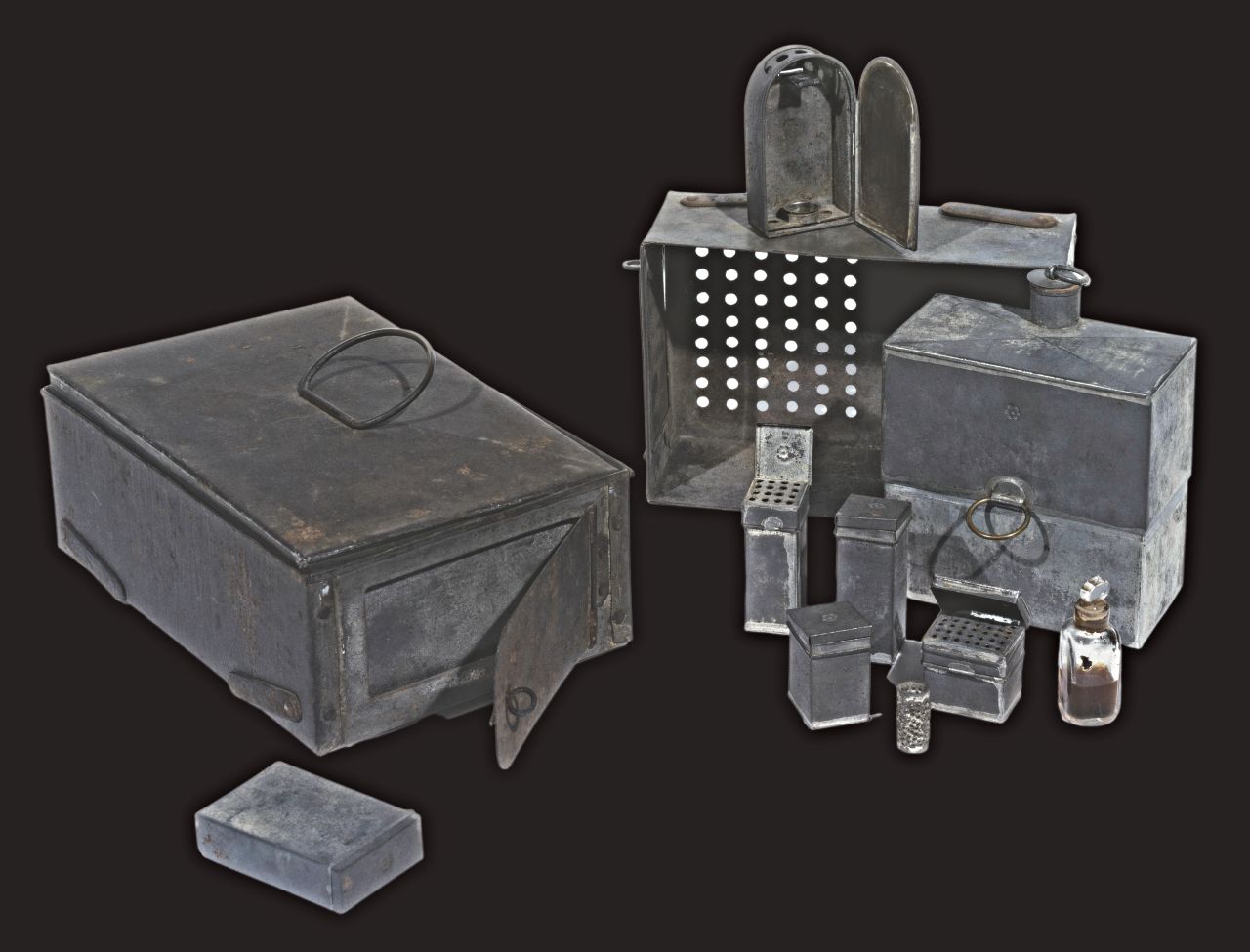 A very well-preserved and innovative tin cooking apparatus was among Joseph Banks’ (1743-1820) personal belongings and is thought to have been used on James Cook’s (1728-1779) first voyage, 1768-1771, an expedition in which the Linnaeus apostle Daniel Solander (1733-1782) also took part as Banks’ assistant. This uniquely preserved portable equipment must have been very handy for cooking on the many field trips undertaken during the expedition; however, how often it was used remains unknown. In addition to the cooking apparatus itself, one can also see a colander, storage jars, a salt cellar, and a pepper pot. The pieces slot together so ingeniously that everything fits neatly into the box-like outer case. The specially made equipment might also have been used to dry plants before storing them in paper parcels during the extensive collecting work on field trips. (Courtesy: Royal Geographical Society, London, United Kingdom).
![The botanist Francis Masson (1741-1805) was a contemporary who met both Carl Peter Thunberg and Anders Sparrman (1748-1820) in the Cape province in 1773 [named Mason in their journals]. Furthermore, Masson travelled on the outward leg to the Cape with James Cook’s second voyage, worked at Kew Garden and was sent out by Joseph Banks et al. to collect plants for other distant places – and therefore had several connections to the Linnaean network. (From: Francis Masson’s 1796 publication, Stapeliae Novae, on the South African succulents, here illustrated with the Stapelia ambigua. Wikimedia Commons).](https://www.ikfoundation.org/uploads/image/5-a-francis-832x1280.jpg) The botanist Francis Masson (1741-1805) was a contemporary who met both Carl Peter Thunberg and Anders Sparrman (1748-1820) in the Cape province in 1773 [named Mason in their journals]. Furthermore, Masson travelled on the outward leg to the Cape with James Cook’s second voyage, worked at Kew Garden and was sent out by Joseph Banks et al. to collect plants for other distant places – and therefore had several connections to the Linnaean network. (From: Francis Masson’s 1796 publication, Stapeliae Novae, on the South African succulents, here illustrated with the Stapelia ambigua. Wikimedia Commons).
The botanist Francis Masson (1741-1805) was a contemporary who met both Carl Peter Thunberg and Anders Sparrman (1748-1820) in the Cape province in 1773 [named Mason in their journals]. Furthermore, Masson travelled on the outward leg to the Cape with James Cook’s second voyage, worked at Kew Garden and was sent out by Joseph Banks et al. to collect plants for other distant places – and therefore had several connections to the Linnaean network. (From: Francis Masson’s 1796 publication, Stapeliae Novae, on the South African succulents, here illustrated with the Stapelia ambigua. Wikimedia Commons).Francis Masson’s relatively short descriptions of his three expeditions into the countryside of the Cape province include a rich selection of plant observations. Furthermore, his second trip was taken in company with the Linnaeus apostle Carl Peter Thunberg; they set out from town on 11 September 1773 and returned over four months later. Among the many matters, Masson noted on 2 November in the journal: ‘The trees were mostly of the Mimosa nilotica of Linnaeus; the species of the birds I have not yet determined, not being provided with books upon Ornithology to settle one half of those which I collected on this journey.’ Masson returned to Kew, outside London, in November 1775, with over 500 plant species and may be regarded as one of the first eminent “plant hunters,” starting with this ground-breaking voyage and, in a systematic effort, completing many more up to his death in Montreal in 1805. He was part of a business idea in which ongoing “hunting for new and exotic plants” was key, whilst the earlier Linnaean network, to a lesser extent, aimed at trade and predominantly focused on classification, sharing specimens, and looking out for new potential additions within their home country’s mercantile economy. Besides travelling to the Cape more than once, Masson collected plants on Madeira, the Canary Islands, the Azores, the Antilles, in Portugal, and, for a lengthy period, in North America.
Overall, two main sending methods existed: either sending collections ahead of one’s own travel from various ports, with a ship sailing in the desired direction, or keeping everything together to be brought on the ship used when going home. Or in a combination of both. One such example can be glimpsed in a letter from Daniel Solander, while on Madeira, to John Ellis (1710-1776) in London, likely sent via another ship anchoring in the bay. He noted: ‘Endeavour, off the Bay of Funchal, Sept. 18, 1768…great many fine Mollusca; got drawing and descriptions of them…we resolved to send what we have by Lisbon…You shall have a large packet by way of Lisbon…’ This dispatch of specimens etc., took place less than two months into the journey, but the majority of the collections were stored on the Endeavour until the return to England almost three years later. Transports of natural history specimens were not always trouble-free, however, as the authorities became suspicious of some boxes in the luggage and why snakes were kept in bottles along the route for The Royal Danish Expedition to Arabia. These issues lingered on for days in Carsten Niebuhr’s (1733-1815) travel description from 24 to 27 April in 1763, among many matters in the port town of Mocha (Yemen) he noted: ‘At nine o’clock in the morning our travelling group arrived to Mocha with servants and luggage. The luggage was, after the country's traditions, brought straight away to the Customs Office… searched through the boxes containing natural history specimens that had arrived by sea at Mocha…Forsskål had put several species of snake in liquor…' As a natural historian, Peter Forsskål (1732-1763) made experiments from the outset of the journey and often used techniques he had learned in his youth. One such occasion was mentioned in his journal in February 1761 from the road of Helsingør in Denmark, before the ship made its third attempt to leave the harbour: ‘…I filtered this seawater through both linen and grey paper four layers thick and scrutinised the resulting sediment most carefully…’ Another quite common issue – aforementioned in connection with clothes and books – with natural history collections was the frequent nuisance of unwanted insects gnawing through possessions.
Daniel Rolander (1723-1793) noted from Suriname in his journal on 30 July 1755: ‘…I had stopped up the cracks of the case with thicker paper that I had saturated in turpentine. The ants still gnawed through the paper and opened up an entry for themselves. Likewise, during the nights, they tried to tear up some fresh plants I had placed in my room, especially if I had placed one or two I had not yet examined or described away in a corner…’ Whilst Anders Sparrman had to overcome similar obstacles with white ants, eating their way through everything in southern Africa two decades later. Half a year earlier, in July 1775, during preparations for an expedition from Cape into the countryside, his journal also included further details of his collection work. ‘At the same time, we furnished ourselves with an oaken cask, made for the purpose of keeping serpents and other animals in brandy; also several reams of paper for drying plants, with leads and needles for insects, and likewise some necessary changes of apparel.’ From a present-day perspective, the collecting was often far from ethical and even cruel, as may be gleaned from Christopher Tärnström’s (1711-1746) journal on 27 September 1746 in the South China Sea. He described how butterflies, rare to him, had been caught onboard the ship: ‘The one had a big body the like of which I had not seen, velvet brown in colour. It shrieked like a big rat when caught and stayed alive for many days on a big sewing needle which I had stuck through it. The other one had a small body and very long wings, ashen coloured and rare.’
Sources:
- Banks, Joseph, The Endeavour Journal of Joseph Banks – 1768-1771. Ed. J. C. Beaglehole, 2 vol., Sydney 1963. (Vol. Two. p. 308).
- Bergius, P.J., ‘Anmärkningar öfver Herbarier, och deras skadande af Insecter’, Kongl. Vetenskaps Akademiens Nya Handlingar, pp. 302-309, 1786 (quote in translation p. 302).
- Blundt, Wilfrid, The Compleat Naturalist: A Life of Linnaeus, London, 1971.
- Fara, Patricia, Sex, Botany & Empire, UK 2003.
- Goodman, David & Russell, Colin A. Ed., The Rise of Scientific Europe 1500-1800, Kent 1991.
- Hansen, Lars, ed., The Linnaeus Apostles – Global Science & Adventure, eight volumes, London & Whitby, 2007-2012 (Quotes from the journals of the Linnaeus Apostles).
- Hansen, Viveka, ‘In the Chest’, The Linnaeus Apostles – Global Science & Adventure, London & Whitby 2010, Vol. One, pp. 248-276.
- Hansen, Viveka, Textilia Linnaeana – Global 18th Century Textile Traditions & Trade, London 2017.
- Howgego, Raymond John, Encyclopedia of Exploration to 1800, Australia 2003.
- Iwao, S. ‘C.P. Thunbergs ställning i japansk kulturhistoria.’ Svenska Linnésällskapets Årsskrift 1953, pp. 135-147.
- Kalm. Pehr, Pehr Kalms Amerikanska reseräkning, published by Svenska Litteratursällskapet i Finland, Helsingfors 1956. (Translation from Swedish & info on paper qualities for natural history collection, etc., pp. 17-91).
- Krook, Hans, ‘Peter Jonas Bergius – Linnés lärjunge och läkarekollega’, Svenska Linnésällskapets Årsskrift 1979-81, pp. 73-86.
- Linnaeus, Carl, Caroli Linnæi ... Philosophia botanica in qva explicantur fundamenta botanica…, Stockholm 1751.
- Manning, Patrick & Rood, Daniel, ed., Global Scientific Practice in an Age of Revolutions, 1750-1850, Pittsburgh 2016.
- Masson, Francis, ‘Francis Masson's account of three journeys at the Cape of Good Hope, 1772-1775’, Philosophical Transactions of the Royal Society of London, vol. 66, pp. 268-317, London 1776 (quote p. 286).
- Saltmarsh, Anna C., ‘Francis Masson: Collecting Plants for King and Country’, Curtis's Botanical Magazine, Vol. 20, No. 4 (Nov. 2003), pp. 225-244 (biographical sketch of Francis Masson).
- Skuncke, Marie-Christine, Carl Peter Thunberg – Botanist and Physician, Career-Building across the Oceans in the Eighteenth Century, Uppsala 2014.
- The Linnaean Correspondence (9 letters from P.J. Bergius to Carl Linnaeus 1752-1769).
- Uppsala University Library, No: 16412/Alvin online (quote in translation from Swedish. Letter from Adam Afzelius to an unknown friend, August 5, 1779).
- Wadström, Carl Bernhard, An Essay on Colonization, Particularly Applied to the Western Coast of Africa, London 1794-95.
More in Books & Art:
Essays
ISSN 2631-4746
The iTEXTILIS is a division of The IK Workshop Society – a global and unique forum for all those interested in Natural & Cultural History.
Open Access Essays by Textile Historian Viveka Hansen
Textile historian Viveka Hansen offers a collection of open-access essays, published under Creative Commons licenses and freely available to all. These essays weave together her latest research, previously published monographs, and earlier projects dating back to the late 1980s. Some essays include rare archival material — originally published in other languages — now translated into English for the first time. These texts reveal little-known aspects of textile history, previously accessible mainly to audiences in Northern Europe. Hansen’s work spans a rich range of topics: the global textile trade, material culture, cloth manufacturing, fashion history, natural dyeing techniques, and the fascinating world of early travelling naturalists — notably the “Linnaean network” — all examined through a global historical lens.
Help secure the future of open access at iTEXTILIS essays! Your donation will keep knowledge open, connected, and growing on this textile history resource.
For regular updates and to fully utilise iTEXTILIS' features, we recommend subscribing to our newsletter, iMESSENGER.
The iTEXTILIS is a division of The IK Workshop Society – a global and unique forum for all those interested in Natural & Cultural History.
Open Access Essays by Textile Historian Viveka Hansen
Textile historian Viveka Hansen offers a collection of open-access essays, published under Creative Commons licenses and freely available to all. These essays weave together her latest research, previously published monographs, and earlier projects dating back to the late 1980s. Some essays include rare archival material — originally published in other languages — now translated into English for the first time. These texts reveal little-known aspects of textile history, previously accessible mainly to audiences in Northern Europe. Hansen’s work spans a rich range of topics: the global textile trade, material culture, cloth manufacturing, fashion history, natural dyeing techniques, and the fascinating world of early travelling naturalists — notably the “Linnaean network” — all examined through a global historical lens.
Help secure the future of open access at iTEXTILIS essays! Your donation will keep knowledge open, connected, and growing on this textile history resource.
For regular updates and to fully utilise iTEXTILIS' features, we recommend subscribing to our newsletter, iMESSENGER.
The IK Foundation & Company Promoting Natural & Cultural History
|
Subscribe to our Newsletter | IK Global iMessenger |
Translate Page |



|
© The IK Foundation & Company 2026 - a truly European organisation since 1988 |
The IK
Workshop Society
Workshop Society
The Field
Station Lab
Station Lab
How to cite & Creative Commons
You are welcome to use the information and knowledge from
The IK Workshop Society, as long as you follow a few simple rules.
LEARN MORE & I AGREE
You are welcome to use the information and knowledge from
The IK Workshop Society, as long as you follow a few simple rules.
LEARN MORE & I AGREE
