
ikfoundation.org
The IK Foundation
Promoting Natural & Cultural History
Since 1988

- WELCOME
- THE IK WORKSHOP SOCIETY
- THE FIELD STATION LAB
- THE DONATION ROOM
- BOOKS & ART0


- CONTACT
iFellows Sign In
Find out more about becoming an iFellow...My Basket
Items: 0Total: €0.00

WEDDING TRADITIONS
– Historical Traces from Whitby and the surrounding Moorland Area: 1700 to 1914
ESSAYS No: CCXXVI | August 20, 2026 | By Viveka Hansen
Dowries given on marriage had a long tradition in England, as in many other countries, and economic needs and social status were usually the most important factors in deciding a dowry’s contents. The dowry was the contribution made by the woman and her relatives to setting up the new family’s home. It could include anything from landed property, money, furniture, etc., among the better-off. However, for many families, it would be made up mainly of “useful objects” like clothes and bed linen that could form an essential part of the newly-weds’ joint home. This essay will look closely into these textile traditions and other links to marriages – researched via parish church registers, advertisements in the local paper, preserved wedding dresses, photographs and notes by Reverend Atkinson on wedding presents, etc., from the 1840s to 1890s.
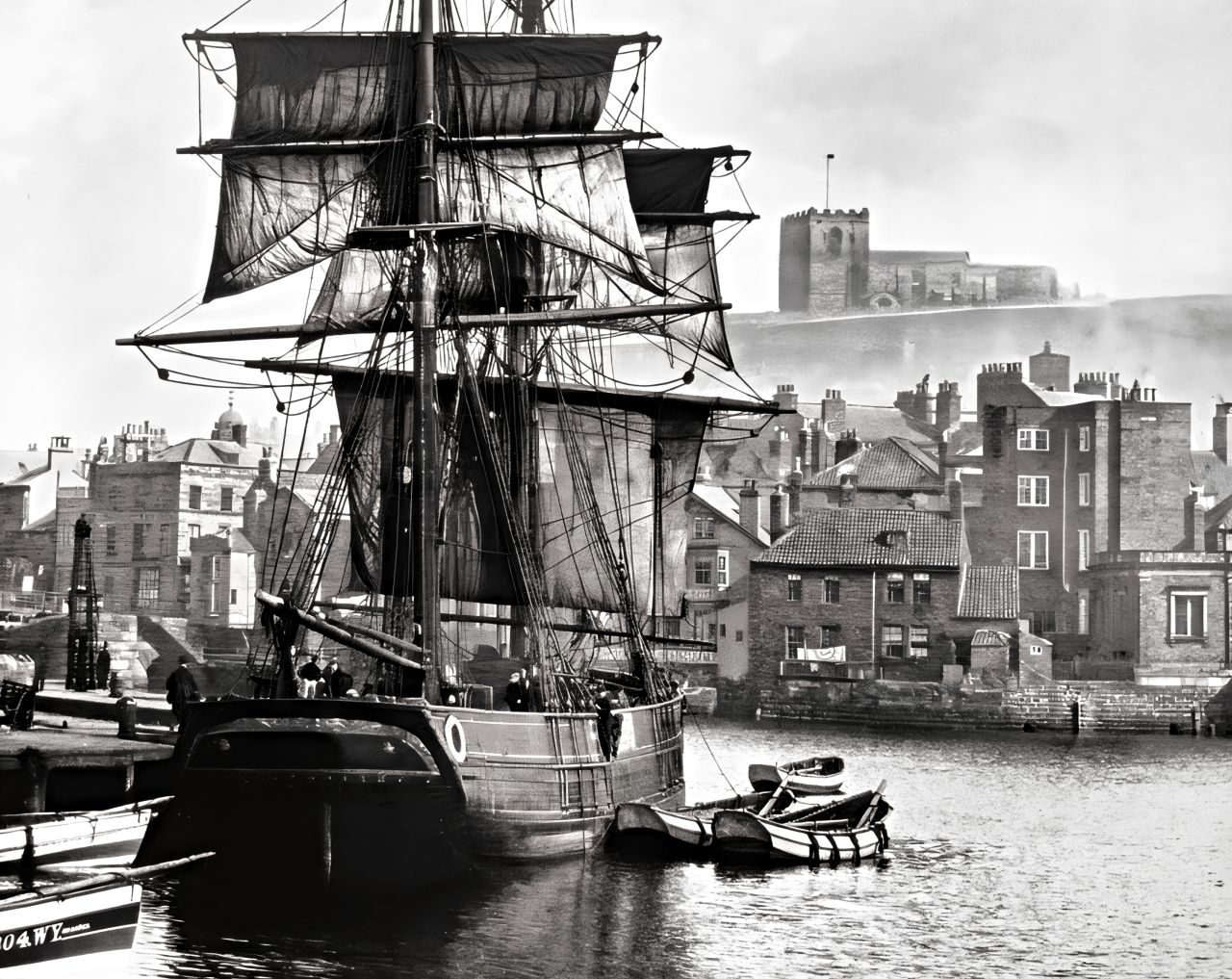 Whitby Upper Harbour, photographed by Frank Meadow Sutcliffe in the 1890s. St Mary’s Church is visible on top of the town’s east cliff, a parish church where many weddings took place in the 19th century and earlier in time. (Courtesy: Whitby Museum…, Photographic Collection, 3-55A).
It has not been possible to find sources directly connecting the textile dowry to marriage in Whitby between 1700 and 1914. But useful parallels can be seen in J. C. Atkinson’s book Forty Years in a Moorland Parish of 1891, in which the author’s many interesting insights refer mainly to conditions between about 1845 and 1890 in nearby Danby and its surroundings. The Reverend John Christopher Atkinson’s (1814-1900) notes on wedding presents in former times give an idea of the young woman’s responsibility for stocking the new home with textiles and also the importance of gifts at the wedding ceremony itself:
- ‘But the wardrobe might be, and often was in the olden times, a constituent portion of the “wedding presents,”... were uncomfortably full with articles of household garnishing or personal wear, made from home-grown, home-spun, home-woven, home-made material, linen or woollen. Much thereof might be the work of the bride’s own deft if toil-hardened fingers; but much, too, came of the many and heartily offered gifts of the neighbours and friends of the young couple...’
Atkinson’s memoir dates back to the 1840s, and traditions tended to be rather more antiquated in the countryside than in a town like Whitby, but it can be taken for granted that for several decades before this, and throughout the 18th century, a newlywed couple in Whitby would have had hand-woven textiles most necessary for their home. Just as the dowry depended on the family’s social position, so the wedding dress would also reflect their economic circumstances, and the common factor was that people would dress as well as they could afford. This might involve luxury silk garments and velvet brocade dyed with expensive imported dyes and embellished with gold thread, whereas women from less wealthy backgrounds would wear their best church dress for their wedding. Probably it was not unusual to choose white or lightly coloured material for a wedding dress in the early decades of the 19th century, judging by the fashion for light-coloured and light-weight textiles in vogue during those years. However, any regular preference for white seems to have emerged only after Queen Victoria chose a white wedding dress in 1840.
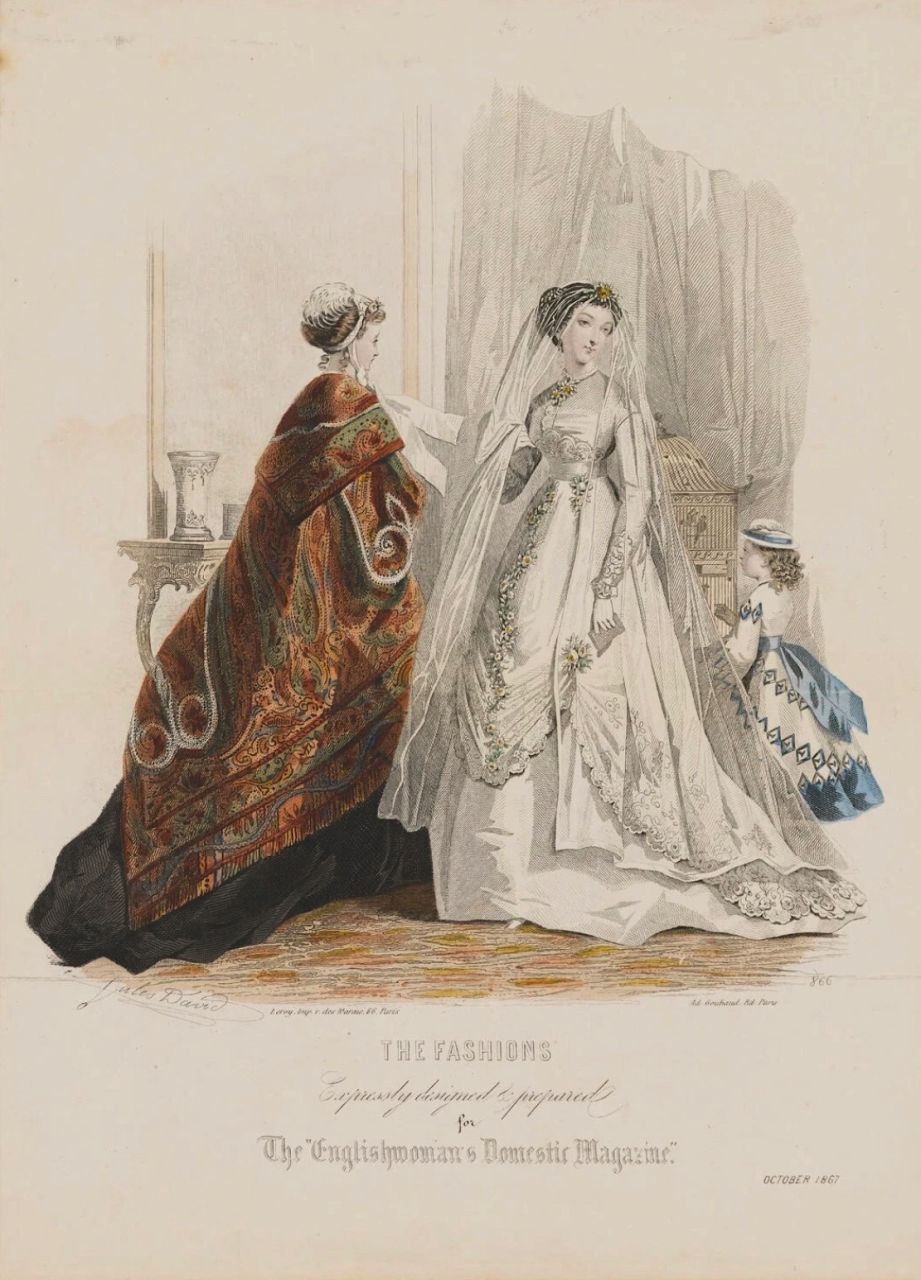 Well-off women increasingly began to wear white for their weddings, particularly during the 1860s, and many continued to use the same dress in other social situations in the first year after their wedding, often with added decorative elements such as extra lace or netting or lengthened sleeves. Although the Whitby Costume Collection contains no white wedding dresses of such an early date, many of its expensive coloured dresses may originally have been intended for a young bride and were continued to be worn afterwards as the best dress for several years. However, this plate – ‘The Fashions’ in October 1867 – is a good example of a fashionable white silk wedding toilet, originally published in ‘The Englishwoman’s Domestic Magazine’, a monthly magazine in the period 1852-79 aiming to reach the Victorian middle-class woman – probably also sold in the coastal town of Whitby. This type of dress, decorated with artificial flowers, embroidery, lace, a matching veil and other exquisite accessories, was obviously intended for a well-to-do clientele. (Courtesy: National Portrait Gallery, Reference Collection NPG D48029. Creative Commons).
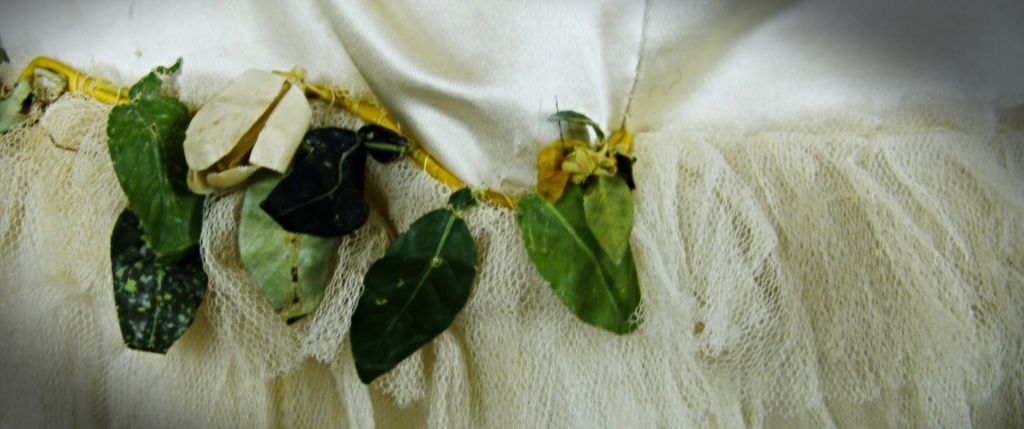 Only two of the ample Whitby Museum collections of white wedding dresses preserved date to before 1914: one from the early 1880s and the other from the Edwardian era. This is a close-up detail of the first-mentioned – an impressive late Victorian dress in cream-coloured satin with its long train would have needed a bustle to achieve its intended form. The bodice is decorated with flowers and leaves in silk or waxed-painted cotton, and is fastened to a white net. The upper part is boned as was fashionable at the time and lined with cream-white silk, with buttons covered in the same material as the dress. A little hat with ribbon and matching fabric flowers completes this expensive garment. (Collection: Whitby Museum…, Costume Collection, COS4.1). Photo: Viveka Hansen, The IK Foundation.
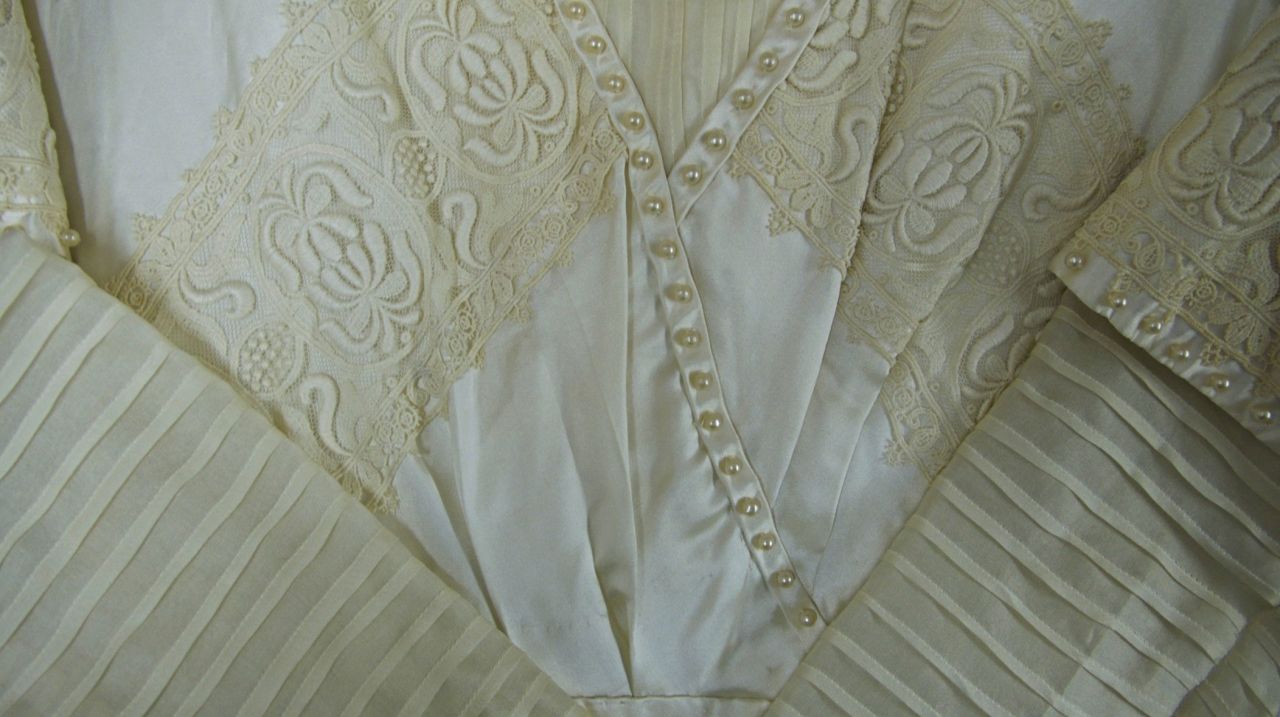 The second dress from this period is of cream-coloured silk and in a high-neck Edwardian style, decorated with broad machine-worked chemical laces, narrow prepared pleats/tucks and a large number of pearls on both sleeves and neckband. (Collection: Whitby Museum…, Costume Collection, 2006. 42.8). Photo: Viveka Hansen, The IK Foundation.
The same collection also contains a unique, exclusive black wedding dress from about 1874; its history is described in the 2005 annual report of the Whitby Lit. & Phil. Soc.:
- ‘...it was worn by Mrs M. Gardener, J. P., of Kingston-upon-Hull. She was in mourning for her father who died a month before the wedding. The marriage could not be postponed because the newly-weds were travelling to India, so the dress was re-created in black satin. It is heavily beaded and embroidered and would have been worn with a full-length black veil. It is heavily boned in the bodice and has a nineteen-inch waist...’
The longer seams are machine-sewn with details and decorations added by hand. Much of the ornamentation consists of jet beads, the bodice fastening at the front with twenty jet buttons. Black lace flounces and a train further embellish this unusual wedding dress, worn with a bustle typical of 1874. (How this dress ended up in Whitby is still being determined).
Though early written records of marriages – from about 1700 to 1837 – can be studied in several church registers, no painted or printed illustrations dating from before the age of photography have been found to give further information about local wedding clothes or the ceremony itself. Several register entries from St Mary’s church (illustrated in a photograph above), Whitby, allow us a glimpse of the two contracting parties:
- Adam Carling sailmaker and Sarah Wear Spinster both of Whitby, 1757 June 11.
- William Soulby Batchelor Weaver & Mary Storm widow both of Whitby, 1762 July 13.
- Thomas Weatherill a Batchelor & Flaxdresser & Jane Newby a Spinster Married by Licence on 7 Nov. 1771.
- William Frank a Bachelor & Flaxdresser & Elizabeth Brown Spinster by Licence on 23 May 1779.
Similarly, Whitby Parish Church Register records marriages between 1608 and 1837, though the man’s occupation is seldom mentioned before the early 18th century, while the woman is described in abbreviated form as a spinster or, less often, widow:
- 1716, Jan. 30, John Wilson, weaver & Elisabeth Walmsley of Wh.
- 1764, Febr. 6, Richard Coates, bach. weaver & Dorothy Renels, sp. both Wh.
- 1771, Aug 26, Thomas Edmonson, bach. weaver & Elizabeth Harrison, sp. both Wh.
- 1783, Feb 16, William Leng, bach. tailor & Ann Frank, sp. both Wh.
- 1790, Mar. 28, Thomas Spenceley, bach. sailmaker & Mary Brolon, sp. both Wh.
- 1798, Apr 4, George Noble, bach. tailor & Sarah Avison, sp both Wh.
- 1804, Nov. 28, John Harrison Wakefield, bach. draper & Ann Stonehouse, sp. Wh.
- 1811, Nov. 24, John Robson, bach. flaxdresser & Rachel Oakland, sp. Wh.
- 1824, July 25, George Bonnington, bach. weaver & Martha Shippin Hill, sp. Wh.
- 1833, May 5, John Witton, bach. sailcloth maker & Margaret Frank. sp. Wh.
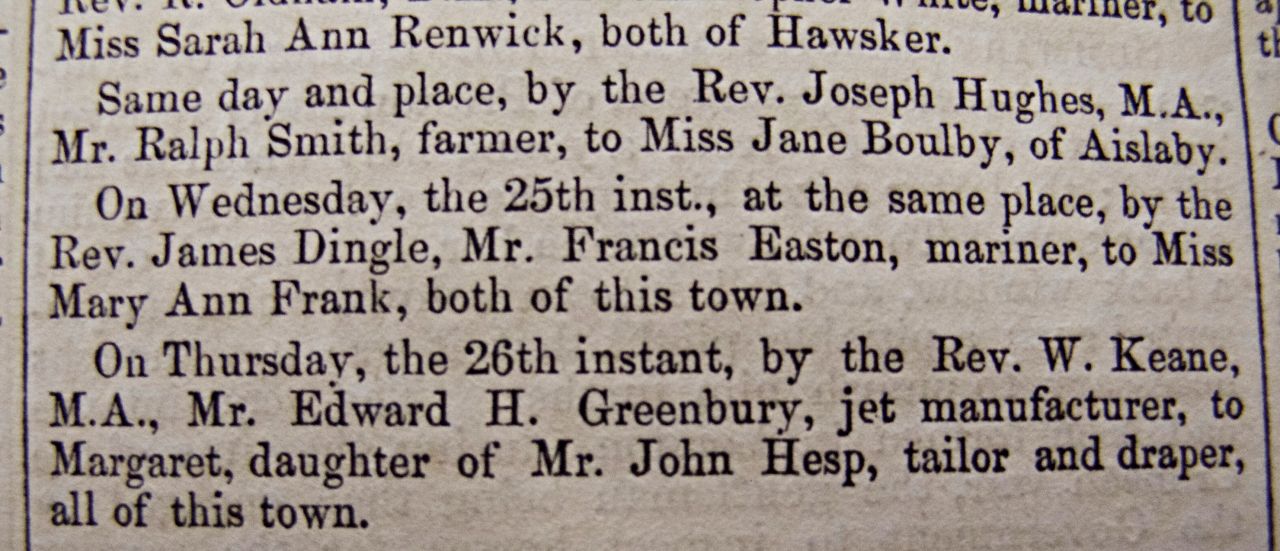 From its first years of publication, the Whitby Gazette frequently published brief marriage notices and continued to do so during the whole period up to 1914, but never with photographs. For instance, on 6 October 1860, one can read, ‘On Wednesday, the 3rd inst., at the Parish Church, by the Rev. R. Oldham, B.A. Mr. Robert Robinson, tailor, Cliff Street, to Miss Ann Chapman, both of this place.’ This tailor continued advertising his business from the same address in Whitby during the same year. This illustrated advertisement from 28 January 1860 recorded the names of recent ‘Marriages’. (Collection: Whitby Museum… Library & Archive). Photo: Viveka Hansen, The IK Foundation.
However, a study of wedding dresses in local photograph collections from the period leading up to the First World War has proved of limited value. The Photographic Collection at Whitby Museum is extensive, but it appears that wedding photographs were seldom donated to other individuals or institutions. It is also often difficult to determine whether the two people in a picture were a wedding couple or were seen on another ceremonial occasion, given that most Victorian brides wore their best everyday dress for their wedding. On the other hand, flowers in buttonholes or rings on fingers may indicate a wedding. Collections of photographs from two Whitby families and a collection of Carte de Visite pictures illustrate this problem. An album that once belonged to a family called Tyerman contains 96 photographs from the 1860s and 1870s. But these include no obvious wedding pictures or even portraits of couples. Similarly, a unique album of Carte de Visite cards shows many young couples, some of whom may have been newly married, even if the bride is not wearing a white wedding dress.
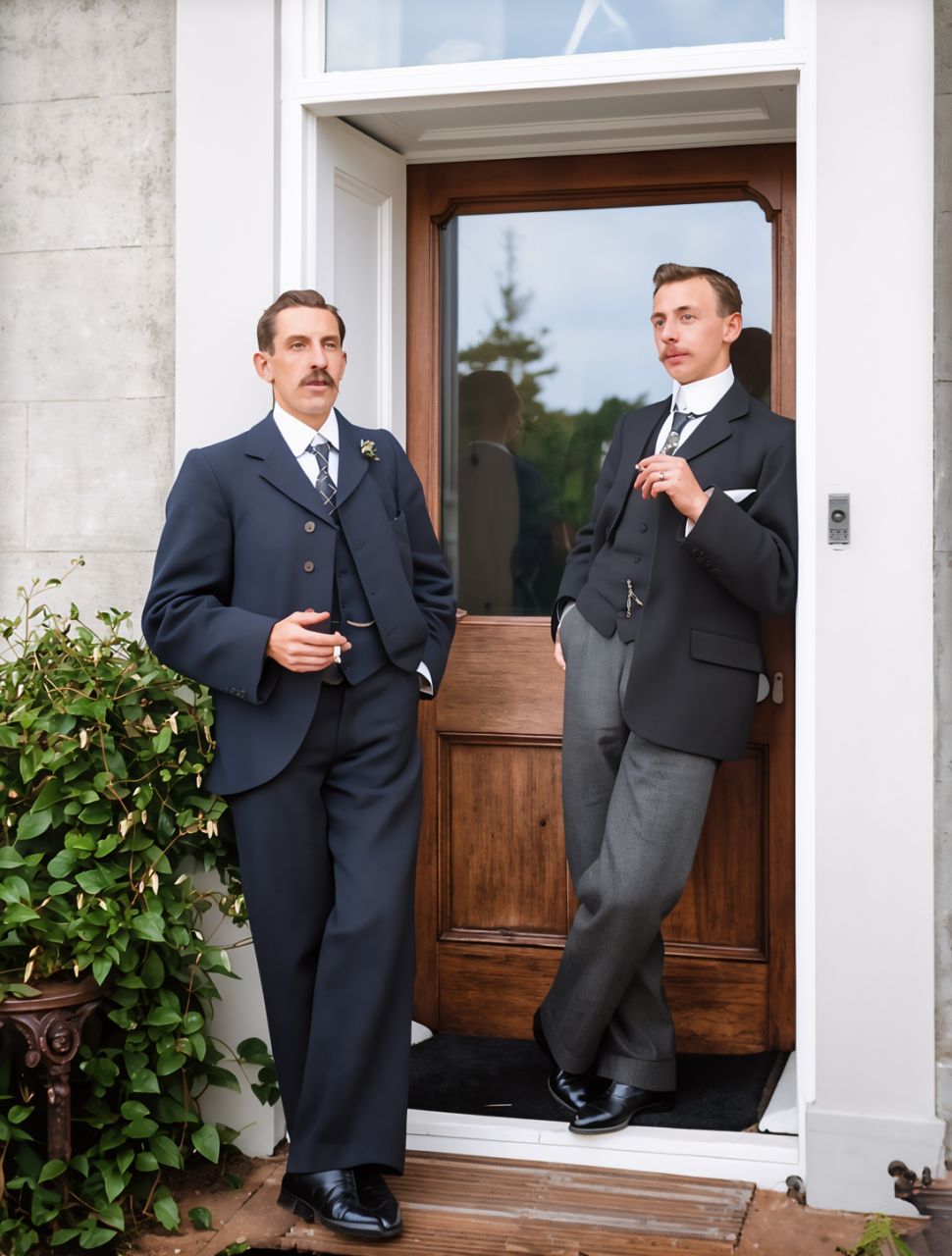 According to notes in the Photographic Collection, two gentlemen from the local bakers’ family, the Botham, dressed for a wedding party c. 1907. It is unknown whether one of them was the groom, but it is possible. (Courtesy: Whitby Museum… Photographic Collection, 2002/13.29 & modern digital colourisation).
The picture above is part of the second family collection – the Botham family – which also contains a wedding portrait, in the form of a family photograph taken outdoors, with the young Mary Botham and her husband in the centre. This picture (not available for this essay) dates from about 1908-1910, judging by the large-sized hats all the ladies wear. The bride’s dress is white, and her hat is even more enormous than those of the other female family members, while several of the other young women are dressed in white or very light-coloured dresses, as was the fashion at the time.
Sources:
- Ashelford, Jane, The Art of Dress – Clothes and Society 1500-1914, London 2002.
- Atkinson, J.C. Forty Years in a Moorland Paris, London 1923 (quote pp. 210-211).
- Hansen, Viveka, The Textile History of Whitby 1700-1914 – A lively coastal town between the North Sea and North York Moors’, London & Whitby 2015 (pp. 263-266).
- Hartley, Marie & Ingilby, Joan, Life and Tradition in The Moorlands of North-East Yorkshire, West Yorkshire 1990.
- Reports of Whitby Lit. & Phil. Society. Reports 2001-2010 (quote: from 2005, p. 23).
- The Englishwoman’s Domestic Magazine, Wikipedia.
- Whitby Gazette, 1855-1914.
- Whitby, North Yorkshire County Library; Whitby, St Mary Marriages 1705-1780, transcriptions.
- Whitby Museum (Whitby Lit. & Phil.), Whitby, United Kingdom. | Costume Collection (Wedding dresses). | Library & Archive (Whitby Gazette, original papers & Whitby Parish Church Register – Marriages 1700-1837). | Photographic Collection (F.M. Sutcliffe collection & other local photographs). | Research made during the years 2006-2012.
More in Books & Art:
Essays
ISSN 2631-4746
The iTEXTILIS is a division of The IK Workshop Society – a global and unique forum for all those interested in Natural & Cultural History.
Open Access Essays by Textile Historian Viveka Hansen
Textile historian Viveka Hansen offers a collection of open-access essays, published under Creative Commons licenses and freely available to all. These essays weave together her latest research, previously published monographs, and earlier projects dating back to the late 1980s. Some essays include rare archival material — originally published in other languages — now translated into English for the first time. These texts reveal little-known aspects of textile history, previously accessible mainly to audiences in Northern Europe. Hansen’s work spans a rich range of topics: the global textile trade, material culture, cloth manufacturing, fashion history, natural dyeing techniques, and the fascinating world of early travelling naturalists — notably the “Linnaean network” — all examined through a global historical lens.
Help secure the future of open access at iTEXTILIS essays! Your donation will keep knowledge open, connected, and growing on this textile history resource.
For regular updates and to fully utilise iTEXTILIS' features, we recommend subscribing to our newsletter, iMESSENGER.
The iTEXTILIS is a division of The IK Workshop Society – a global and unique forum for all those interested in Natural & Cultural History.
Open Access Essays by Textile Historian Viveka Hansen
Textile historian Viveka Hansen offers a collection of open-access essays, published under Creative Commons licenses and freely available to all. These essays weave together her latest research, previously published monographs, and earlier projects dating back to the late 1980s. Some essays include rare archival material — originally published in other languages — now translated into English for the first time. These texts reveal little-known aspects of textile history, previously accessible mainly to audiences in Northern Europe. Hansen’s work spans a rich range of topics: the global textile trade, material culture, cloth manufacturing, fashion history, natural dyeing techniques, and the fascinating world of early travelling naturalists — notably the “Linnaean network” — all examined through a global historical lens.
Help secure the future of open access at iTEXTILIS essays! Your donation will keep knowledge open, connected, and growing on this textile history resource.
For regular updates and to fully utilise iTEXTILIS' features, we recommend subscribing to our newsletter, iMESSENGER.
The IK Foundation & Company Promoting Natural & Cultural History
|
Subscribe to our Newsletter | IK Global iMessenger |
Translate Page |



|
© The IK Foundation & Company 2026 - a truly European organisation since 1988 |
The IK
Workshop Society
Workshop Society
The Field
Station Lab
Station Lab
How to cite & Creative Commons
You are welcome to use the information and knowledge from
The IK Workshop Society, as long as you follow a few simple rules.
LEARN MORE & I AGREE
You are welcome to use the information and knowledge from
The IK Workshop Society, as long as you follow a few simple rules.
LEARN MORE & I AGREE
