
ikfoundation.org
The IK Foundation
Promoting Natural & Cultural History
Since 1988

- WELCOME
- THE IK WORKSHOP SOCIETY
- THE FIELD STATION LAB
- THE DONATION ROOM
- BOOKS & ART0


- CONTACT
iFellows Sign In
Find out more about becoming an iFellow...My Basket
Items: 0Total: €0.00

BABY CLOTHING AND CHRISTENING
– In the Coastal Town of Whitby: 1820s to 1914
ESSAYS No: CCXII | December 5, 2025 | By Viveka Hansen
The christening was a tradition cherished by well-off Victorian and Edwardian families, who often commemorated it with a photograph, primarily to showcase the christening gown and its exclusive lace and embroidery to the best effect. However, according to my research in the local Whitby collections, such photographs are scarce before 1914. The Costume Collection, however, contains a selection of such gowns, of which at least twenty can be linked to the period from about 1830 to 1914, although precise dating is often difficult, as these garments changed very little in appearance over a long time. This essay aims to provide a glimpse into this religious practice through preserved baby garments, photographs, and various written primary sources, further supported by traces to Whitby drapers, as evidenced by records of their children’s baptisms in Parish Church Records from the 1820s and 1830s.
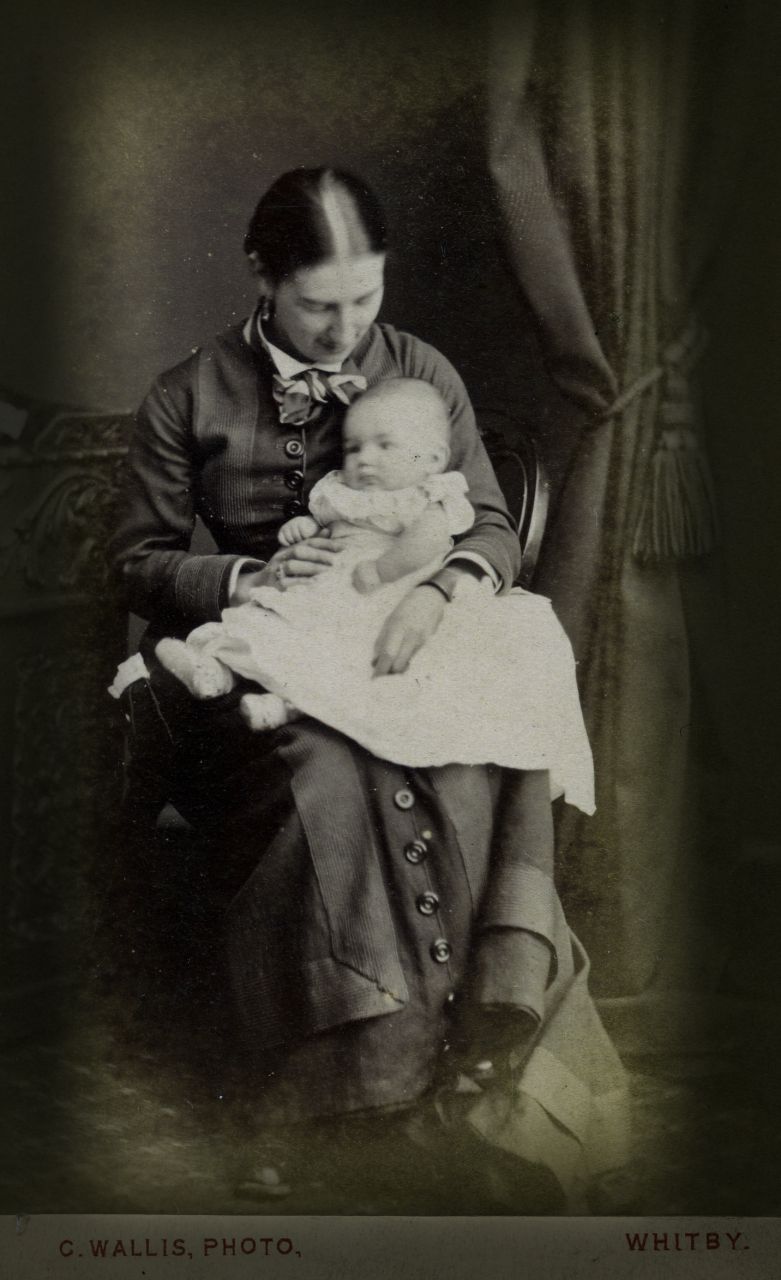 One rare example in Whitby Museum’s Photographic Collection is this Carte de Visite from the ‘Waller Pier Portrait Rooms Whitby’, a firm that operated as both a ‘Photographer & Miniature Painter’. Judging by the woman’s dress, this photograph of a mother and child originates from the 1870s, with the child’s voluminous christening gown carefully spread across the mother’s knee. (Courtesy: Whitby Museum…, Photographic Collection, Carte de Visite 29).
The most significant clues to an early date of a christening gown are hand-stitching, hand-worked embroidery and lace. Similarly, many of these garments can be classified as late Victorian or Edwardian from their machine-stitched details and seams. Though there are inevitable exceptions since these gowns were often passed down through a large group of siblings or from one generation to the next within the family, thus giving the gown’s hand-stitching a special status even in the later years of the century. On the other hand, a hand-sewn christening gown from this time might well be finished with broad machine-made lace, like on the garment illustrated below from the late Victorian period. Yet the fact that the garment’s added bobbin laces seem to have been hand-worked may indicate that the lace was specially chosen for this particular occasion from the home- or professional seamstress’s general stock.
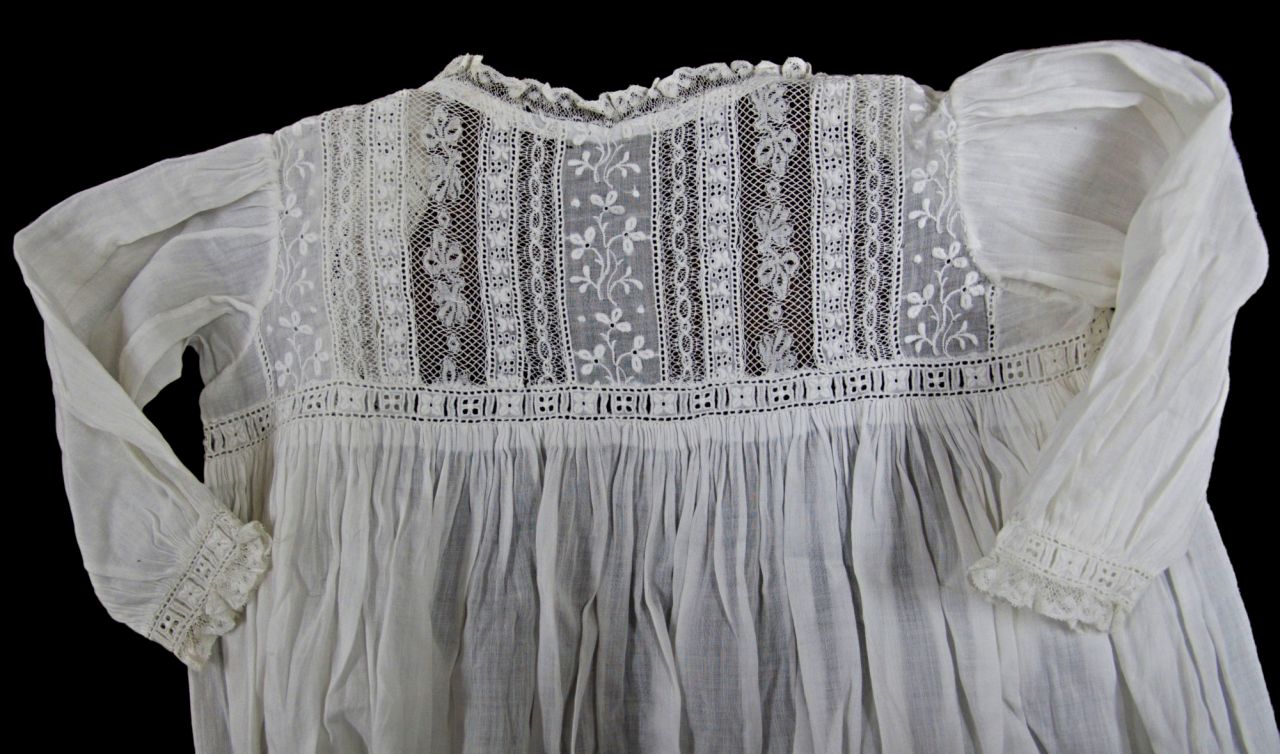 Christening gown with machine-made lace and late-Victorian whitework embroidery. (Collection: Whitby Museum…, Costume Collection, GBI43). Photo: Viveka Hansen, The IK Foundation.
 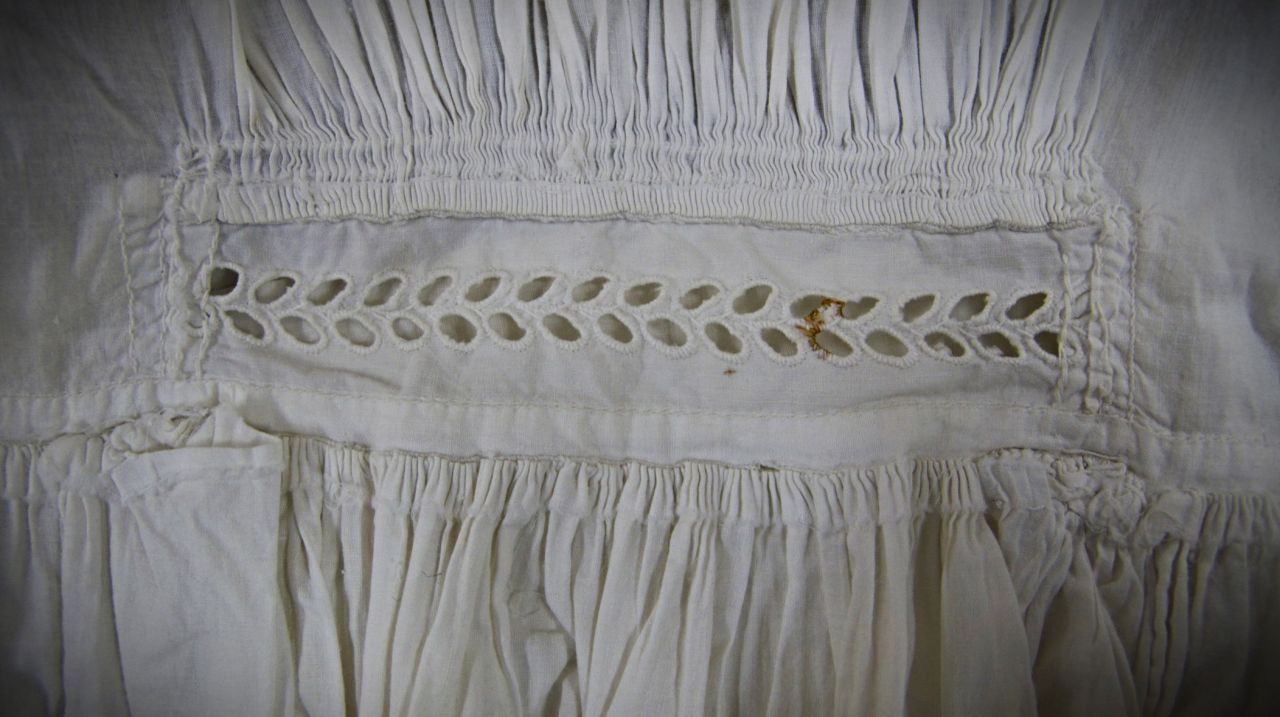 Close-up detail of stitching on a christening gown. A garment that was entirely hand-stitched – probably in the 1830s or 1840s – judging from the particularly fine gathering at the back that was such a common feature of women’s clothes at the time. This well-worked christening gown in fine cotton batiste has been finished with exquisite smocking, gathering, pleating, bobbin lace, cutwork and broderie anglaise. (Collection: Whitby Museum…, Costume Collection, GBI 1). Photo: Viveka Hansen, The IK Foundation.
 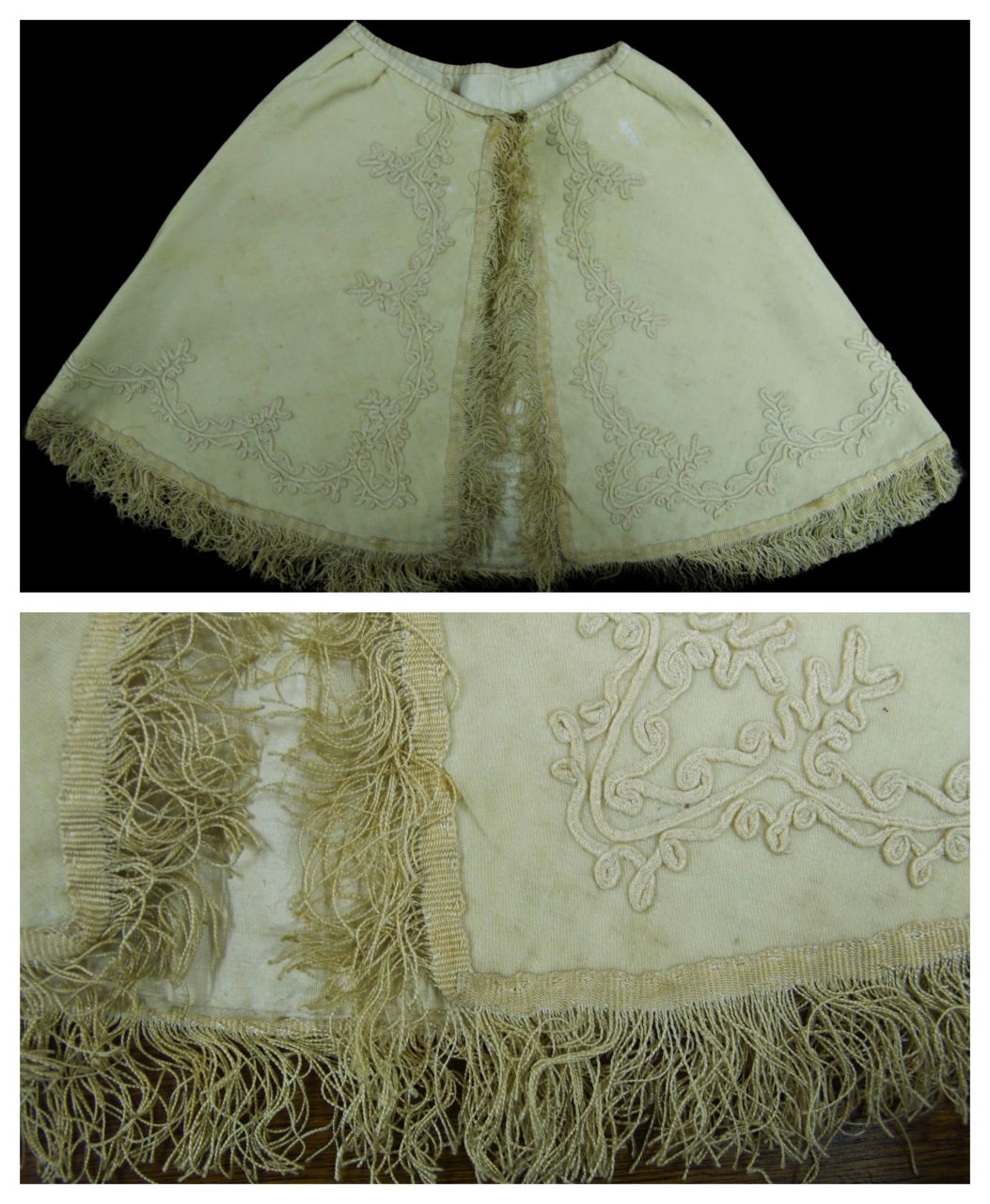 The collection also includes two christening garments that would have been especially suitable during the colder months to keep the baby warm on the way to and from the church. This illustrated item is a baby cape in fine cream-coloured wool, decorated with a silk fringe, lined with matching silk, and fastened at the neck with a hook. The decorations on this entirely hand-sewn garment feature a slender silk cord sewn into a complex festoon-shaped motif. It can be dated to the 1850s or 1860s, based on the stitching and decoration details. (Collection: Whitby Museum…, Costume Collection, GBS14). Photo: Viveka Hansen, The IK Foundation.
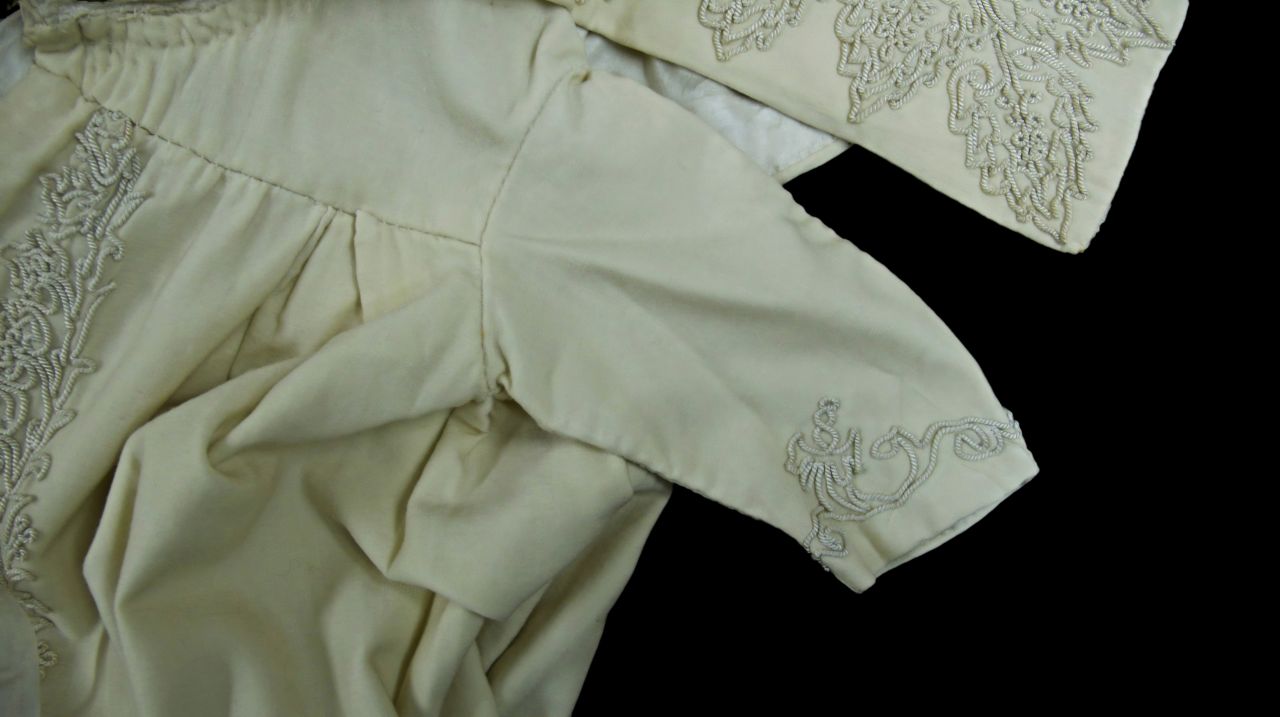 The second garment for a baby features similar decoration, this time crafted with cotton perle yarn into a leaf-like design that, based on its material and stitching details, likely dates from around 1900. This christening cloak, made of fine cream-coloured wool, is a wide, richly decorated cape; while the small matching baby jacket sewn inside would have provided extra warmth and helped the baby look particularly elegant both before and after the baptism. (Collection: Whitby Museum…, Costume Collection, 2005/48.5). Photo: Viveka Hansen, The IK Foundation.
 Apart from Christening gowns, small caps in various styles – a garment that could be used for this occasion and everyday wear – are the most common items in the collection. This may be explained by the fact that until the end of the 19th century, caps were an essential part of a baby’s outfit since this little headgear was commonly worn both day and night, including during baptisms. These caps are often beautifully decorated with satin stitch or broderie anglaise and usually finished with lace, although caps knitted or crocheted in fine, thin cotton yarn are also found. In many cases, it can be difficult to date these caps since the design has hardly changed over a long period, but if machine-sewn, they cannot be earlier than the 1850s. Handworked lace, in most cases, indicates an origin from the beginning of the 19th century.
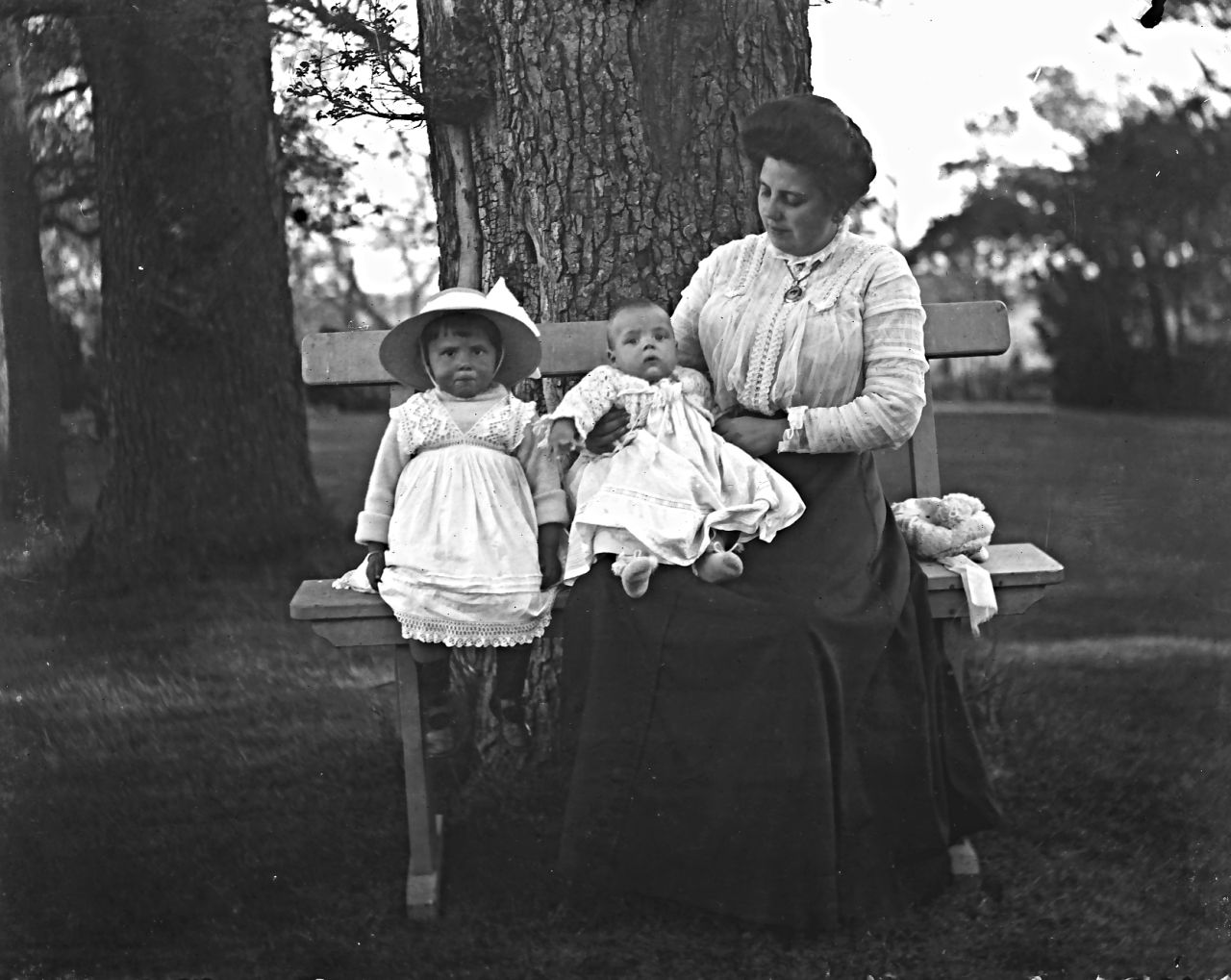 Like other local photographs from Whitby, it is possible that the baby dressed in white was photographed on the day of his or her christening. This picture from the Botham family’s collection of glass plates provides a good example of babies’ and toddlers’ clothes from around 1905, either purchased from one of the town’s shops specialising in baby clothing or made by a mother skilled at sewing, another relative, or a family servant. (Courtesy: Whitby Museum…, Photographic Collection, 2002/13.21).
Reflections from the earlier period – the 1830s to 1840s – show that a child’s early life can be traced through baptism and burial entries in the parish church registers of Whitby. This is exemplified by cases such as when the baby’s father worked as a local draper. Overall, young people made up most of the drapers in the 1841 census, with 16 of the 18 being forty years old or younger. Meanwhile, the six local linen drapers were aged between thirty and forty-five. Many of these active traders also appear in 1823, 1834, and 1840 town directories, the 1837 Poor Law Valuation, and the parish church registers. The younger men were likely to later advertise in the Whitby Gazette. One such individual was the 30-year-old tailor William Swales of Golden Lion Bank, who was already professionally active as early as 1835, as evidenced by the baptism of a child in the parish registers. The 40-year-old draper John Cassap of Baxtergate is mentioned during 1827-1834 in connection with the baptisms of five children and also appears in the 1837 valuation. It has also been possible to trace his exact contemporary, the tailor and draper James Frank of Flowergate, through the baptisms of five children in 1824-1832 and again in the 1837 valuation. His 17-year-old son, Thomas Frank, also appears as a tailor in the 1841 census. Meanwhile, the 60-year-old draper William Clarkson of Church Street, in addition to being described as a tailor at the baptisms of his seven children from 1823 to 1834 and mentioned in the directories of the same period and the 1837 valuation, was also one of the part-owners of the local shipping fleet. Even if children are often invisible in 19th-century written sources, baptismal entries in parish church registers are a clear exception. In my in-depth research on textile occupations in Whitby, this source repeatedly provided important historical facts, which also offered a clearer and more detailed understanding of an individual textile trader’s lifespan – such as for drapers, tailors, weavers, spinners, sailmakers, and other occupations.
Sources:
- Ashelford, Jane, The Art of Dress – Clothes and Society 1500-1914, London 2002.
- Hansen, Viveka, The Textile History of Whitby 1700-1914 – A lively coastal town between the North Sea and North York Moors’, London & Whitby 2015 (pp. 212-213, 243-244 & 266-267. | Appendix I. Parish Church Registers – Textile Occupations 1676-1837: pp. 387-394).
- Hartley, Marie & Ingilby, Joan, Life and Tradition in The Moorlands of North-East Yorkshire, West Yorkshire, 1990.
- Whitby Gazette, 1855-1914.
- Whitby Museum (Whitby Lit. & Phil.), Whitby, United Kingdom. | Costume Collection (studies of circa 25 christening gowns, one christening cape, and baby caps). | Library & Archive (Whitby Gazette, original papers, 14064, Tyerman Photograph Album & Parish Church Registers). | Photographic Collection (Sutcliffe collection & other local photographs). | Research made during the years 2006-2012.
- Whitby, North Yorkshire County Library, United Kingdom (Census 1841, microfilm).
More in Books & Art:
Essays
ISSN 2631-4746
The iTEXTILIS is a division of The IK Workshop Society – a global and unique forum for all those interested in Natural & Cultural History.
Open Access Essays by Textile Historian Viveka Hansen
Textile historian Viveka Hansen offers a collection of open-access essays, published under Creative Commons licenses and freely available to all. These essays weave together her latest research, previously published monographs, and earlier projects dating back to the late 1980s. Some essays include rare archival material — originally published in other languages — now translated into English for the first time. These texts reveal little-known aspects of textile history, previously accessible mainly to audiences in Northern Europe. Hansen’s work spans a rich range of topics: the global textile trade, material culture, cloth manufacturing, fashion history, natural dyeing techniques, and the fascinating world of early travelling naturalists — notably the “Linnaean network” — all examined through a global historical lens.
Help secure the future of open access at iTEXTILIS essays! Your donation will keep knowledge open, connected, and growing on this textile history resource.
For regular updates and to fully utilise iTEXTILIS' features, we recommend subscribing to our newsletter, iMESSENGER.
The iTEXTILIS is a division of The IK Workshop Society – a global and unique forum for all those interested in Natural & Cultural History.
Open Access Essays by Textile Historian Viveka Hansen
Textile historian Viveka Hansen offers a collection of open-access essays, published under Creative Commons licenses and freely available to all. These essays weave together her latest research, previously published monographs, and earlier projects dating back to the late 1980s. Some essays include rare archival material — originally published in other languages — now translated into English for the first time. These texts reveal little-known aspects of textile history, previously accessible mainly to audiences in Northern Europe. Hansen’s work spans a rich range of topics: the global textile trade, material culture, cloth manufacturing, fashion history, natural dyeing techniques, and the fascinating world of early travelling naturalists — notably the “Linnaean network” — all examined through a global historical lens.
Help secure the future of open access at iTEXTILIS essays! Your donation will keep knowledge open, connected, and growing on this textile history resource.
For regular updates and to fully utilise iTEXTILIS' features, we recommend subscribing to our newsletter, iMESSENGER.
The IK Foundation & Company Promoting Natural & Cultural History
|
Subscribe to our Newsletter | IK Global iMessenger |
Translate Page |



|
© The IK Foundation & Company 2026 - a truly European organisation since 1988 |
The IK
Workshop Society
Workshop Society
The Field
Station Lab
Station Lab
How to cite & Creative Commons
You are welcome to use the information and knowledge from
The IK Workshop Society, as long as you follow a few simple rules.
LEARN MORE & I AGREE
You are welcome to use the information and knowledge from
The IK Workshop Society, as long as you follow a few simple rules.
LEARN MORE & I AGREE
