
ikfoundation.org
The IK Foundation
Promoting Natural & Cultural History
Since 1988

- WELCOME
- THE IK WORKSHOP SOCIETY
- THE FIELD STATION LAB
- THE DONATION ROOM
- BOOKS & ART0


- CONTACT
iFellows Sign In
Find out more about becoming an iFellow...My Basket
Items: 0Total: €0.00

CURTAIN ARRANGEMENTS
– at a Manor House in 1758
ESSAYS No: CIII | March 10, 2019 | By Viveka Hansen
Curtains will be looked at more closely in this essay, studied from an 18th century Inventory at Christinehof Manor House in southernmost Sweden. That such listed fabrics would have kept out draught and added warmth to the high ceiling halls, drawing rooms, and chambers is doubtful in most cases, as the majority of the curtain arrangements seem to have been of sheer or even transparent qualities. Furthermore, the ground floor lacked curtains altogether, whilst on the first floor nine rooms and on the second floor six rooms were without window hangings. This historical handwritten document is also evidence that curtains were not seen as a necessary interior detail, even in the wealthiest of Swedish aristocratic homes in 1758.
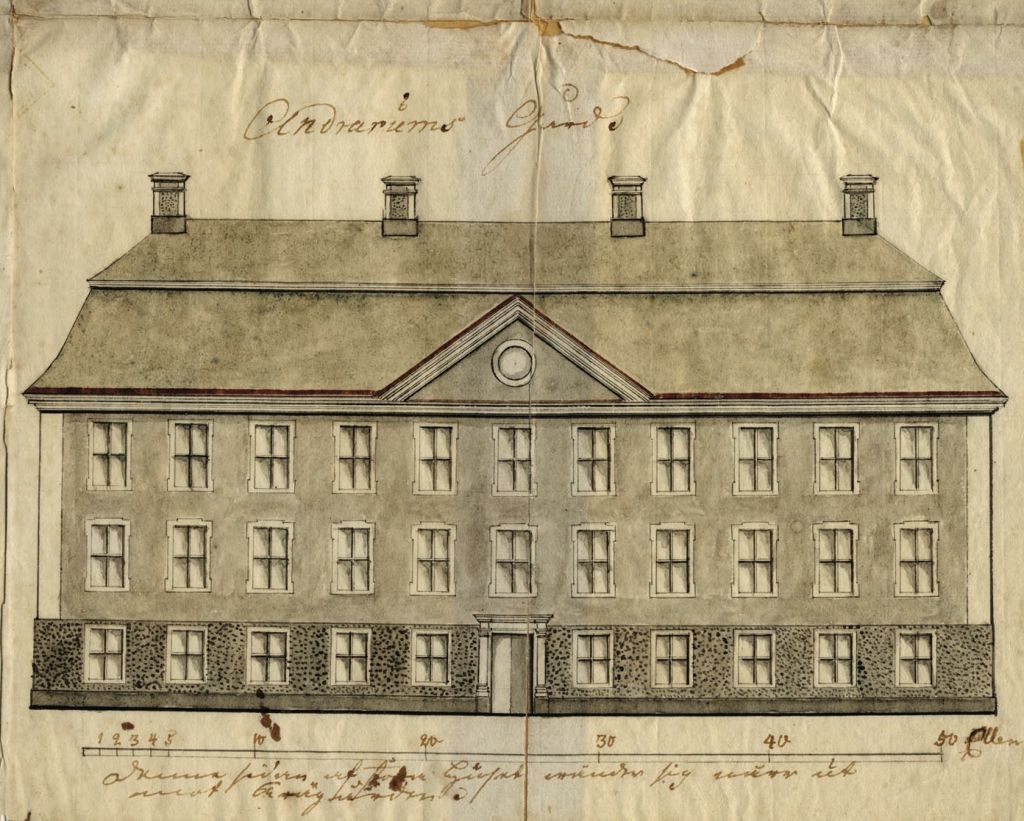 This original drawing shows the planned north facade of “Andrarums Gård’ in 1737, re-named Christinhof manor house after the death of Christina Piper (1673-1752) as a memory of her founding of the Piper family’s estate in tail. The drawing gives an idea of the large amount of windows for a three storey manor house with two wings, even if some minor details were changed before the building work started and up to it was finished in the autumn of 1741. A notation from the same time additionally gives a view of the original windows: ’Four window frames of oak: 48 smaller window frames of pine: glass squares of 12 glasses in every window frame’. Most windows were also added with indoor wooden-panelled shutters. However, at what time the present-day windows with six squares instead of 48 were altered is unknown, but most probably after the Inventory was written in 1758. (From: Mannerstråle…Anno 1741, 1991).
 The exact design of each and every curtain is not known, but judging by the detailed descriptions in the Inventory, a variation of arrangements was in use. Even if sheer fabrics seem to have been preferred, the exception was a diaper woollen or silk quality for a total of eleven windows. For example, the Countess’ Drawing room was noted as ‘4 curtains for the windows of diaper to tie up and down with tassels, braids and cords’ – a style in vogue already in the 17th century. In her adjoining bedchamber on the first floor, some puzzling notations were included. ‘One pair of diaper day curtains with thread fringes and tassels’ when the room actually had two windows, together with the odd word ‘day’, as the curtains must have had some form of use during the night as well. According to an additional note in 1767, the same room was added with ‘one pair of linen roller-blinds’.
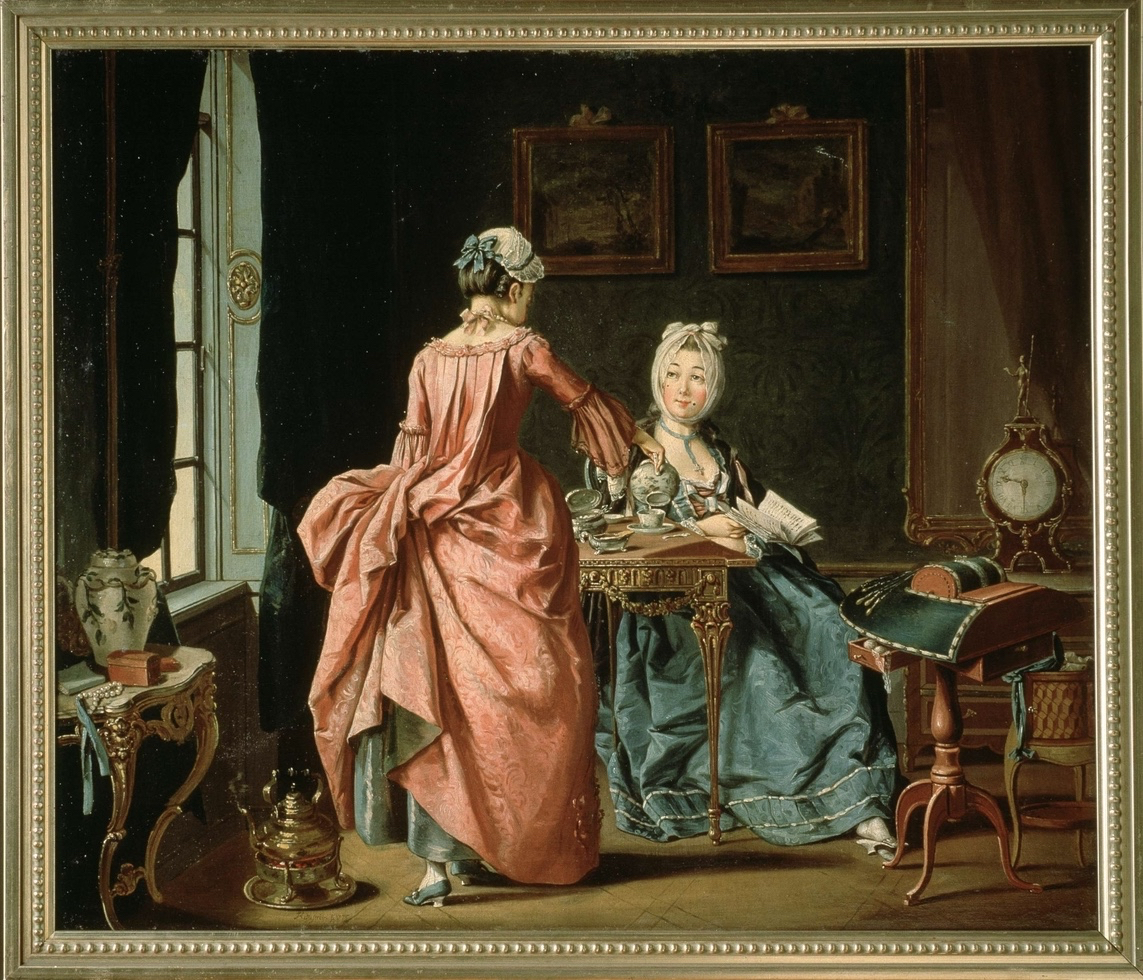 This somewhat later oil on canvas by Pehr Hilleström in 1775 may be studies from several angles of a wealthy home in 18th century Sweden. The consumer revolution is present in silk fabrics, pearls, porcelain, gilded furniture and much more in the luxurious interior where the lady is served tea or coffee by the almost equally fashionable lady’s maid or female relative. The depiction of her relaxed everyday life also included some useful or industrious occupations – as reading and bobbin-lace making. Whilst the dark green hanging curtains loosely were tied back to each side of the window to give a pleasant light and present a decorative elegance of the home. (Courtesy of: Nordic Museum… NM.0177655*1, Digitalt Museum).
The sheerer qualities were dominated by the ‘gossamer cloth’, which referred to an almost transparent linen, listed in the 1758 Inventory for 14 curtains. Together with four ‘gossamer cloth from Hälsingland’ and at one occasion ‘brocaded gossamer cloth from Hälsingland’. These textiles were purchased/ordered from the well-established Linen Manufacture of Flor in Hälsingland province or, even more likely, via the same manufacturer’s linen shop (Flors Linnebod). This shop was situated at the marketplace Riddarhustorget in Stockholm, close by for shopping to one of the Piper family’s other residences, named “The Palace”. These delicate curtains lacked all sorts of additional tassels, ribbons or cords and were of a light-hanging model. Colours mentioned in the Inventory are ‘white and green’, ‘blue and white’ or ‘white’ or ‘green’ only. An arrangement in Baron Unger’s chamber on the second floor gives further details of interest. The room had one window, but the listing included ‘2 old diaper curtains’ and ‘2 white gossamer cloth ditto’. The heavier old diaper quality was probably useful for draught and for darkening the room during bright summer nights. The more modern ‘gossamer cloth’ of linen must primarily have been a decorative feature in the guest room.
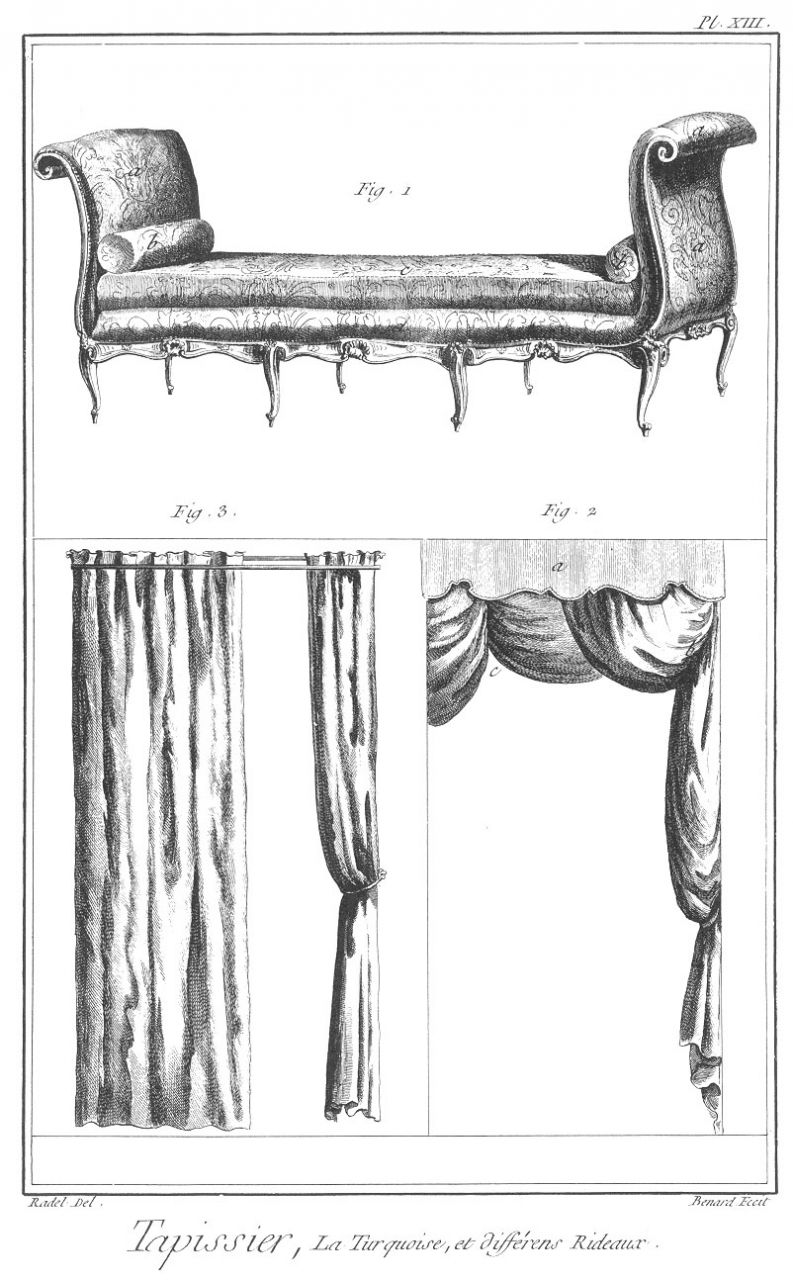 These drawings from an 18th century French encyclopaedia, include illustrative examples of three curtain arrangements (Fig 2 & 3). A simple hanging, a hanging model drawn to the side and tied with a cord together with a more complex drapery added with a lambrequin. All probably being similar in style to the ones listed in the 1758 Inventory. (From: ‘Encyclopédie ou Dictionnaire raisonné des sciences – Les Arts et Métiers, Tapissier’… 1771).
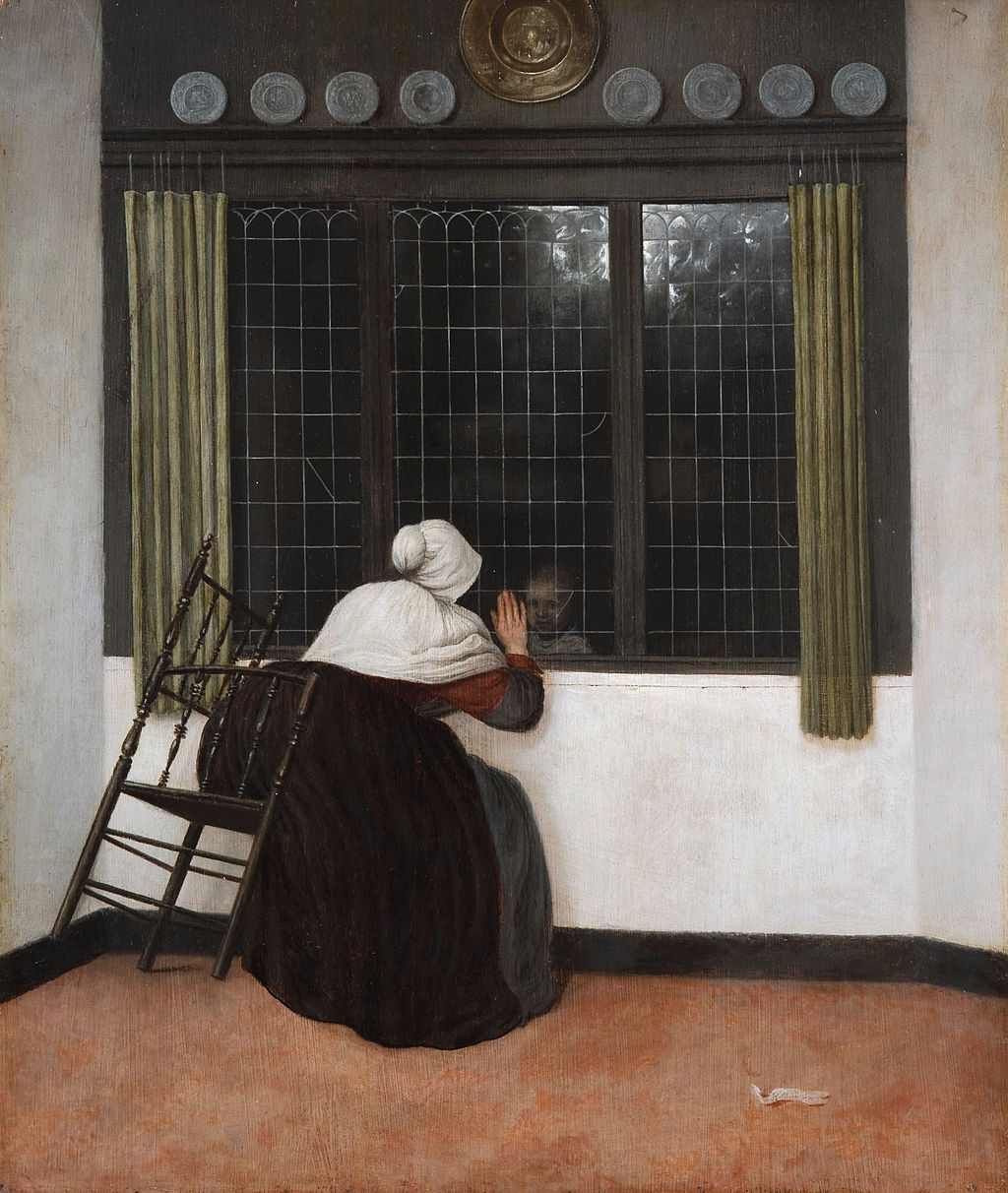 Already in mid-17th century curtains seem to have been quite common on the Continent, judging by a brief study of Dutch paintings. However, in Sweden the large amounts of fabrics needed for curtains were still regarded as a nonessential extra expense hundred years later judging by this 1758 inventory among other contemporary primary sources – or maybe one preferred to show off the windows and use the indoor wooden-panelled shutters for draught protection. | Oil on panel ‘Femme à la fenêtre’ ca 1654-62 by the Dutch painter Jacob Vrel. (Courtesy of: Foundation Custodia (collection Frits Lugt), Paris. Wikimedia Commons).
In addition to the curtain arrangements at Christinehof manor house, six roller-blinds of linen were listed – either green, yellow or red and fitted with ‘cords and iron hooks’. In one of the most representative rooms the First Drawing room on the first floor, windows added with blinds of this kind also had ‘four cotton curtains with their iron rods’. Hanging curtains on iron rods appears to have been a typical arrangement in manor houses, as detected in inventory lists written as early as the 1680s. It may also have been a natural choice to demonstrate one’s high standard of living by using fine cottons in a room visited by wealthy guests, which could easily be admired from the garden side of the house. Cotton was still regarded as a luxury item in Sweden during the mid-18th century, as these delicate fabrics were approximately four times more expensive than the linen qualities of equal standard.
This is the sixth essay based on the Inventory dated 1758 at Christinehof Manor House. Quotes from the document are translated from Swedish to English.
Sources:
- Encyclopédie ou Dictionnaire raisonné des sciences – Les Arts et Métiers, Tapissier, Plate XIII, Vol. 9, Paris 1771.
- Hansen, Lars, Piper, Carl & Piper, Christina, Tankebok, Piperska Handlingar No. 4, London & Christinehof 2016.
- Hansen, Viveka, Inventariüm uppå meübler och allehanda hüüsgeråd sid Christinehofs Herregård upprättade åhr 1758, Piperska Handlingar No. 2, London & Whitby 2004 (pp. 19-20 & 38-62).
- Hansen, Viveka, Katalog över Högestads & Christinehofs Fideikommiss, Historiska Arkiv, Piperska Handlingar No. 3, London & Christinehof 2016.
- Historical Archive of Högestad and Christinehof (Piper Family Archive, no D/Ia/Inventory 1758 & unnumbered original drawing from 1737).
- Karlson, William, Ståt och Vardag – i Stormaktstidens herremanshem, Lund 1945 (C17th curtains pp. 47-51).
- Mannerstråle, Carl-Filip, Nya huset i Andrarum Anno 1741, Piperska Handlingar No. 1, Christinehof 1991 (pp. 21 & 26-27).
Essays
ISSN 2631-4746
The iTEXTILIS is a division of The IK Workshop Society – a global and unique forum for all those interested in Natural & Cultural History.
Open Access Essays by Textile Historian Viveka Hansen
Textile historian Viveka Hansen offers a collection of open-access essays, published under Creative Commons licenses and freely available to all. These essays weave together her latest research, previously published monographs, and earlier projects dating back to the late 1980s. Some essays include rare archival material — originally published in other languages — now translated into English for the first time. These texts reveal little-known aspects of textile history, previously accessible mainly to audiences in Northern Europe. Hansen’s work spans a rich range of topics: the global textile trade, material culture, cloth manufacturing, fashion history, natural dyeing techniques, and the fascinating world of early travelling naturalists — notably the “Linnaean network” — all examined through a global historical lens.
Help secure the future of open access at iTEXTILIS essays! Your donation will keep knowledge open, connected, and growing on this textile history resource.
For regular updates and to fully utilise iTEXTILIS' features, we recommend subscribing to our newsletter, iMESSENGER.
The iTEXTILIS is a division of The IK Workshop Society – a global and unique forum for all those interested in Natural & Cultural History.
Open Access Essays by Textile Historian Viveka Hansen
Textile historian Viveka Hansen offers a collection of open-access essays, published under Creative Commons licenses and freely available to all. These essays weave together her latest research, previously published monographs, and earlier projects dating back to the late 1980s. Some essays include rare archival material — originally published in other languages — now translated into English for the first time. These texts reveal little-known aspects of textile history, previously accessible mainly to audiences in Northern Europe. Hansen’s work spans a rich range of topics: the global textile trade, material culture, cloth manufacturing, fashion history, natural dyeing techniques, and the fascinating world of early travelling naturalists — notably the “Linnaean network” — all examined through a global historical lens.
Help secure the future of open access at iTEXTILIS essays! Your donation will keep knowledge open, connected, and growing on this textile history resource.
For regular updates and to fully utilise iTEXTILIS' features, we recommend subscribing to our newsletter, iMESSENGER.
The IK Foundation & Company Promoting Natural & Cultural History
|
Subscribe to our Newsletter | IK Global iMessenger |
Translate Page |



|
© The IK Foundation & Company 2026 - a truly European organisation since 1988 |
The IK
Workshop Society
Workshop Society
The Field
Station Lab
Station Lab
How to cite & Creative Commons
You are welcome to use the information and knowledge from
The IK Workshop Society, as long as you follow a few simple rules.
LEARN MORE & I AGREE
You are welcome to use the information and knowledge from
The IK Workshop Society, as long as you follow a few simple rules.
LEARN MORE & I AGREE
