
To place one’s initials etc., on possessions or produced goods is a tradition stretching back through Nordic heritage, including many woven interior textiles for the home and the young woman’s dowry. Other details of importance for double interlocked tapestries or “rölakan” – were decorative tassels or ribbons placed in the corners of the cushions – a technique that was practised in many parts of Scandinavia during the 18th and 19th centuries. The aim of this essay is to briefly depict and discuss some decorative as well as practical details from these beautiful textiles.
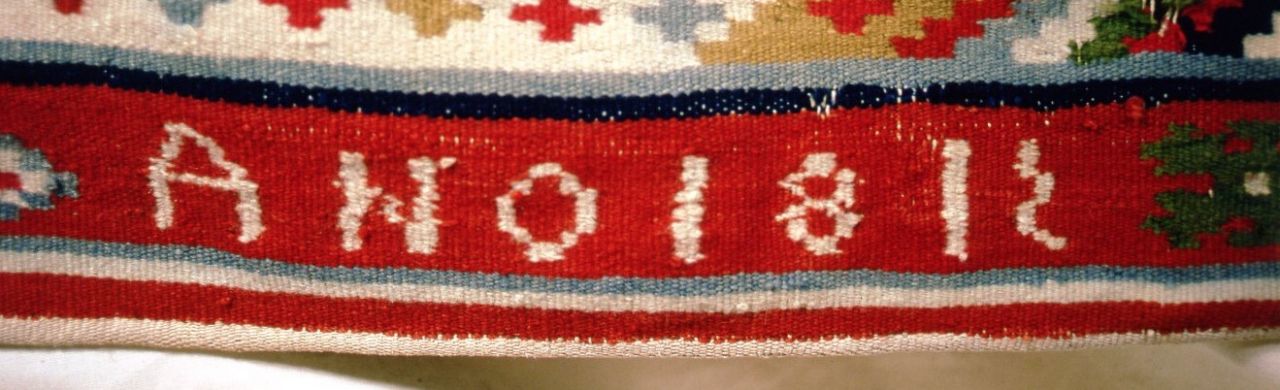 Part of a border with the woven marking,’ ANO 1812,’ on an impressive bedcover with trees and deer within eight-sided frames. Färs district, Skåne. (Owner: Malmö Museum). Photo: The IK Foundation, London.
Amongst the documented double interlocked tapestries – from the research of circa 1600 examples – it can be stated that barely 20% of the textiles have said markings. These are positioned in various ways; on an empty bottom surface alongside other smaller motifs, by replacing the motif with markings, in the borders or within a star pattern. The markings are comprised of dates, names, places of birth etc. These signatures were typically added during the weaving process, but also embroidered markings were used. It is worth noting that certain patterns, especially complex and compact weaves had, in turn, a much higher percentage of markings. Examples are “Bäckahäst” (a water spirit in popular belief) within an eight-sided frame 84%, “Skyttsstjärnan” (star from Skytts district) 83%, bedcover with deer and tree within an eight-sided frame 64% and horseman 60%.
![This very similar bedcover, with trees and a lion within eight-sided frames, emanates from the same area. But has instead an embroidered marking in the border, which says; ‘KAD ANO 1805.’ The first three initials imply a woman’s name, unknown who but for example, “Kristina Anders Dotter” [Daughter]. (Private ownership). Photo: The IK Foundation, London.](https://www.ikfoundation.org/uploads/image/2-ch-82.jpg) This very similar bedcover, with trees and a lion within eight-sided frames, emanates from the same area. But has instead an embroidered marking in the border, which says; ‘KAD ANO 1805.’ The first three initials imply a woman’s name, unknown who but for example, “Kristina Anders Dotter” [Daughter]. (Private ownership). Photo: The IK Foundation, London.
This very similar bedcover, with trees and a lion within eight-sided frames, emanates from the same area. But has instead an embroidered marking in the border, which says; ‘KAD ANO 1805.’ The first three initials imply a woman’s name, unknown who but for example, “Kristina Anders Dotter” [Daughter]. (Private ownership). Photo: The IK Foundation, London.For cushions placed on chairs, benches and carts, a backing material with filling was needed to be placed between these two cloths to make the cushion as comfortable and warm as possible. Bedcovers were, however, for the most part not stuffed. The back of the textile was usually more coarse and simpler in contrast to the decorative front on show.
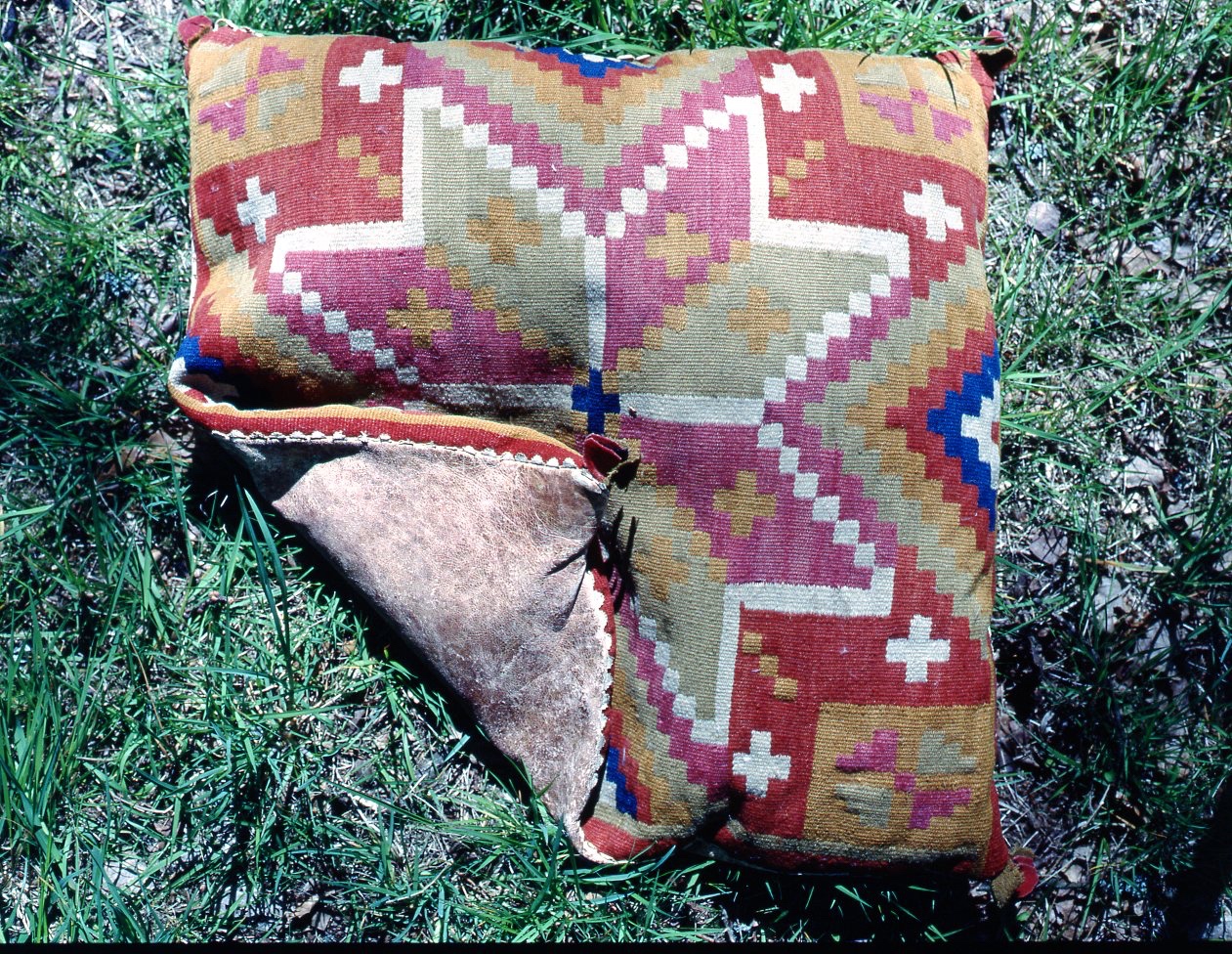 A chair cushion, with an eight-sided star, whilst the backing of leather has an unusually beautiful white leather border as an extra decoration. East Göinge district, Skåne. (Owner: Broby hembygdsförening). Photo: The IK Foundation, London.
Several techniques and materials are represented, but the most common is a weft ribbed fabric into borders, followed by rosepath and other weaving techniques typical for respective areas or leather. The studies at museums and homestead museums showed that few cushions (less than 10%) still retain their padding, dominated by feathers, straw, reeds, horsehair and grass or other easily acquired materials.
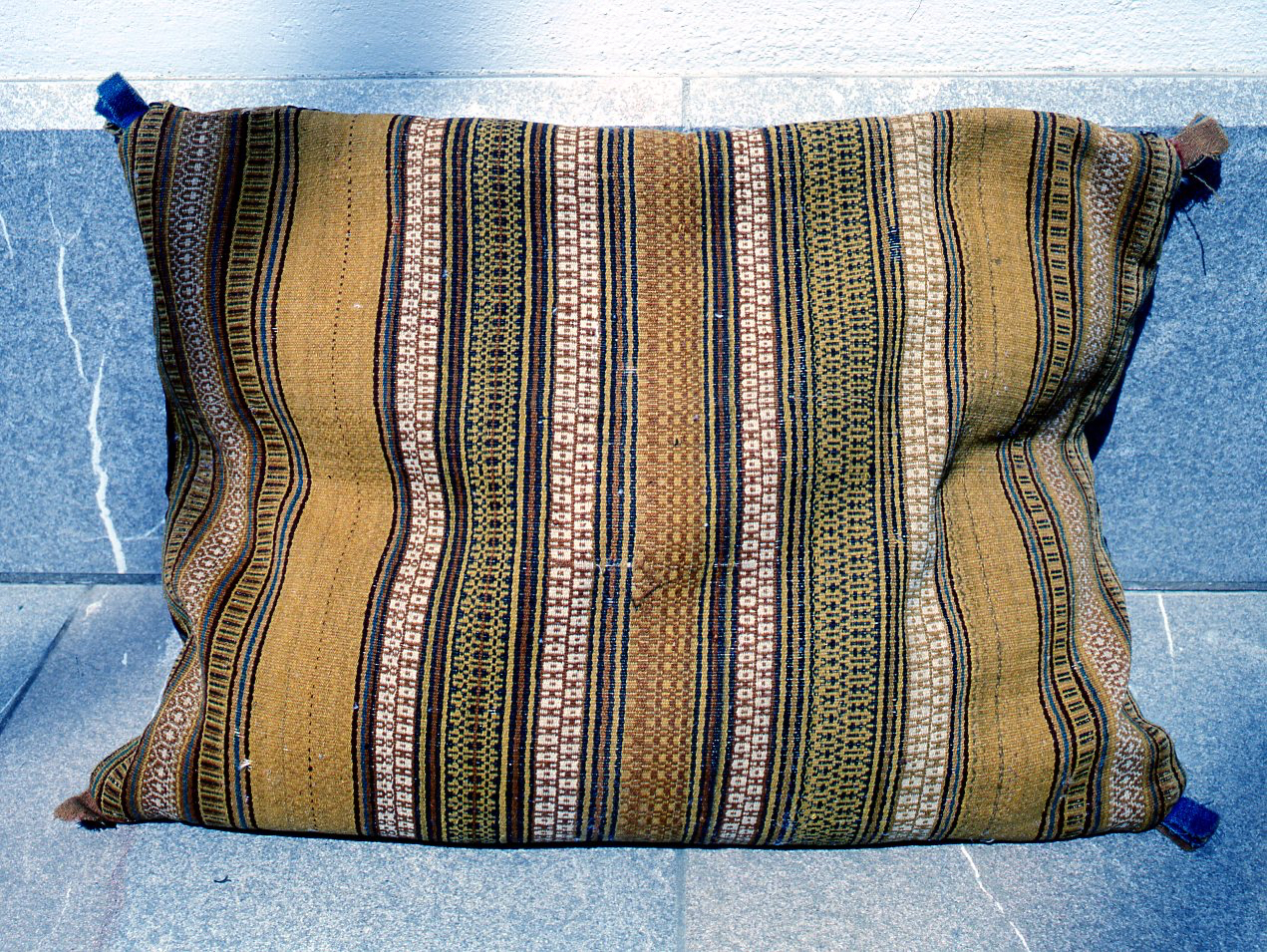 Cushion for a cart from south eastern Skåne with rosepath as the back, a usual technique in this part of the province. (Private ownership). Photo: The IK Foundation, London.
Tassels and ribbons, which decorate the corners of cushions in all sizes, were very common, whilst bedcovers lacked this decoration. The corner tassels had more than a decorative reason, as they had a strengthening effect on the pillow's weakest point. Ribbons, tassels, fringes, balls, lace, etc. All served these two important purposes; to make the cushion aesthetically pleasing and durable.
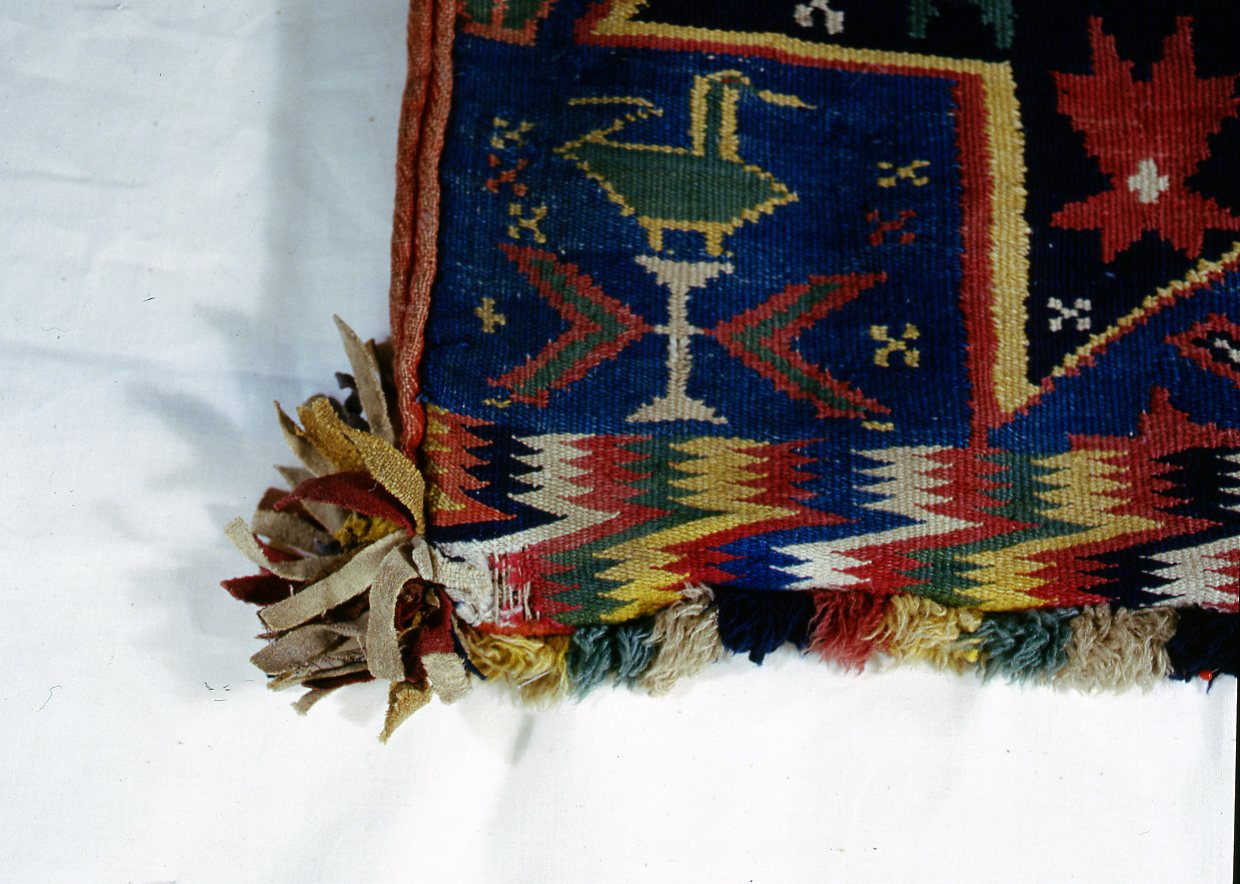 “Kavelfrans” (napped edgings), corner tassel of cloth and a decorative border. On a “rölakan” cushion from Skytts district, Skåne. (Owner: Malmö Museum). Photo: The IK Foundation.
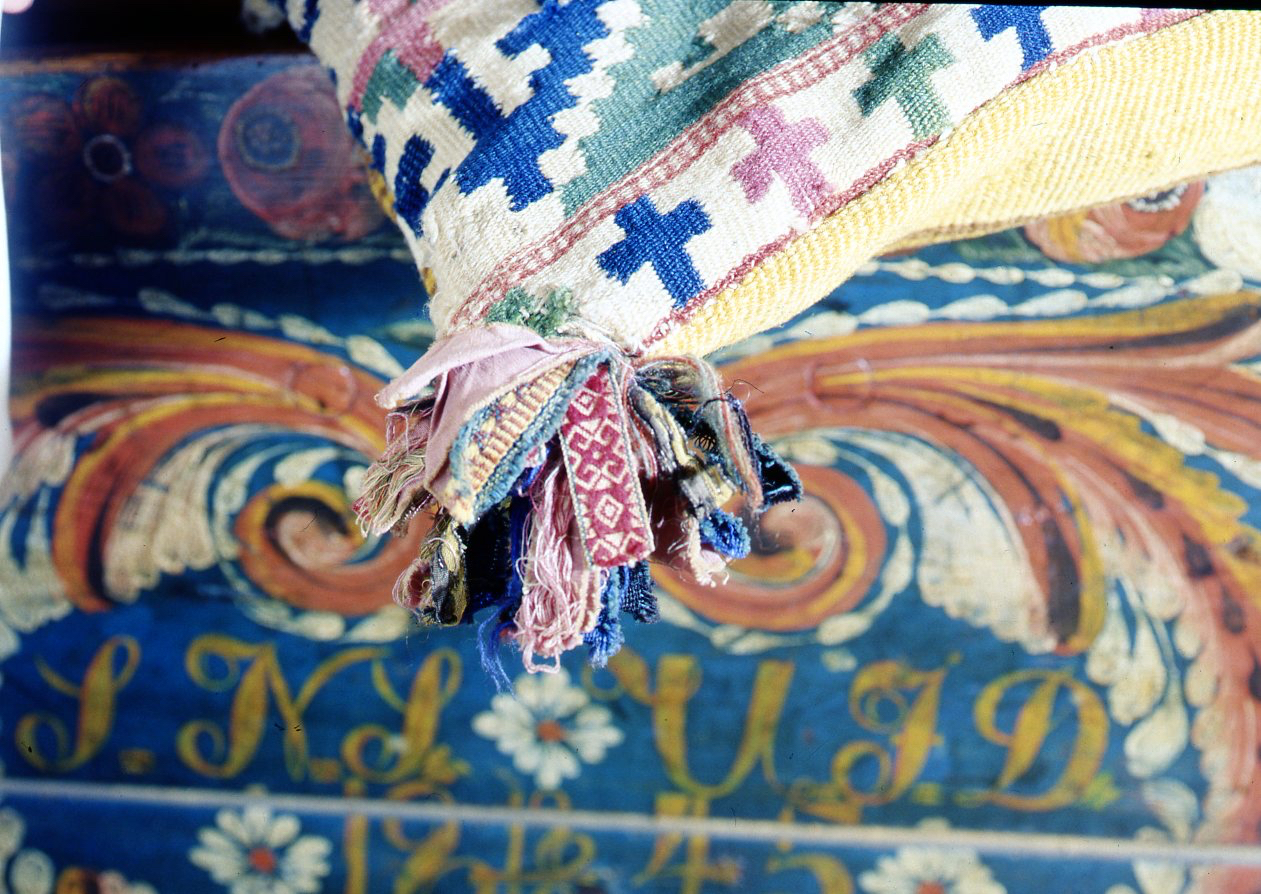 An unusually decorative corner tassel comprised of leftover cloth pieces and residue from paxxxttern-woven ribbons, on a cushion from south eastern Skåne. (Owner: Österlen museum). Photo: The IK Foundation, London.
Sources:
- Hansen, Viveka, Textila Kuber och Blixtar – Rölakanets Konst och Kulturhistoria, Christinehof 1992 (pp. 60-70).
- Hansen, Viveka, Swedish Textile Art, London 1996.