
ikfoundation.org
The IK Foundation
Promoting Natural & Cultural History
Since 1988

- WELCOME
- THE IK WORKSHOP SOCIETY
- THE FIELD STATION LAB
- THE DONATION ROOM
- BOOKS & ART0


- CONTACT
iFellows Sign In
Find out more about becoming an iFellow...My Basket
Items: 0Total: €0.00

HISTORICAL REPRODUCTIONS
– A Weaving Tradition: “Gåsögon” or Lozenge Twill
ESSAYS No: CCXVIII | April 2, 2026 | By Viveka Hansen
Twill weaving has many variations; one is a reversible diamond-shaped lozenge twill on four shafts – named “gåsögon” since at least 250 years back in Sweden. Whilst this decorative technique evidently has a much longer history in the Nordic area, due to excavated finds of fragmented cloth from the Viking Age. This picture essay, however, will focus on my own weaving experience as a handicraft using this technique, introduced with a few historical reflections dating back to the mid-19th century. The planning and making in a cultural context also aim to give a glimpse of such long-lived traditions, which gradually changed and even became intertwined with industrialisation over several generations. Hands-on skills, attention to detail, creative work, gathering for the dowry and educational weaving – all were important for producing towels, tablecloths, napkins and other furnishing textiles for the home.
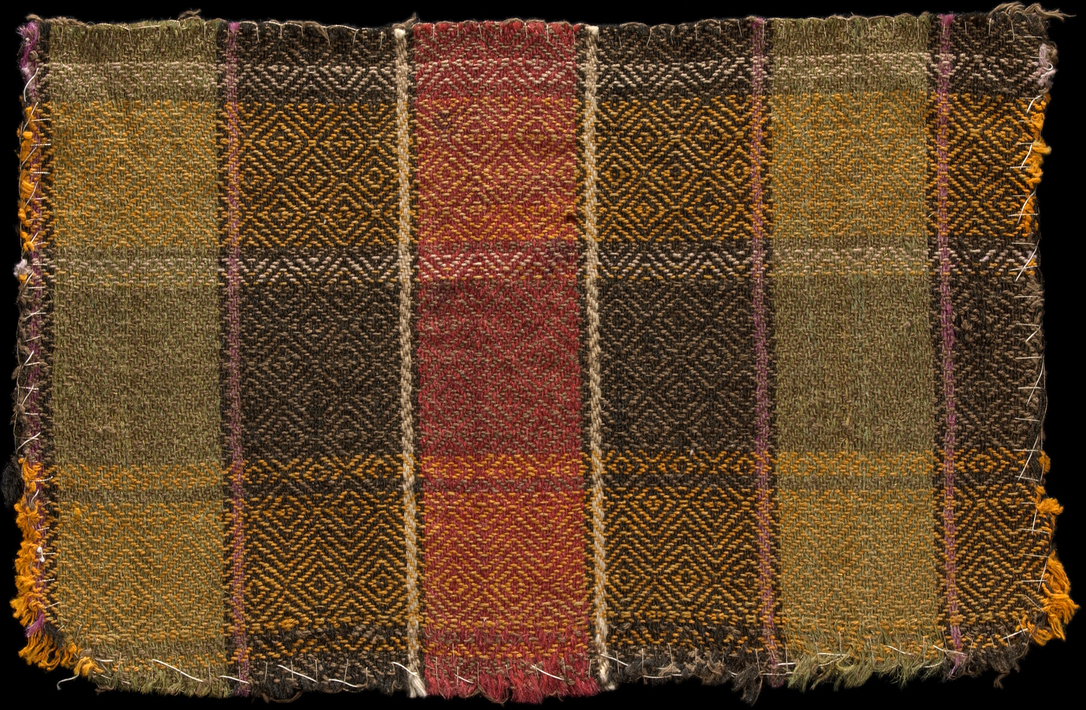 This carefully constructed handwoven composition in “gåsögon”, circa 1860-1900, is believed to be a remnant of a bedcover, originating from Äppelbo parish, Dalarna province, in central Sweden. The intense orange colour is probably chemically dyed, and the use of machine-spun cotton threads indicates that the bedcover was woven after the year 1860. For the striped warp (horizontal in this picture), several colours of cotton yarn were used, while the weft includes hand-spun wool and cow hair, and the district white lines were woven with three spooled threads of white cotton yarn. In this twill variation, with its diagonal lines changing direction in both warp and weft, the typical diamond-shaped design is clearly visible in this textile. The uneven overcasting around the extant fabric sample was probably performed later.| Given as a gift to the Nordic Museum in 1926. (Courtesy: The Nordic Museum, Stockholm. NM.0157990. DigitaltMuseum).
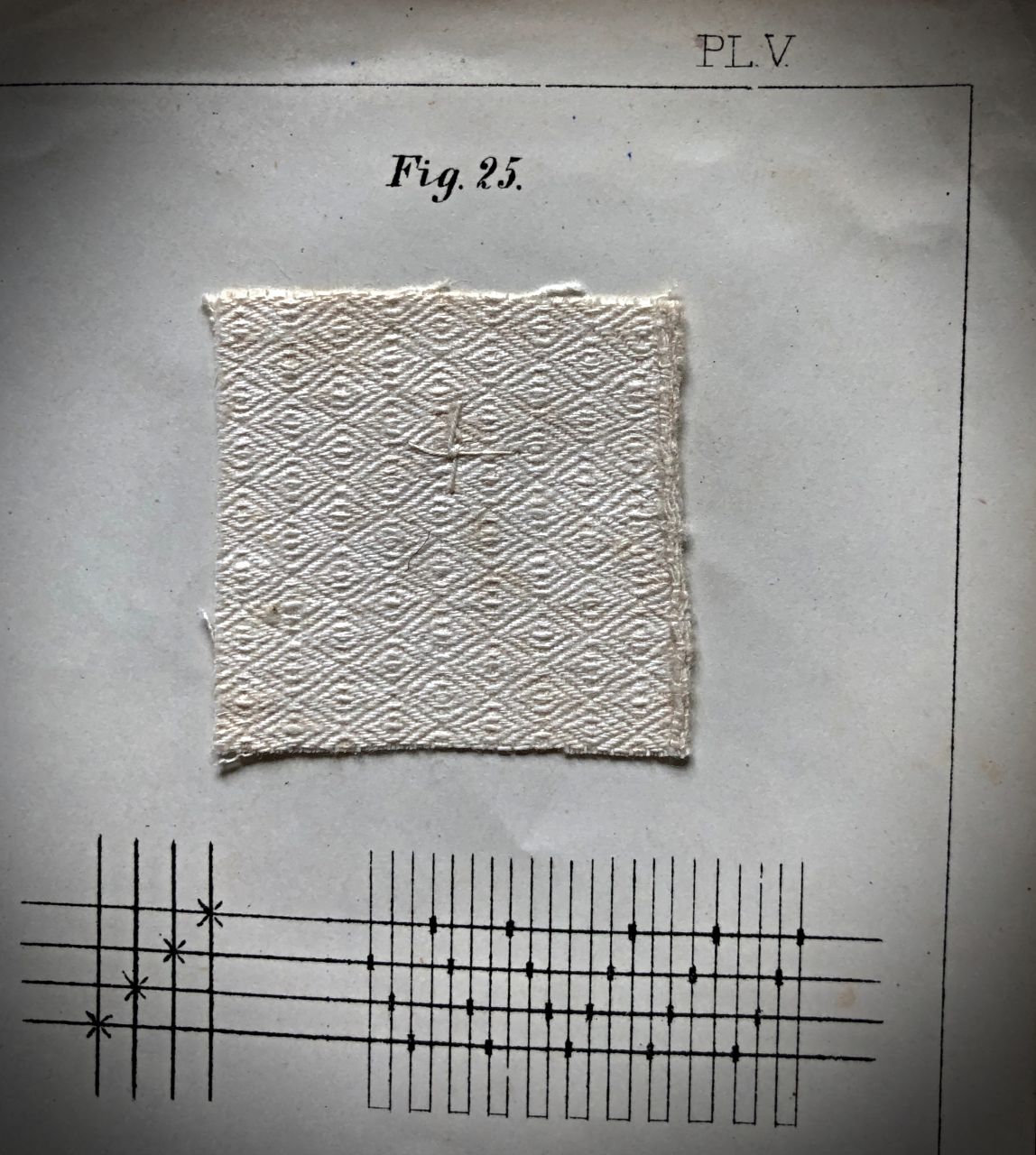 During a period of increasing industrialisation, several books were published to promote traditional hand weaving in Sweden. This informative example was published in 1873 via a central committee and the itinerant weaving teacher Anna Wallin in Stockholm County. Due to popular demand to learn more about this handicraft during her courses in 1871-72, she wrote an eight-page leaflet that included 47 weaving guides and attached textile samples for each technique. Her aim was educational, and she wanted her present students and future interested young women to learn practical techniques for weaving household linen and carpets, which could be woven on ordinary looms still common in many Swedish countryside homes in the 1870s. Among the 47 samples, this delicately woven “gåsögon” was included on a white cotton warp and weft, together with the diagrammed threading of the warp on four shafts to the right and the tie-up of the four treadles to the left. It is notable that, when this sample book was published, the weaving term “gåsögon” had been in use for at least 100 years. This is evident via the listing of ‘gåsögon mönster’ (gåsögon motifs) in an estate inventory dated 1781 in Växjö (Småland province), according to the Swedish Academy Dictionary. (From: Wallin…1873, Pl. V. Fig. 25). Photo and book collection: Viveka Hansen, The IK Foundation.
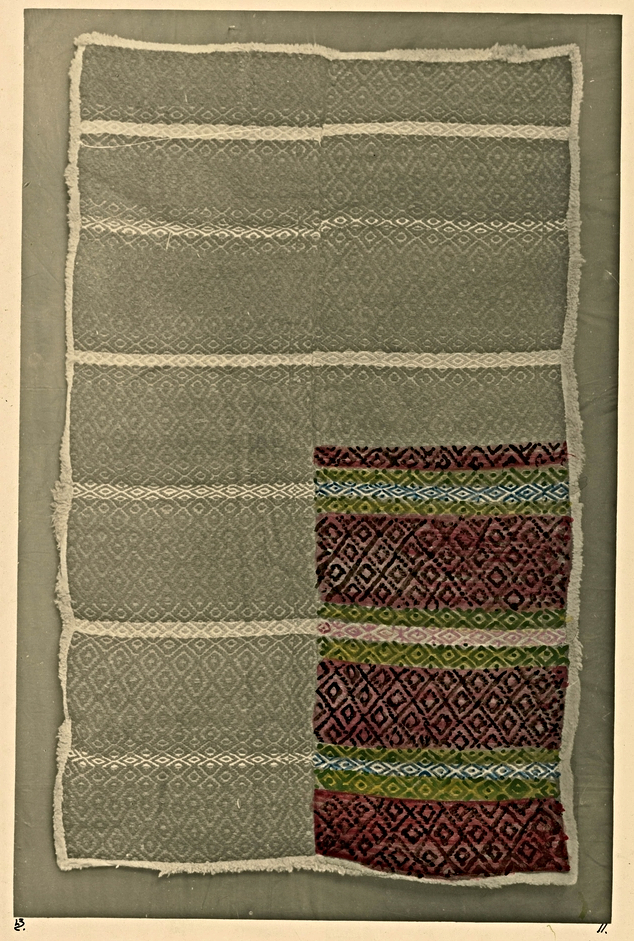 This handwoven bedcover, with the upper side in the techniques “gåsögon” and rose path, whilst the back is lined with a sheep felt for warmth, was photographed and partly coloured in the early 20th century. It was part of an almost monumental inventory of the country people’s textiles in Sweden, compiled by Lilli Zickerman (1858-1949) during 1910-1932. Today, the originals are kept at the Nordic Museum in Stockholm, comprising approximately 24,000 written records, sketches, and black-and-white photographs, including many partly hand-coloured pictures, such as this illustrated bedcover. The geometric design measures 138 cm × 205 cm and was woven on a linen warp with a wool-and-cow-hair weft, at an unknown date. This multicoloured textile is evidence that the “gåsögon” technique’s distinctive geometric design was popular on a variety of household textiles. On the coarsest of bedclothes, but also fine linen tablecloths during the 19th century.|Sunnerbo district, Småland province, Sweden. (Courtesy: Hemslöjdens Samlingar, Zickermans studiesamling. HSZ.80-07528. DigitaltMuseum).
 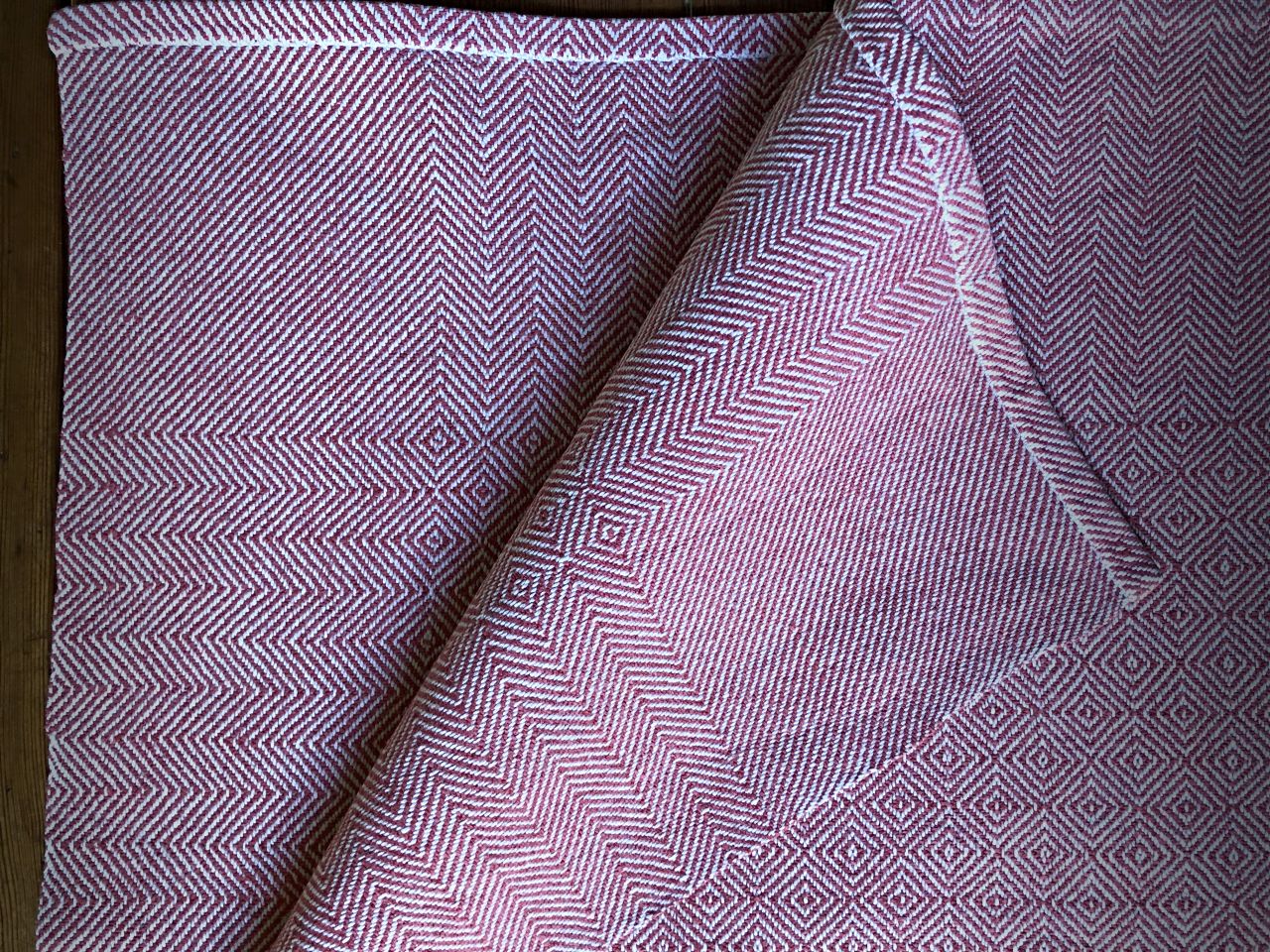 My historical reproductions of the “gåsögon” technique are introduced by this hand-woven tablecloth, measuring 110 cm x 110 cm, made of cottolin yarn (machine-spun with a mix of cotton and flax fibres), with a white warp and red weft. The aim of adding a long-lasting textile to one’s home was the same as it was 150-200 years ago; however, two aspects of the weaving technique, in particular, differ from the 19th-century weavers’ options. Firstly, the cottolin yarn was unavailable, so a cotton warp and linen weft were probably preferred or linen yarn for both warp and weft. Handlooms used in domestic settings also traditionally had a limited width, so a tablecloth of this size was woven in half-width. After the weaving, two identical pieces of fabric were stitched together with the finest stitches. (Private ownership). Photo and woven tablecloth: Viveka Hansen, The IK Foundation.
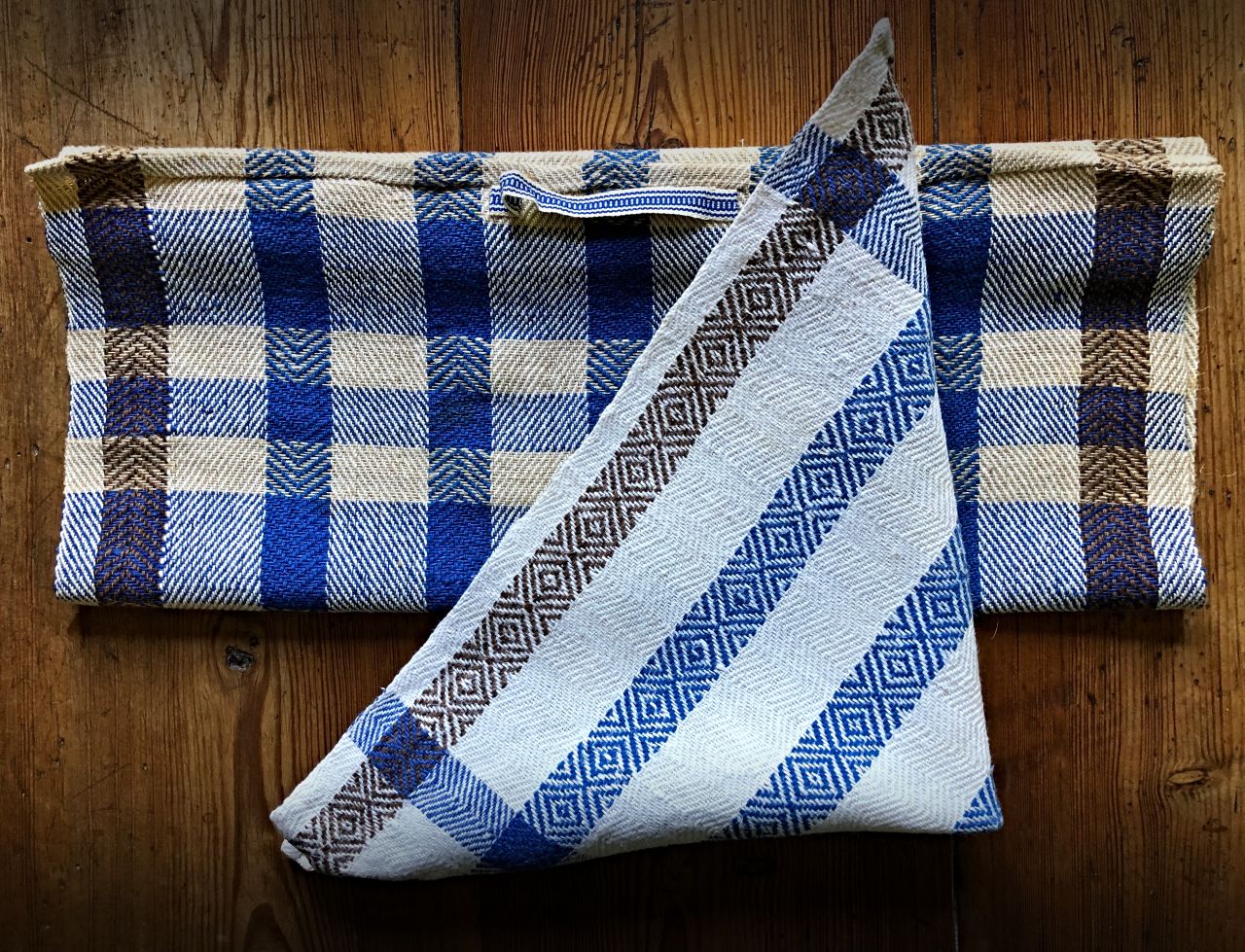 A second attempt at the technique used two towels, with a cotton warp and a linen weft. This is a variation of the technique “gåsögon,” with the threading arranged in different groups to produce a striped effect in this twill variant. The visible difference between the two depicted towels was achieved by the shedding order and the chosen colour of the linen weft thread. The towel at the back was woven in chevron twill; that is, the shedding order was repeated as 1, 2, 3, 4, and a light brown weft thread was used. Whilst in the towel at the front, woven on the same warp, white linen yarn was used for the weft, and the shedding order was turning at regular intervals (1, 2, 3, 4, 1, 2, 3, 4, 3, 2, 1, 4, 3, 2, 1 and so on) to get the diamond-shaped “gåsögon” design. (Private ownership). Photo and woven towels: Viveka Hansen, The IK Foundation.
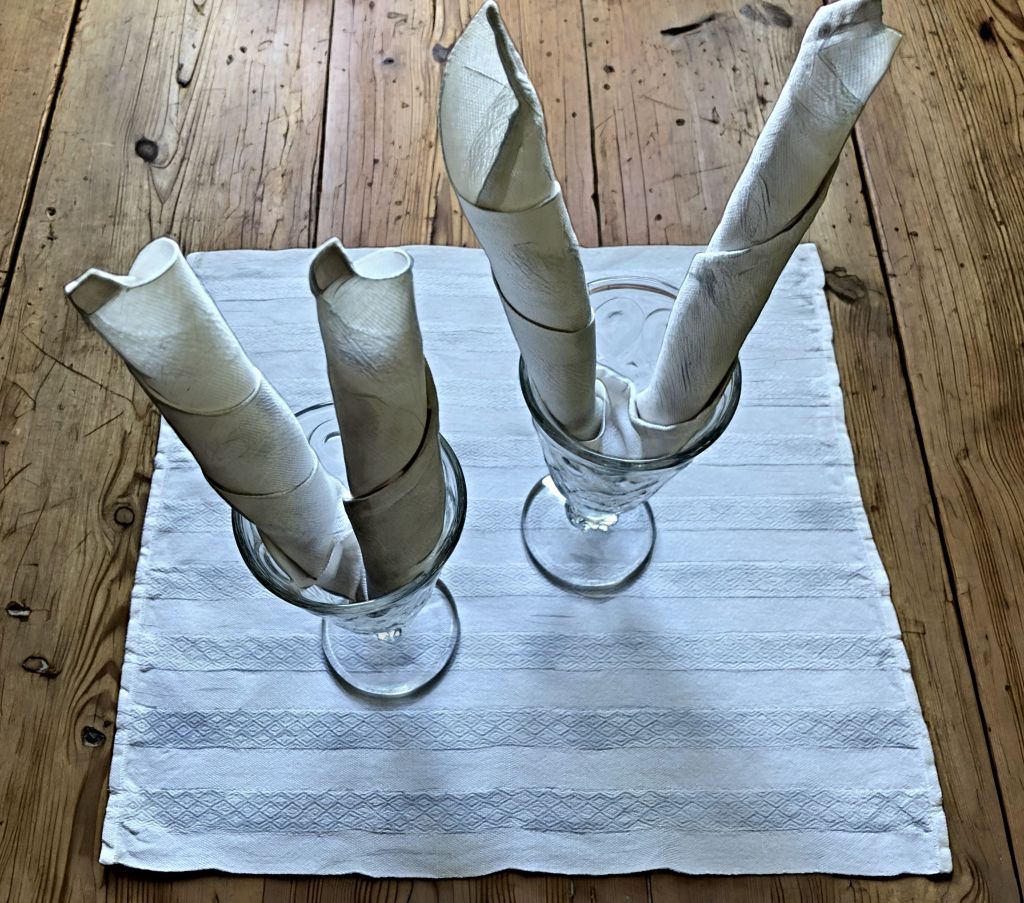 Twelve napkins of “gåsögon” and tabby, woven on my handloom more than 40 years ago, are still in use over and over again in the household. A close-up image of the design is below. (Private ownership). Photo and woven napkins: Viveka Hansen, The IK Foundation.
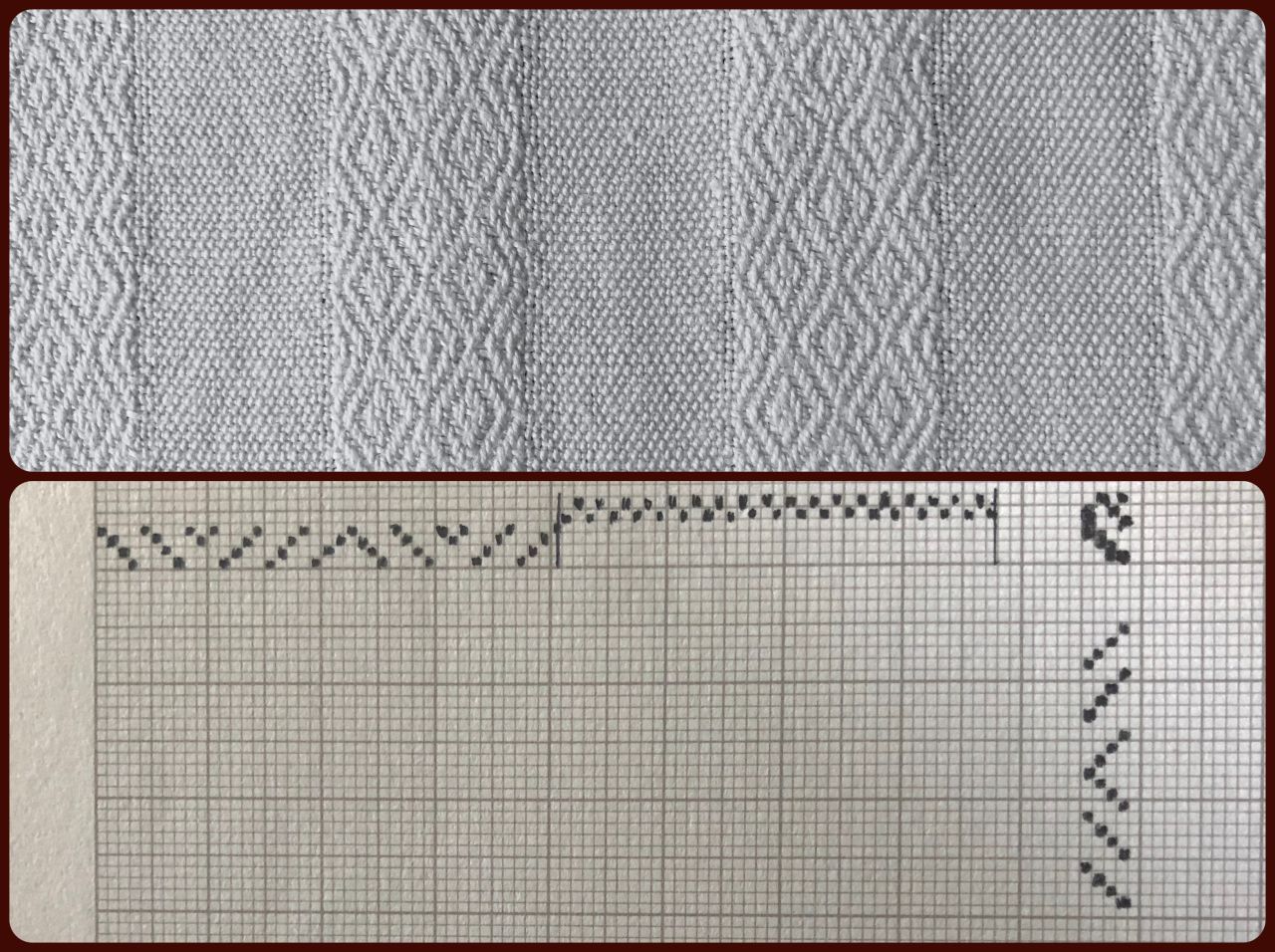 Once again, this is a technique variation that produces a striped effect with alternating “gåsögon” and tabby on the white cotton warp, using a white linen weft. Compared to the two previous reconstructions, the main difference is that six shafts are needed. As visible on the simple draft (horizontal), the “gåsögon” sections are on four shafts, and the tabby section is on two shafts. Whilst the weave still requires only four treadles, the shedding order runs vertically in the draft. The tie-up is visible in the right-hand top of the draft. (Private ownership). Photo, draft and woven napkin: Viveka Hansen, The IK Foundation.
Sources:
- Cyrus-Zetterström, Ulla, Handbok i vävning: Bindningslära – konstvävnader, Helsingborg 1980. (pp. 17-32).
- DigitaltMuseum (online provenience information about NM.0157990 & HSZ.80-07528).
- Hansen, Viveka, ‘Textilier och skinnberedning i Malmö – från stenålder till medeltid’, Elbogen, 2001, pp. 73-144.
- Hansen, Viveka, | Inspiration of historical weaving in the technique “gåsögon” or lozenge twill: tablecloth, napkins and towels.
- Ingers, Gertrud, Handdukar och duktyg, Malmö 1956 (pp. 28 & 52).
- Strömberg, E., Geijer, A., Hald, M., & Hoffmann, M., Nordisk Textilteknisk Terminologi, Oslo 1974.
- Svenska Akademiens Ordbok (SAOB). | Swedish Academy Dictionary (Search word: “gåsöga”).
- Wallin, Anna, Mönsterbok för väfnader i hemmet, Stockholm 1873.
More in Books & Art:
Essays
ISSN 2631-4746
The iTEXTILIS is a division of The IK Workshop Society – a global and unique forum for all those interested in Natural & Cultural History.
Open Access Essays by Textile Historian Viveka Hansen
Textile historian Viveka Hansen offers a collection of open-access essays, published under Creative Commons licenses and freely available to all. These essays weave together her latest research, previously published monographs, and earlier projects dating back to the late 1980s. Some essays include rare archival material — originally published in other languages — now translated into English for the first time. These texts reveal little-known aspects of textile history, previously accessible mainly to audiences in Northern Europe. Hansen’s work spans a rich range of topics: the global textile trade, material culture, cloth manufacturing, fashion history, natural dyeing techniques, and the fascinating world of early travelling naturalists — notably the “Linnaean network” — all examined through a global historical lens.
Help secure the future of open access at iTEXTILIS essays! Your donation will keep knowledge open, connected, and growing on this textile history resource.
For regular updates and to fully utilise iTEXTILIS' features, we recommend subscribing to our newsletter, iMESSENGER.
The iTEXTILIS is a division of The IK Workshop Society – a global and unique forum for all those interested in Natural & Cultural History.
Open Access Essays by Textile Historian Viveka Hansen
Textile historian Viveka Hansen offers a collection of open-access essays, published under Creative Commons licenses and freely available to all. These essays weave together her latest research, previously published monographs, and earlier projects dating back to the late 1980s. Some essays include rare archival material — originally published in other languages — now translated into English for the first time. These texts reveal little-known aspects of textile history, previously accessible mainly to audiences in Northern Europe. Hansen’s work spans a rich range of topics: the global textile trade, material culture, cloth manufacturing, fashion history, natural dyeing techniques, and the fascinating world of early travelling naturalists — notably the “Linnaean network” — all examined through a global historical lens.
Help secure the future of open access at iTEXTILIS essays! Your donation will keep knowledge open, connected, and growing on this textile history resource.
For regular updates and to fully utilise iTEXTILIS' features, we recommend subscribing to our newsletter, iMESSENGER.
The IK Foundation & Company Promoting Natural & Cultural History
|
Subscribe to our Newsletter | IK Global iMessenger |
Translate Page |



|
© The IK Foundation & Company 2026 - a truly European organisation since 1988 |
The IK
Workshop Society
Workshop Society
The Field
Station Lab
Station Lab
How to cite & Creative Commons
You are welcome to use the information and knowledge from
The IK Workshop Society, as long as you follow a few simple rules.
LEARN MORE & I AGREE
You are welcome to use the information and knowledge from
The IK Workshop Society, as long as you follow a few simple rules.
LEARN MORE & I AGREE
