
ikfoundation.org
The IK Foundation
Promoting Natural & Cultural History
Since 1988

- WELCOME
- THE IK WORKSHOP SOCIETY
- THE FIELD STATION LAB
- THE DONATION ROOM
- BOOKS & ART0


- CONTACT
iFellows Sign In
Find out more about becoming an iFellow...My Basket
Items: 0Total: €0.00

SILK SAMPLES in 1831
– Import Regulations, Smuggling and Dutiable Goods in Sweden
ESSAYS No: CCXVII | March 16, 2026 | By Viveka Hansen
Swedish customs regulations were immensely complex during the 18th and 19th centuries. In a textile context, it was intertwined with dutiable goods, import bans on domestic weaving, sumptuary laws, luxury debates, lucrative smuggling, corrupt customs officers, and the expanding consumer revolution and industrialisation. For the State, however, to impose a duty on sought-after wares – like silk qualities – had two main aims. To stimulate manufacturing within the country, assisted by protective import duties and, sometimes, via selective or total bans. Secondarily, to increase the State finances via the high duties on imported merchandise, for instance, fabrics, coffee or wine. This essay focuses on a rediscovered archival book from the South Customs District in Sweden, revealing rare evidence of how officers were expected to recognise the characteristics of a wide range of silk and half-silk fabrics that were banned from import in 1831. To my knowledge, this is the first time this document will be examined in detail, together with a historical reflection on such desirable goods.
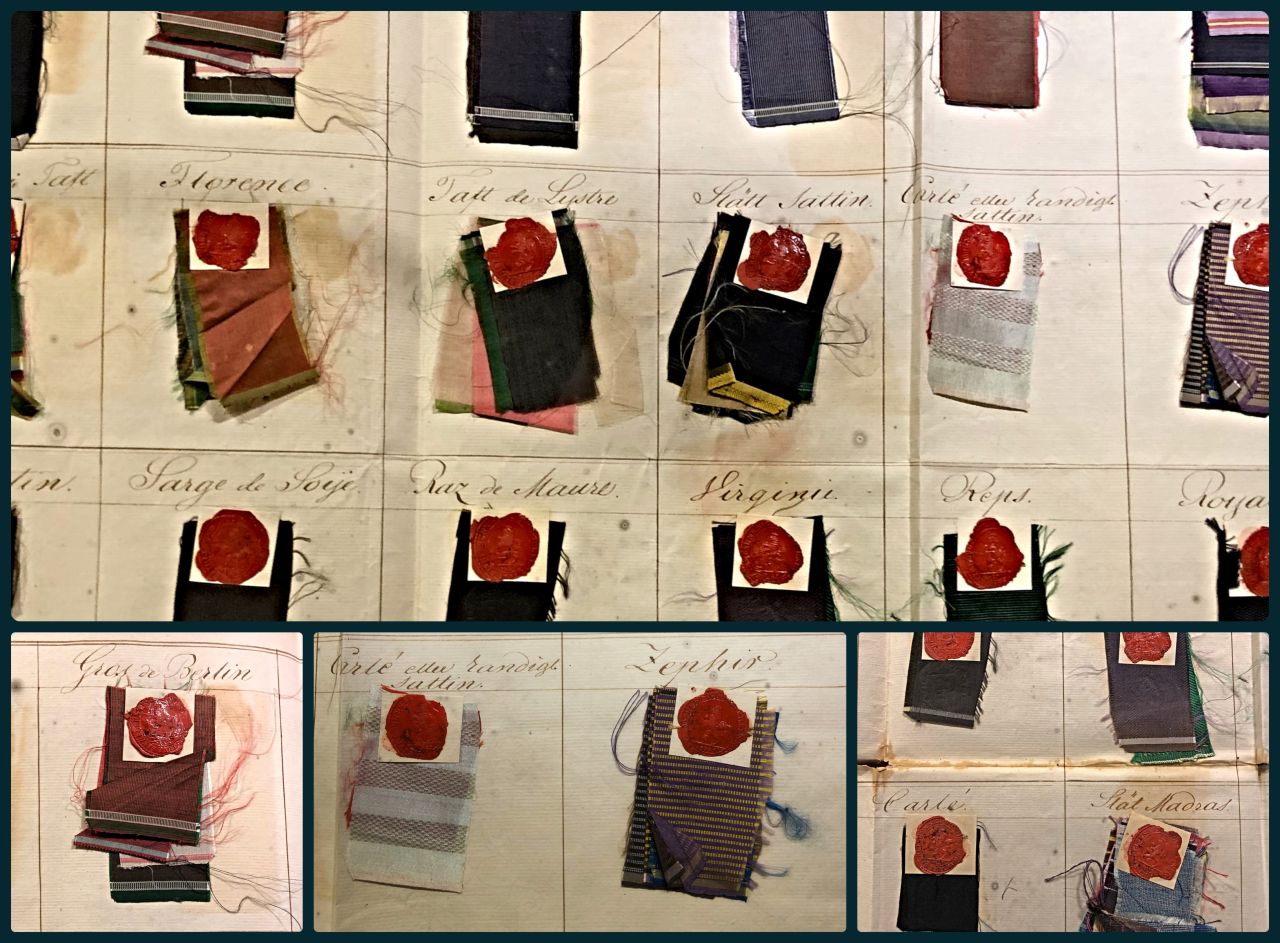 The document exhibits excellent attention to detail, as evidenced by a handwritten letter (see below), and the foldout includes 54 silk samples, fastened and sealed, divided into 20 groups. A common obstacle with most sampled fabrics is tracing the trade routes by which such silks reached Swedish customs, owing to a lack of written documentation. This means that the manufacturer or even the country of origin is often unknown; if it was regarded as illicit trade via harbours, some traders or private individuals may have been unaware of the complex rules, or smuggling may have occurred along the coastal areas. However, several of these qualities can be explained in greater detail, as supported by the titles above each sample group, which will be illustrated and analysed further in this case study. (Collection: The National Archive… See sources). Photo: Viveka Hansen, The IK Foundation.
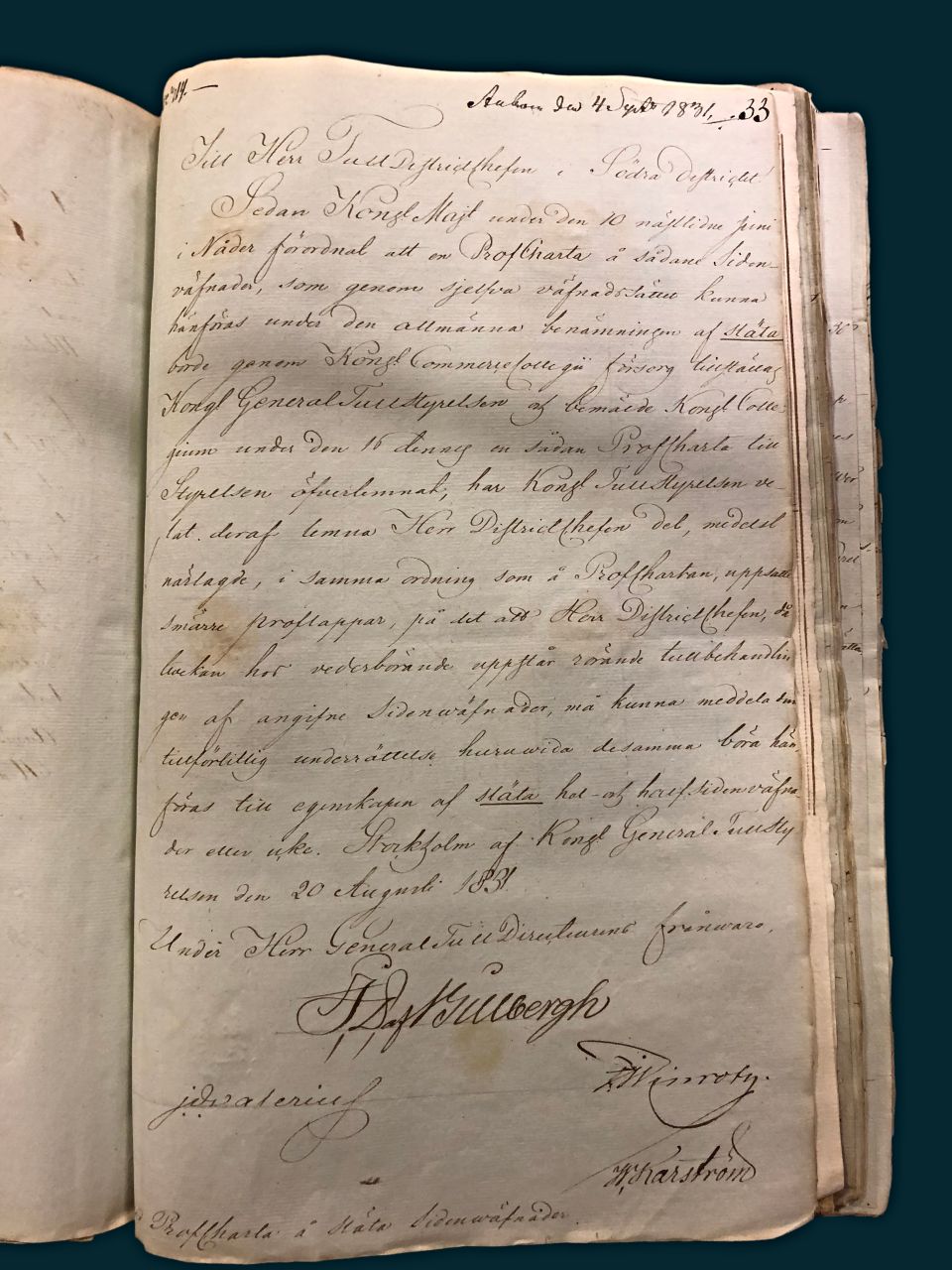 The letter, presented in an English translation below from the Swedish language, ’Arrived on 4th September 1831’, was addressed to the Customs South District. It had been bound in a letter-book numbered ’33’, followed by a foldout sample chart of silks for the same year for the South Customs District in Sweden. (Collection: The National Archive… See sources). Photo: Viveka Hansen, The IK Foundation.
‘To Mr Customs District Director in the South District.
Since the Royal Majesty, on the 10th of last June, in favour arranged that a Sample chart with such Silk fabrics, which due to the weaving technique itself can be classified to the general term of Plain, ought via the Royal Board of Commerce to be provided for to the Royal General Customs Board and the aforesaid Royal Board of Commerce on the 16th in this month, such a Sample chart had been delivered to the Board. The Royal Customs Board has thereof given Mr District Director’s part, by means of placing in the same order as on the Sample Chart with fastened small fabric samples, so Mr District Director, when uncertainty arises has the authority concerning the Customs’ treatment of mentioned Silk fabrics, and may be able to give reliable information in case the same should be classified due to the characteristics of Plain silk or half-silk fabrics or not. Stockholm of the Royal General Customs Board, the 20th August 1831.
During Mr General Customs Director’s absence.
[Signed by four individuals]
Sample Chart of Plain Silk fabrics.’
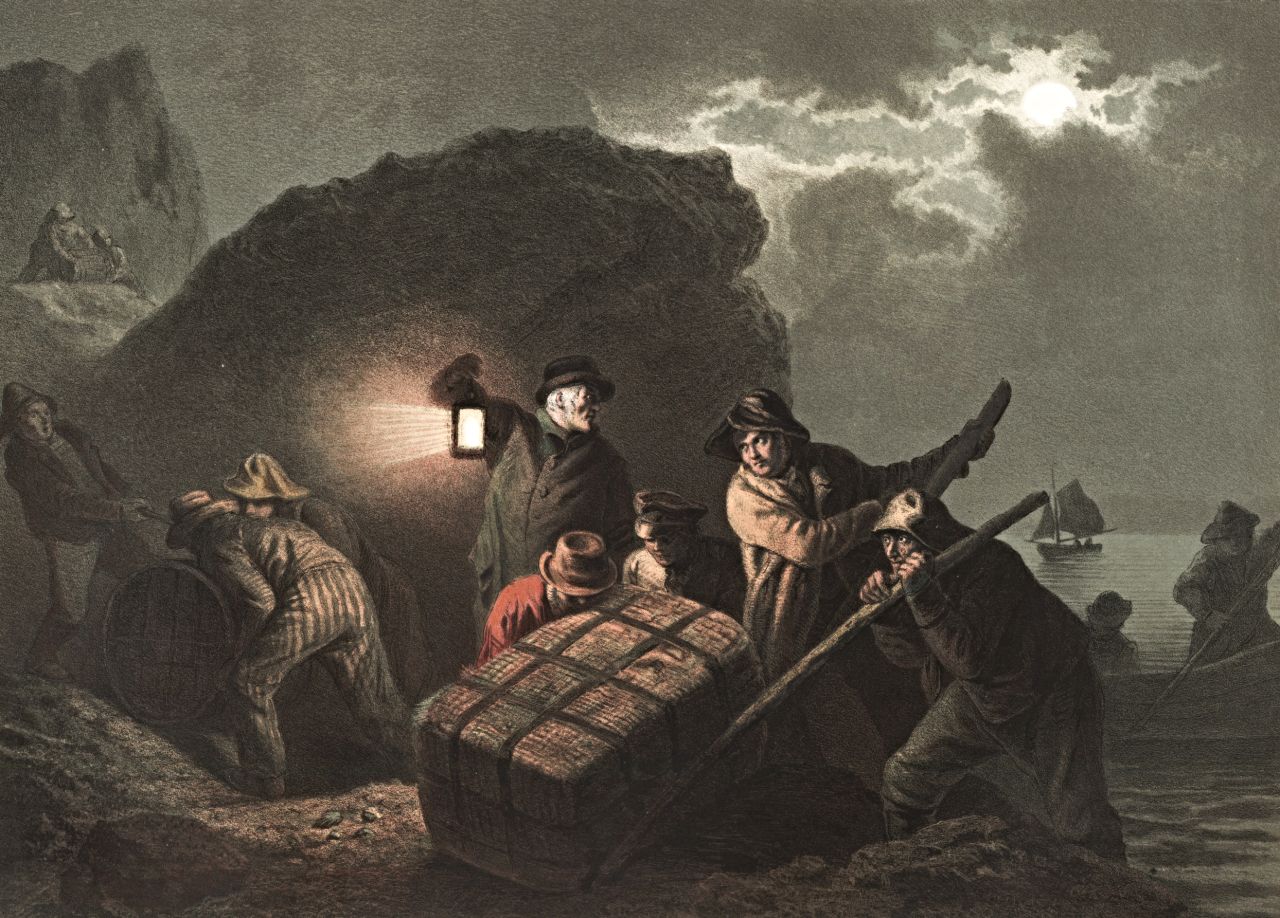 This lithograph, illustrating smugglers on the west coast of Sweden, by Joseph Wilhelm Wallander (1821-1888), offers an enlightening view of this longstanding illicit trade. In particular, regarding the substantial number of individuals involved, the boat sailing in the coastal waters with the desired goods, which was loaded onto a smaller rowing boat with two men, who met up with a group of smugglers on the rocky shoreline, where each man and boy had their role to play to safeguard the valuable goods. The centred, heavy, large bale may have been tightly packed with folded fabrics. | The illustration was included in the book ‘Bilder ur svenska folklifvet’, printed in 1855. (Courtesy: Uppsala University Library, Sweden. Alvin-record 89184).
![In a historical context, looking back to the previous century, the extensive illicit trade in foreign textiles to Swedish ports and along the coastal areas had multiple causes. A few observations linked to the desire for luxury, import regulations, domestic manufacturing goals, and sumptuary laws illustrate such matters. Overall, Stockholm held a significant position in international textile trade and in the city's manufacturing development. Here visualised with ‘Skeppsbron’ [The Ships’ Bridge], Old Stockholm harbour in the early 19th century. The wealthy merchants and ship-owners had their living quarters and offices in these large houses in the harbour. (Courtesy: National Museum, Stockholm, Sweden. Watercolour by Johan Peter Cummelin).](https://www.ikfoundation.org/uploads/image/4a-cumelin-nm-1280x958.jpg) In a historical context, looking back to the previous century, the extensive illicit trade in foreign textiles to Swedish ports and along the coastal areas had multiple causes. A few observations linked to the desire for luxury, import regulations, domestic manufacturing goals, and sumptuary laws illustrate such matters. Overall, Stockholm held a significant position in international textile trade and in the city's manufacturing development. Here visualised with ‘Skeppsbron’ [The Ships’ Bridge], Old Stockholm harbour in the early 19th century. The wealthy merchants and ship-owners had their living quarters and offices in these large houses in the harbour. (Courtesy: National Museum, Stockholm, Sweden. Watercolour by Johan Peter Cummelin).
In a historical context, looking back to the previous century, the extensive illicit trade in foreign textiles to Swedish ports and along the coastal areas had multiple causes. A few observations linked to the desire for luxury, import regulations, domestic manufacturing goals, and sumptuary laws illustrate such matters. Overall, Stockholm held a significant position in international textile trade and in the city's manufacturing development. Here visualised with ‘Skeppsbron’ [The Ships’ Bridge], Old Stockholm harbour in the early 19th century. The wealthy merchants and ship-owners had their living quarters and offices in these large houses in the harbour. (Courtesy: National Museum, Stockholm, Sweden. Watercolour by Johan Peter Cummelin).This textile trade, in turn, had an impact on the rest of Sweden, a subject that has been meticulously charted by economic historians. As early as the 1930s and 40s, historians such as Eli Heckscher and, in recent decades, Klas Nyberg, among others, did so. The subject is wide-ranging, covering a vast body of source material, and only a few principal features of the development are included here by way of illustration. Heckscher’s conclusions demonstrated, for example, how textile imports changed across different periods of the Age of Liberty: silk, linen, broadcloth, and haberdashery goods accounted for 5.6% of total imports to Stockholm in 1746-1750 but only 0.8% in 1761-1763. Records still extant show that Sweden’s strict import bans on textiles of all kinds appeared most obviously in the early 1760s, but that did by no means guarantee that it was the exact truth; particularly with the fabric smuggling in mind, which is likely to have increased in scope at that time. There was, nevertheless, an elaborate network of people involved with imported fabrics, as well as domestically produced ones, as revealed by present-day research on the subject. Nyberg’s studies show a multitude of groups within the bourgeoisie during the period 1740-1800, who together with the most influential merchants played a part in imports, exports, weaving, dyeing, sewing or trading in cloth and clothes, including wholesale, retail and small shops, both in the form of trading houses and minor family-based enterprises, textile manufactures, silk and clothes traders, traders in unbleached linen, linen traders, dyers, milliners and hatters, linen weavers and tailors.
Historian Pia Lundqvist also gives some enlightening observations about the illicit trade in research of ‘Forbidden Fabrics’, primarily based on a sample collection dated 1849 to 1854. In particular, regarding the trade of a myriad of fabrics, which were handled and confiscated by the customs officers in the harbours of Malmö, Ystad, Helsingborg, Visby and Göteborg. However, these fabrics probably accounted for only a tiny percentage of the smuggled textile goods arriving along the Swedish coasts by boat during the same period. Additionally, her text emphasises that smuggled textiles from abroad were sought after and distributed to customers across cities, towns, and the countryside. In accordance with my case study of the 1831 silks – illustrated and discussed in more detail below – the statistical tables in Lundqvist’s article further emphasise that silks such as taffeta and satin, along with many other silks, kinds of cotton, and woollens, were subject to total import bans in Sweden during the period 1816 to 1851.
 Two of the twenty groups of silk samples, showing ‘Carlé or striped satin’ and ‘Zephir’, with two respective five pieces of silk, the seals reveal the year ‘1825’. The satin quality had been woven on a single-coloured white warp, whilst the striped effect was created by the visible weft and the weave structure. The ‘Zephir’, on the other hand, clearly had a striped warp, with equal numbers of yellow and purple warp threads and the weft in purple only (on the top sample). The weave design is unequal-sided. On these two sample groups, just as in the rest, the existing selvedge makes it possible to establish the warp and weft direction on the silks. (Collection: The National Archive… See sources). Photo: Viveka Hansen, The IK Foundation.
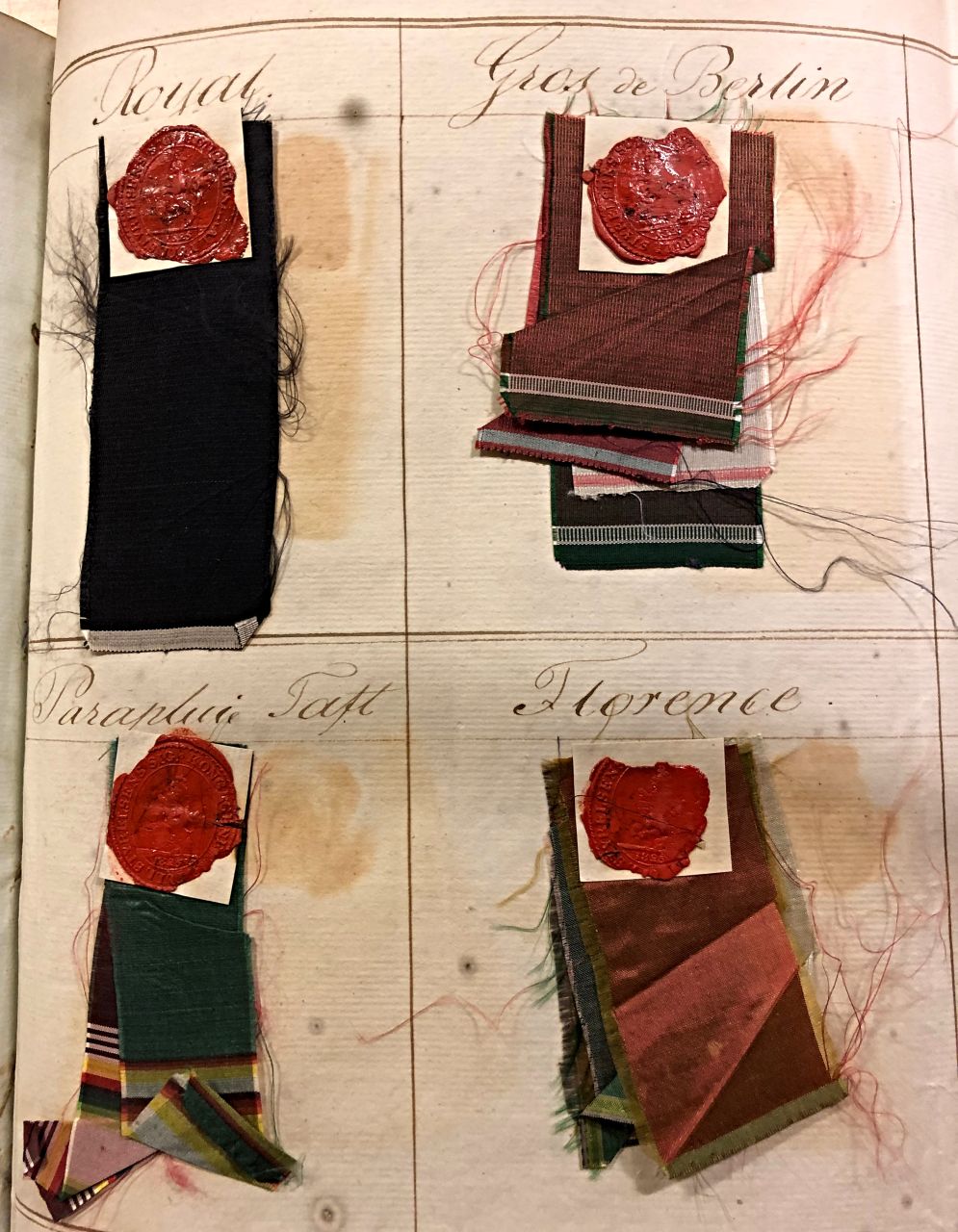 Further examples of silk qualities, which, despite some similarities, reveal characteristic details linked to manufacturing and probable uses. (Collection: The National Archive… See sources). Photo: Viveka Hansen, The IK Foundation.
The art of dyeing a durable black colour – without fading to grey – was complex prior to synthetic dyes in the 1850s, so due to its sought-after colour, plain black silk, like this example above, could be named ‘Royal’. The best results were achieved with bark and plants containing a great deal of tannin, and when green vitriol, soot or a decoction of oak-apple was added, the resulting colour was black. To the right, ‘Gros de Berlin’, which was plain – with one single colour in the warp as well as the weft – but with double threads to make the weft-faced fabric somewhat more hard-wearing, probably with a connection to Berlin. ‘Florence’ was a plain silk with a satin weave. Whilst the fourth final sample type illustrated above was named ’Parapluie Taft’, a taffeta of plain weave used for a parapluie, either to protect from rain or sunlight. Notably, the warp threads are multicoloured and striped near the selvedge, while the rest of the fabric is a single colour. See the contemporary umbrella below to see how such fine striped silk was typically stretched across the canopy. Silk samples, as well as the umbrella silk quality, are both warp-faced, with the least-visible weft threads shuttled in one colour only.
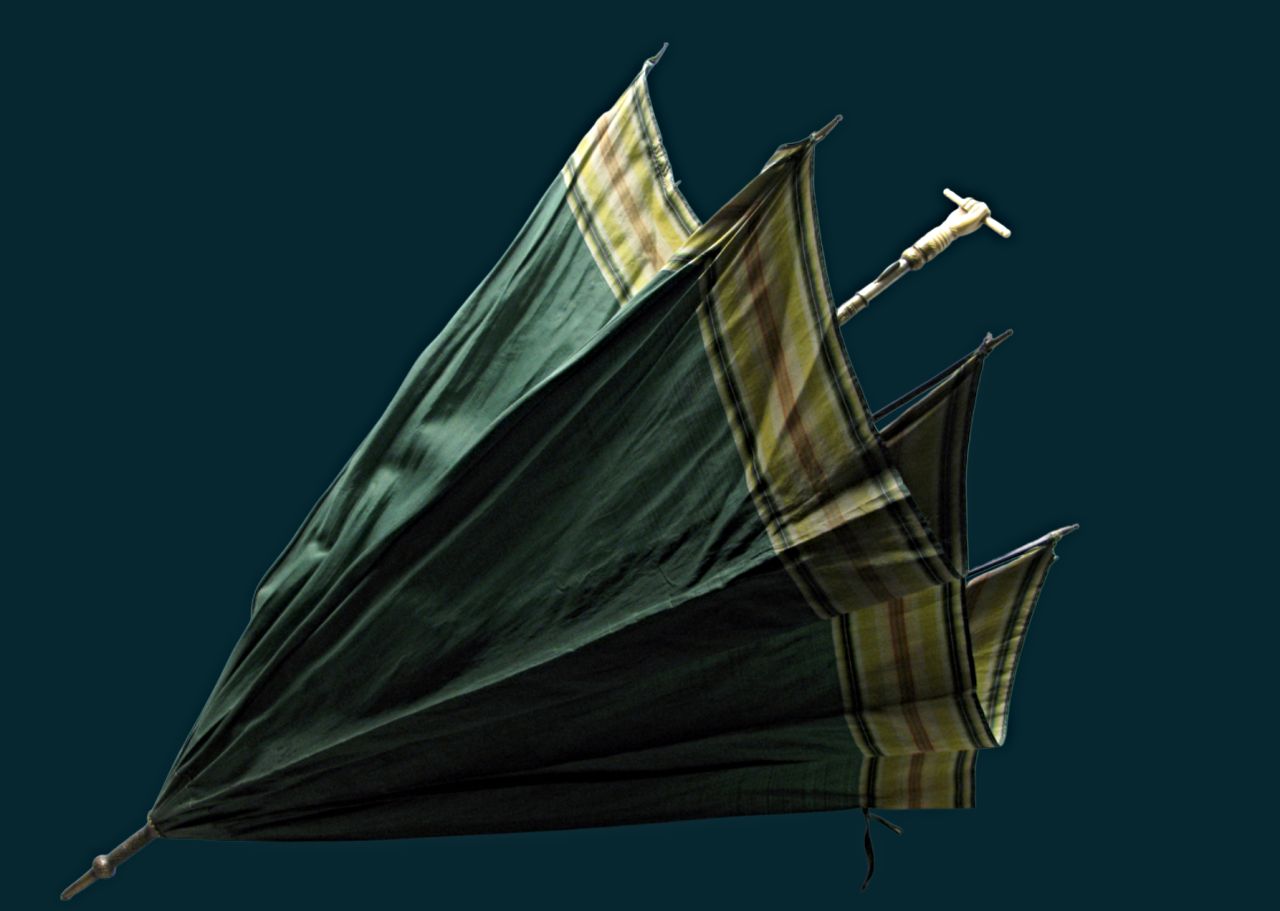 A silk Parapluie – umbrella or parasol – dated to the 1820-1860s, with a bone/ivory handle and metal ribs. Interestingly, this particular well-preserved model of taffeta silk with woven stripes at the edge of the folding canopy is comparable to the sample in the image above, named ‘Parapluie Taft’. (Courtesy: The Nordic Museum, Stockholm, Sweden. NM.0108736. DigitaltMuseum).
![These four silk sample groups include various plain-weave types. ‘Eternell’ and ‘Gros d’ Eté’ are similar to double weft threads, particularly visible in the border close to the selvedge, but with differences in thinness. ’Gros d´Eté also visibly had been woven assisted by two shuttles – light green and black silk weft thread end on the top sample – which show in detail how the alternating single and double weft threads were used to get the striped effect.‘Taft de Lystre’ was a lightweight, almost paper-thin taffeta silk. ‘Slätt Sattin’ [Plain Satin] is finally smooth silk where the warp threads cover the weft threads altogether due to the point of design in the weaving structure. (Collection: The National Archive… See sources). Photo: Viveka Hansen, The IK Foundation.](https://www.ikfoundation.org/uploads/image/8a-1831-1080x1280.jpg) These four silk sample groups include various plain-weave types. ‘Eternell’ and ‘Gros d’ Eté’ are similar to double weft threads, particularly visible in the border close to the selvedge, but with differences in thinness. ’Gros d´Eté also visibly had been woven assisted by two shuttles – light green and black silk weft thread end on the top sample – which show in detail how the alternating single and double weft threads were used to get the striped effect.‘Taft de Lystre’ was a lightweight, almost paper-thin taffeta silk. ‘Slätt Sattin’ [Plain Satin] is finally smooth silk where the warp threads cover the weft threads altogether due to the point of design in the weaving structure. (Collection: The National Archive… See sources). Photo: Viveka Hansen, The IK Foundation.
These four silk sample groups include various plain-weave types. ‘Eternell’ and ‘Gros d’ Eté’ are similar to double weft threads, particularly visible in the border close to the selvedge, but with differences in thinness. ’Gros d´Eté also visibly had been woven assisted by two shuttles – light green and black silk weft thread end on the top sample – which show in detail how the alternating single and double weft threads were used to get the striped effect.‘Taft de Lystre’ was a lightweight, almost paper-thin taffeta silk. ‘Slätt Sattin’ [Plain Satin] is finally smooth silk where the warp threads cover the weft threads altogether due to the point of design in the weaving structure. (Collection: The National Archive… See sources). Photo: Viveka Hansen, The IK Foundation.![The four final sample groups, which will be examined more closely, provide further insight into the variation of plain silks to be recognised through illicit trade – in the main, suitable and intended for use in clothing. ‘Raz de Maure’ and ‘Virginie’ were woven in twill, with the right-hand sample, visible to the eye, being the most robust. ‘Carlé’, on the other hand, was a delicate black satin type, whilst ‘Slät Madras’ [Plain Madras] varied in quality from all the other sample groups on the 1831 customs document. The difference is that this was half silk, that is to say, a plain woven fabric, here in nine colour combinations, which had been woven on a striped cotton warp with a single coloured silk weft. (Collection: The National Archive… See sources). Photo: Viveka Hansen, The IK Foundation.](https://www.ikfoundation.org/uploads/image/9a-1831-1144x1280.jpg) The four final sample groups, which will be examined more closely, provide further insight into the variation of plain silks to be recognised through illicit trade – in the main, suitable and intended for use in clothing. ‘Raz de Maure’ and ‘Virginie’ were woven in twill, with the right-hand sample, visible to the eye, being the most robust. ‘Carlé’, on the other hand, was a delicate black satin type, whilst ‘Slät Madras’ [Plain Madras] varied in quality from all the other sample groups on the 1831 customs document. The difference is that this was half silk, that is to say, a plain woven fabric, here in nine colour combinations, which had been woven on a striped cotton warp with a single coloured silk weft. (Collection: The National Archive… See sources). Photo: Viveka Hansen, The IK Foundation.
The four final sample groups, which will be examined more closely, provide further insight into the variation of plain silks to be recognised through illicit trade – in the main, suitable and intended for use in clothing. ‘Raz de Maure’ and ‘Virginie’ were woven in twill, with the right-hand sample, visible to the eye, being the most robust. ‘Carlé’, on the other hand, was a delicate black satin type, whilst ‘Slät Madras’ [Plain Madras] varied in quality from all the other sample groups on the 1831 customs document. The difference is that this was half silk, that is to say, a plain woven fabric, here in nine colour combinations, which had been woven on a striped cotton warp with a single coloured silk weft. (Collection: The National Archive… See sources). Photo: Viveka Hansen, The IK Foundation.In conclusion, the final sumptuary law in Sweden was introduced in 1794 but was discontinued two years later due to its unpopular restrictions on the wearing of silk fabrics and brightly coloured clothes among large segments of society. This reality indicates that, in 1831, such a restrictive law could have been remembered only by older people. However, the import ban still affected a large number of silk qualities in the 1830s, including all plain silks, among others, as exemplified by the fabrics observed in this essay. One of the main reasons for import bans of desired plain silks was that such fabrics were regarded as possible to produce in enough amounts by the Swedish manufacturers; many did not agree, the desirable foreign qualities were popular, and smuggling and illicit trade appeared to have been extensive during the first half of the 19th century along the Swedish coast and harbours. The complexity and often-changing rules surrounding the import of silk fabric, among other goods, however, largely came to an end during the period 1855 to 1880, when free trade agreements were introduced, which made the smuggling of fabrics less attractive and lucrative – as evidenced by many historical sources.
Sources:
- Cyrus-Zetterström, Ulla, Handbok i vävning: Bindningslära – konstvävnader, Helsingborg 1980.
- Hansen, Viveka, Textilia Linnaeana – Global 18th Century Textile Traditions & Trade, London 2017 (p. 302).
- Heckscher, Eli, Sveriges ekonomiska historia från Gustav Vasa – Det moderna Sveriges grundläggning, Del. II:1-2, Stockholm 1949 (tab. 24).
- Lundqvist, Pia, ‘Förbjudna tyger’, Dolda innovationer: Textila produkter och ny teknik under 1800-talet, pp. 190-213, Stockholm 2013.
- Nyberg, Klas, ed., Till salu – Stockholms textila handel och manufaktur 1722-1846, Stockholm 2010.
- Strömberg, E., Geijer, A., Hald, M., & Hoffman, M., Nordiskt textilteknisk terminologi, Oslo 1974.
- The National Archive (Riksarkivet), Regional Archive in Lund, Sweden. SE/LLA/10943/EI a/2. A letter and an additional foldout with 54 sealed silk samples. (Research visit in October 2021).
More in Books & Art:
Essays
ISSN 2631-4746
The iTEXTILIS is a division of The IK Workshop Society – a global and unique forum for all those interested in Natural & Cultural History.
Open Access Essays by Textile Historian Viveka Hansen
Textile historian Viveka Hansen offers a collection of open-access essays, published under Creative Commons licenses and freely available to all. These essays weave together her latest research, previously published monographs, and earlier projects dating back to the late 1980s. Some essays include rare archival material — originally published in other languages — now translated into English for the first time. These texts reveal little-known aspects of textile history, previously accessible mainly to audiences in Northern Europe. Hansen’s work spans a rich range of topics: the global textile trade, material culture, cloth manufacturing, fashion history, natural dyeing techniques, and the fascinating world of early travelling naturalists — notably the “Linnaean network” — all examined through a global historical lens.
Help secure the future of open access at iTEXTILIS essays! Your donation will keep knowledge open, connected, and growing on this textile history resource.
For regular updates and to fully utilise iTEXTILIS' features, we recommend subscribing to our newsletter, iMESSENGER.
The iTEXTILIS is a division of The IK Workshop Society – a global and unique forum for all those interested in Natural & Cultural History.
Open Access Essays by Textile Historian Viveka Hansen
Textile historian Viveka Hansen offers a collection of open-access essays, published under Creative Commons licenses and freely available to all. These essays weave together her latest research, previously published monographs, and earlier projects dating back to the late 1980s. Some essays include rare archival material — originally published in other languages — now translated into English for the first time. These texts reveal little-known aspects of textile history, previously accessible mainly to audiences in Northern Europe. Hansen’s work spans a rich range of topics: the global textile trade, material culture, cloth manufacturing, fashion history, natural dyeing techniques, and the fascinating world of early travelling naturalists — notably the “Linnaean network” — all examined through a global historical lens.
Help secure the future of open access at iTEXTILIS essays! Your donation will keep knowledge open, connected, and growing on this textile history resource.
For regular updates and to fully utilise iTEXTILIS' features, we recommend subscribing to our newsletter, iMESSENGER.
The IK Foundation & Company Promoting Natural & Cultural History
|
Subscribe to our Newsletter | IK Global iMessenger |
Translate Page |



|
© The IK Foundation & Company 2026 - a truly European organisation since 1988 |
The IK
Workshop Society
Workshop Society
The Field
Station Lab
Station Lab
How to cite & Creative Commons
You are welcome to use the information and knowledge from
The IK Workshop Society, as long as you follow a few simple rules.
LEARN MORE & I AGREE
You are welcome to use the information and knowledge from
The IK Workshop Society, as long as you follow a few simple rules.
LEARN MORE & I AGREE
