
ikfoundation.org
The IK Foundation
Promoting Natural & Cultural History
Since 1988

- WELCOME
- THE IK WORKSHOP SOCIETY
- THE FIELD STATION LAB
- THE DONATION ROOM
- BOOKS & ART0


- CONTACT
iFellows Sign In
Find out more about becoming an iFellow...My Basket
Items: 0Total: €0.00

TEXTILE ART AND HANDICRAFT
– Historical Reflections of Beautiful Clothes and Household Objects
ESSAYS No: CCXIX | April 16, 2026 | By Viveka Hansen
“Munkabälte” [monk’s belt] was one of many four-shafted art-woven textiles, which were popular in farming communities for household needs and, in particular, for the gathering of textiles for the young woman’s dowry. The technique was known under various local names in Sweden, but this picture essay will focus on domestic handloom weaving in the 19th and early 20th centuries in two of the southernmost provinces, Skåne and Blekinge. The geometric designs formed cubes, stars, stripes, and rhombi floating over the woven ground in wool, linen, and cotton. Overall, this weaving technique came to have many uses, such as bedcovers, cushions, aprons and neckerchiefs for the home, and festive dresses. Equally, the established handicraft organisations around 1900 promoted and disseminated knowledge of this style of weaving through inventories, exhibitions, weaving schools, and publications. My practical experience of weaving “munkabälte” will also be part of this historical perspective.
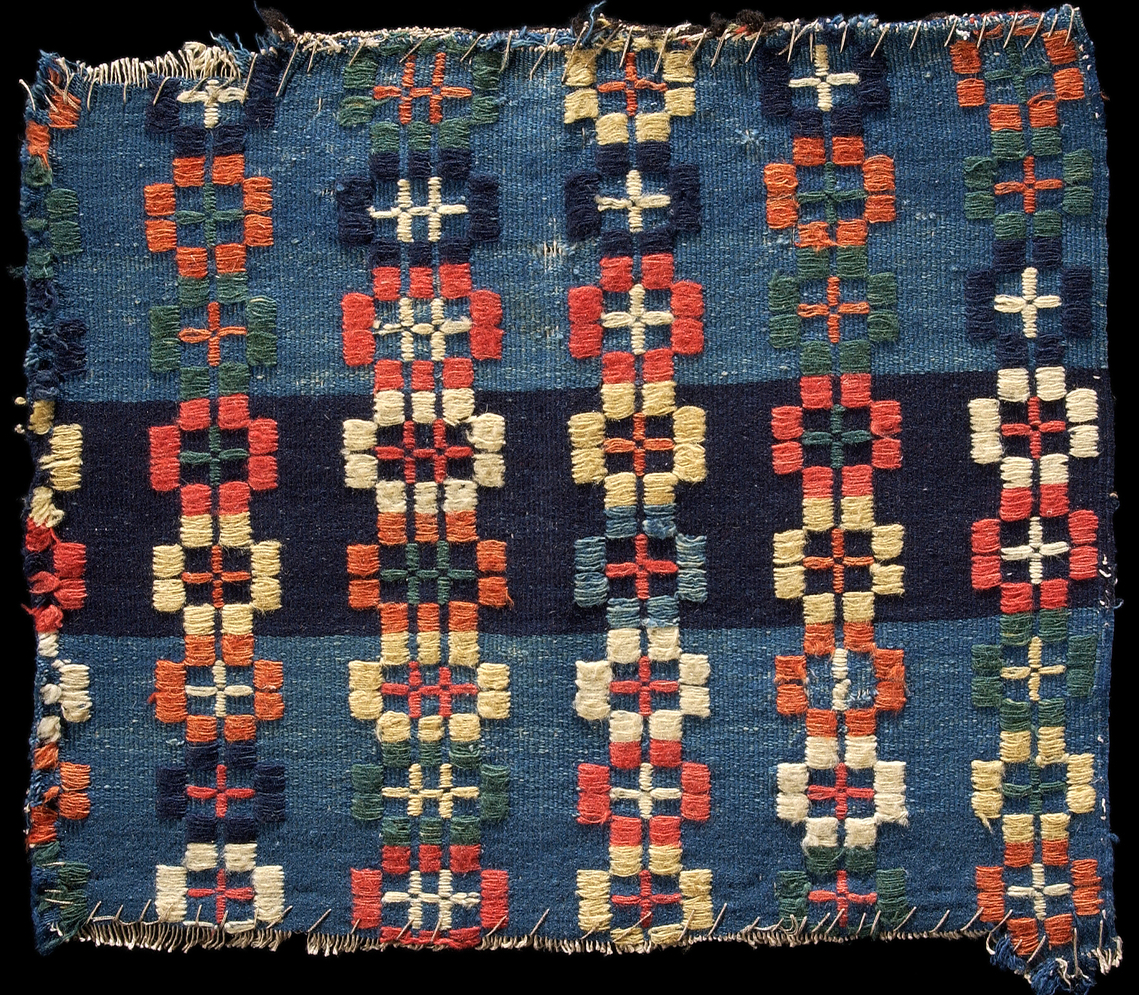 This colourful example was woven during the first half of the 19th century on a linen warp and natural dyed woollen weft. Today, only a fragment is extant, 47 x 40 cm, of a once much larger textile, probably a decorative bedcover. The shuttle was used for the indigo/woad blue main weft, whilst the brocading weft was inserted by hand during weaving due to the use of several colours, including red, blue, green, white and yellow. | Färs or Vemmenhög districts, Skåne province, Southernmost Sweden. (Courtesy: The Nordic Museum, Stockholm. NM.0134537. DigitaltMuseum).
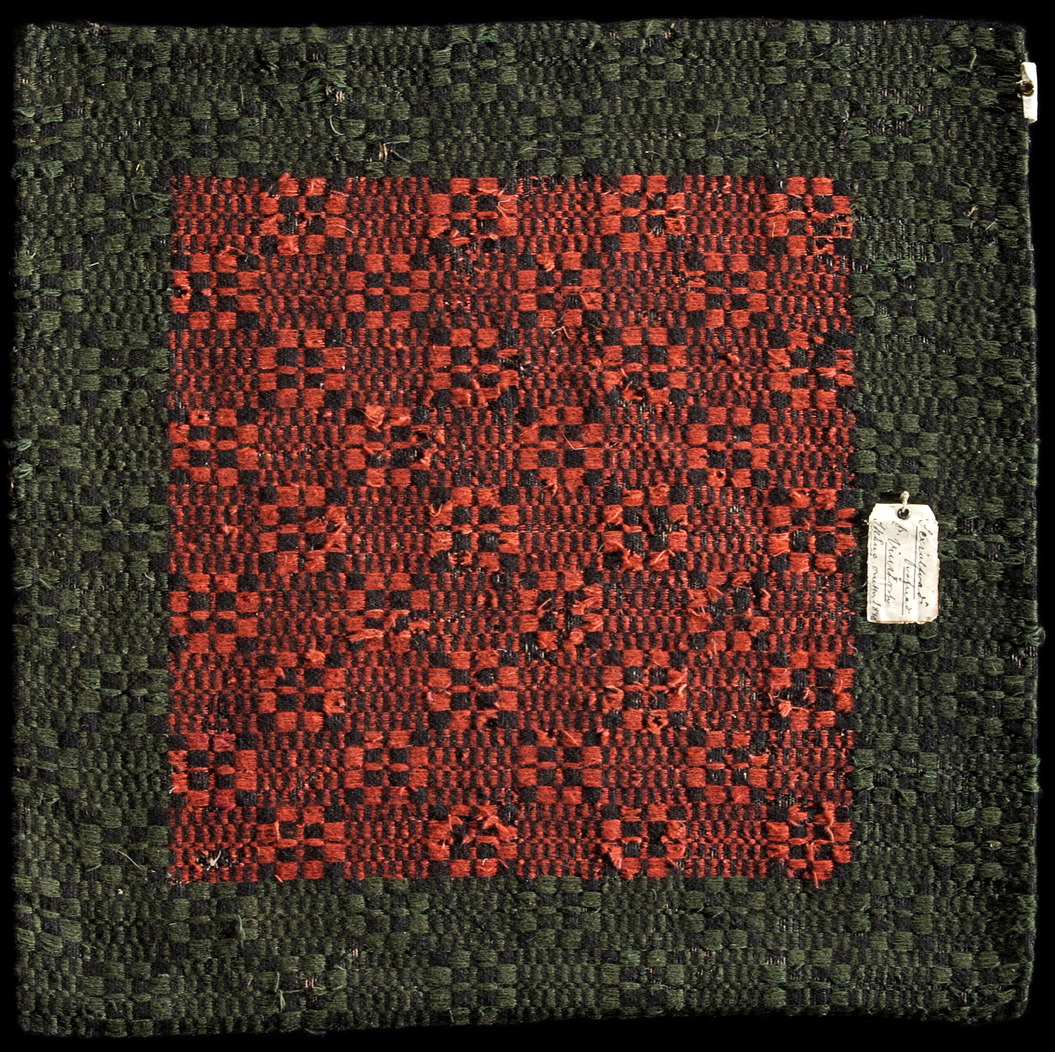 Seat cushion, woven on eight shafts, circa 1840, Bara district, Skåne province, southernmost Sweden. This “munkabälte” textile is more complex to weave than the example illustrated above. A square-shaped cushion on a linen warp – fully covered as always in this technique – has a geometrical star design across its entire surface. The centred mirror section was woven into the brocading weft due to the simultaneous use of green and red natural-dyed wool picks. In contrast to the upper and lower edges, where the brocaded weft could be shuttled with green wool only, which made this part of the weaving process quicker. It may be noted that the shuttled main weft alternates during the weaving with the picks (either shuttled or inserted by hand) and is distinctly visible in all the small black staples and cubes. The contemporary back fabric is also preserved as a handwoven twill, with a linen warp and a woollen weft. Even if both of these introduced textiles are similar in size today, the main difference is that this one was originally woven as a seat cushion with a suitable back fabric, whilst a small section from a bedcover above was remade into a pad or simply saved as a memory of a once-colourful furnishing textile. (Courtesy: The Nordic Museum, Stockholm. NM.0324905. DigitaltMuseum).
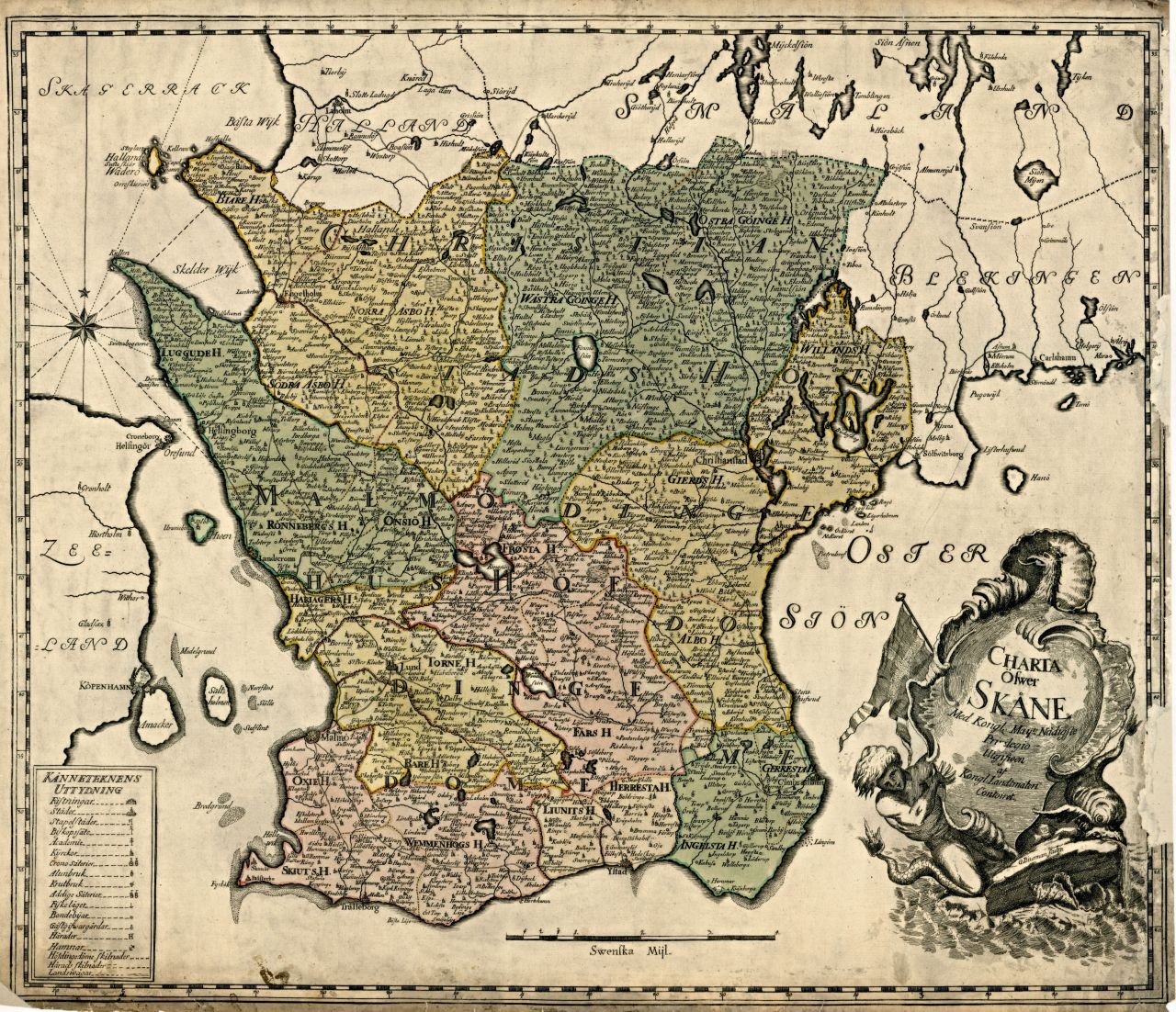 This map of Skåne – dated to the 1770s-1780s – gives a detailed geographical view not only of this most southerly province with each and every district area but also of the Blekinge province in the upper right-hand corner, where “munkabälte” was equally a popular weaving technique. Even if this map predates the illustrated textiles, it is highly likely that the technique was known in the oral tradition, under the same or another local name, by the female weavers in the farming community during this period. However, according to the Svenska Akademiens Ordbok (Swedish Academy Word Book), it is uncertain from where, when, and why this weaving technique acquired its name, but it appears to have first been recorded in print in 1876. (Courtesy: Postmuseum, POST.045074. DigitaltMuseum).
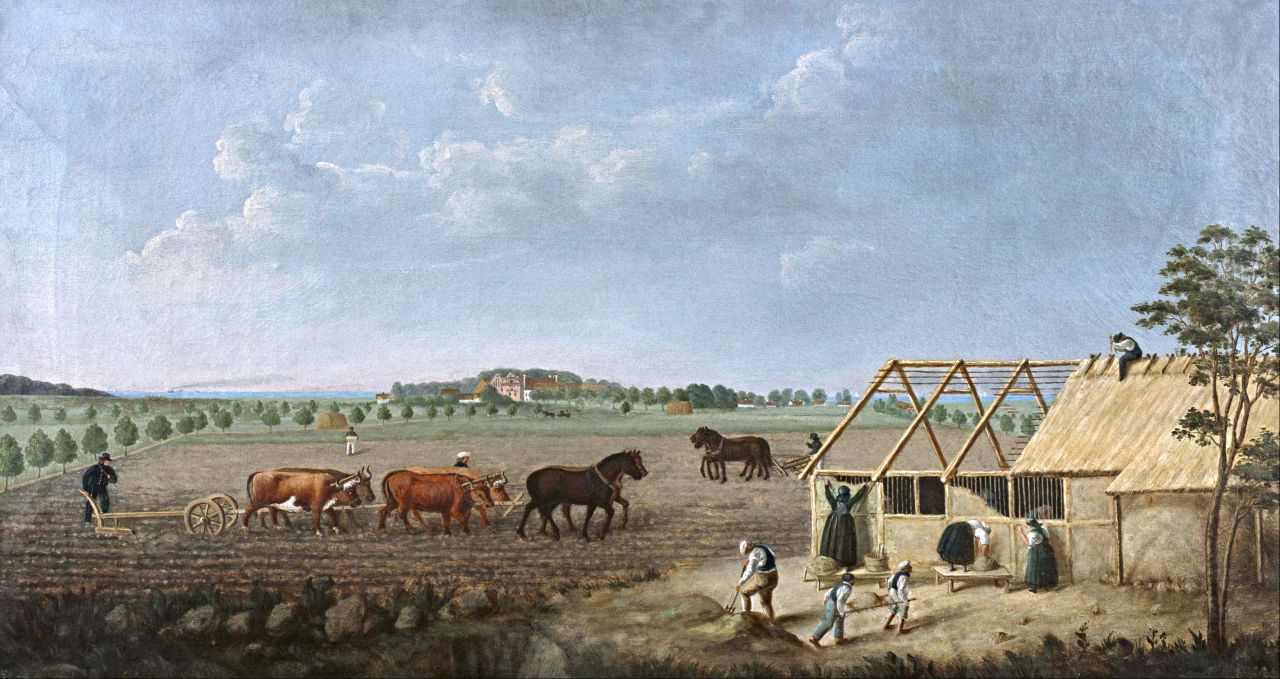 The construction of a farmhouse and ongoing ploughing in the parish of Östra Vemmenhög in Vemmenhög district, Skåne province, in the spring of 1866. Textile art was particularly plentiful in such comfortable living farmers’ households. Interestingly, the Vemmenhög district was also among the areas in Skåne where bedcovers in “munkabälte” were most popular. See two further hand-coloured photographs of these woven bedcovers below. | Oil on canvas by Carl Conrad Dahlberg (1805-1870). (Courtesy: Malmö Museum. Sweden. MMK 002887. Public Domain).
 Several bedcovers of a similar elaborate design in “munkabälte”, framed with star motifs in “opphämta”, with Vemmenhög district provenance (or close to this area) in Skåne. Among other sources, as evidenced by an inventory compiled during the 1910s by the local Malmö Handicraft Organisation. These particular textiles were not marked with years or signatures. Still, according to some owners at the time who had knowledge of the weaver one or two generations earlier in their family, this design appears to have flourished in a small geographic area around the 1840s to 1860s. This partly hand-coloured photograph shows a bedcover with intricate star motifs, originating from the village of Västra Nöbbelöv, approximately 15 kilometres from the place of origin of the bedcover illustrated below, and, notably, in a nearby parish to the house-building painting depicted above. The handicraft organisation had additionally attached the equivalence of the initially used natural dyed colours in red, yellow, green, blue and undyed wool to the photograph. (Courtesy: Stiftelsen Skånsk Hemslöjd, MLH.1245. DigitaltMuseum).
 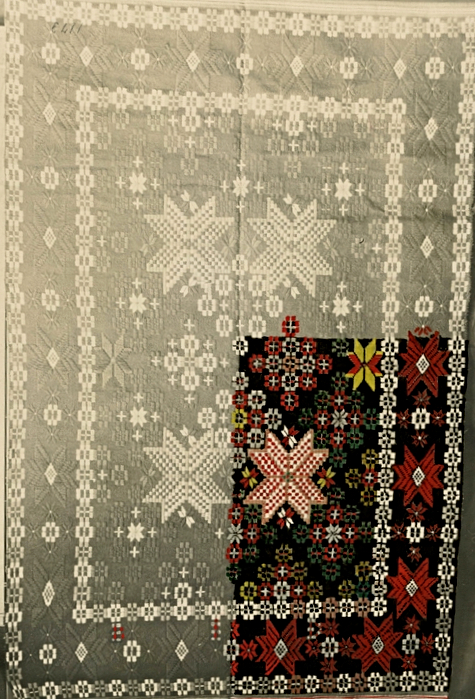 Another almost monumental inventory of the country's people’s textiles in Sweden was made by Lilli Zickerman (1858-1949) from 1910 to 1932; it is today kept at the Nordic Museum in Stockholm. In the form of circa 24,000 written records, sketches, and photographs in black and white, which include many partly hand-coloured pictures. The “munkabälte” technique from the southernmost province, Skåne, was one of many recorded textiles, which is here exemplified with such a bedcover, with a contrasting weft brocaded technique named “opphämta” in the wide framing border. This unidentified handloom weaver demonstrated great attention to detail, despite the added complexity of the two intertwined techniques. The geometric star design measures 120 cm x 185 cm, woven on a linen warp with a woollen weft for the shuttled ground threads and in the brocading weft, picked by hand. The bedcover was made at an unknown date during the 19th century in the village of Södra Åbo, Vemmenhög district, Skåne province. (Courtesy: Hemslöjdens samlingar, HSZ.74-07036. DigitaltMuseum).
 ![Before the monumental textile inventory over 22 years, Lilli Zickerman also assisted in collecting about 200 textile samples from Blekinge province. Evident via information linked to this large sample book, recorded as ‘Hushållnings-sällskapets Slöjdmagasin, Karlskrona 1906’ [The Housekeeping-Society Craft Magazine, Karlskrona in 1906]. A number of “munkabälte” qualities in the finest cotton in the warp and weft are included, registered among 68 headscarves. Just as on the woollen qualities already depicted and discussed, the similarities in the weaving technique are visible in these cotton qualities too, with the brocading weft forming cubes, stars and stripes on the plain ground weft. Information about the handloom weavers is lacking in this sample book, though. But these handwoven textiles were likely to have been woven either in a domestic sphere, in a hall connected to the Housekeeping Society, in weaving schools, or even from several of these possibilities. (Collection: Kulturen in Lund, KM.27866, acquired in 1921). Photo: Viveka Hansen, The IK Foundation.](https://www.ikfoundation.org/uploads/image/7a-img_3313.jpg) Before the monumental textile inventory over 22 years, Lilli Zickerman also assisted in collecting about 200 textile samples from Blekinge province. Evident via information linked to this large sample book, recorded as ‘Hushållnings-sällskapets Slöjdmagasin, Karlskrona 1906’ [The Housekeeping-Society Craft Magazine, Karlskrona in 1906]. A number of “munkabälte” qualities in the finest cotton in the warp and weft are included, registered among 68 headscarves. Just as on the woollen qualities already depicted and discussed, the similarities in the weaving technique are visible in these cotton qualities too, with the brocading weft forming cubes, stars and stripes on the plain ground weft. Information about the handloom weavers is lacking in this sample book, though. But these handwoven textiles were likely to have been woven either in a domestic sphere, in a hall connected to the Housekeeping Society, in weaving schools, or even from several of these possibilities. (Collection: Kulturen in Lund, KM.27866, acquired in 1921). Photo: Viveka Hansen, The IK Foundation.
Before the monumental textile inventory over 22 years, Lilli Zickerman also assisted in collecting about 200 textile samples from Blekinge province. Evident via information linked to this large sample book, recorded as ‘Hushållnings-sällskapets Slöjdmagasin, Karlskrona 1906’ [The Housekeeping-Society Craft Magazine, Karlskrona in 1906]. A number of “munkabälte” qualities in the finest cotton in the warp and weft are included, registered among 68 headscarves. Just as on the woollen qualities already depicted and discussed, the similarities in the weaving technique are visible in these cotton qualities too, with the brocading weft forming cubes, stars and stripes on the plain ground weft. Information about the handloom weavers is lacking in this sample book, though. But these handwoven textiles were likely to have been woven either in a domestic sphere, in a hall connected to the Housekeeping Society, in weaving schools, or even from several of these possibilities. (Collection: Kulturen in Lund, KM.27866, acquired in 1921). Photo: Viveka Hansen, The IK Foundation.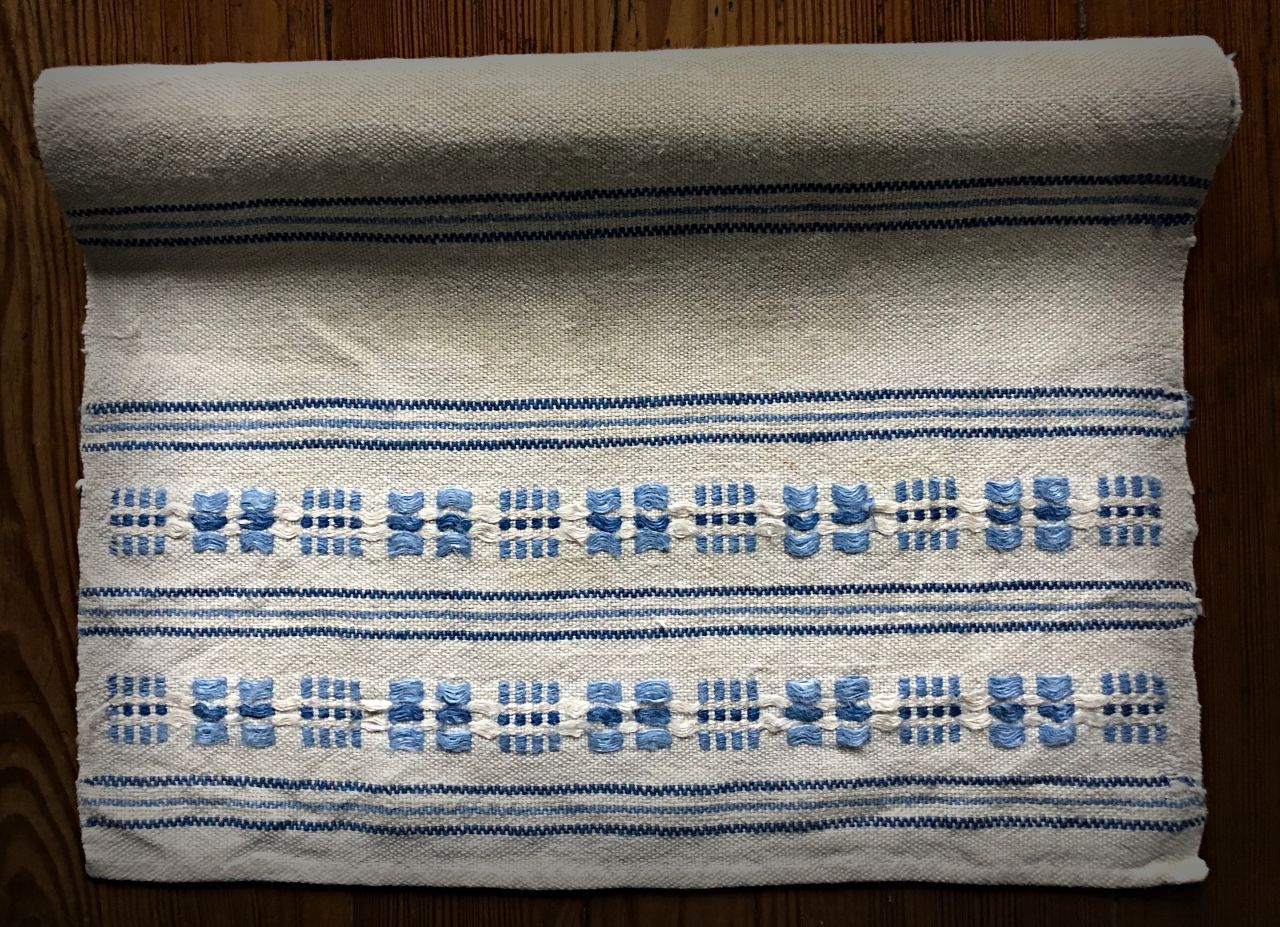 Some of my own weaving experience with this technique dates back many years, in the form of six table mats (26 cm x 40 cm) in the “munkabälte” variation on four shafts and four treadles. For the warp, unbleached cotton yarn 20/2, and for the weft, bleached linen yarn 16/1 and two blue shades, were used. Two treadles were used for the shuttle main weft and two for the shuttle brocading weft. The table mats have got some wear and tear over the years, but are still useful after four decades.| Material and weaving notes: Malmö Handicraft Organisation in the 1980s. (Private ownership). Photo and woven table mat: Viveka Hansen, The IK Foundation.
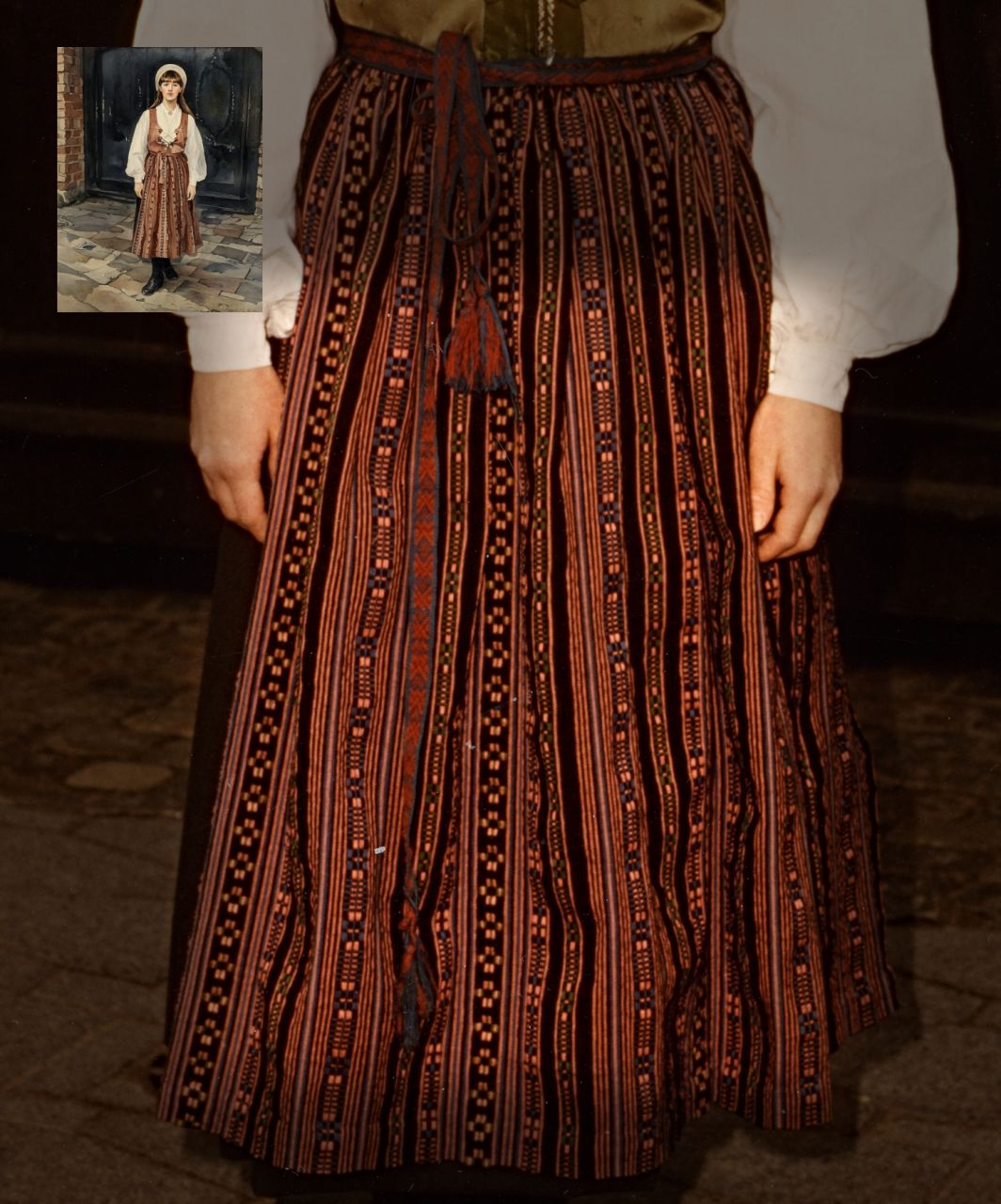 At the Malmö Handicraft Organisation, the staff wore reproductions of traditional dress from various local districts in southern Sweden during Christmas and other special festivities. The inspiration for such garments produced during the 1920s-1960s often originated from areas near the coastal city of Malmö. (Photo: Private ownership).
Aprons, in particular, were woven in borders of “munkabälte” in red, pink, blue and green on a black ground. Women in farming communities always wore an apron (or, at times, two aprons) during the 19th century. The garment protected the skirt, covered the slit at the front of the skirt, could be used to carry eggs from the henhouse, etc. and not least to be a decorative complement to the dress, according to research by the late textile historian Gertrud Ingers, who visited many country houses and farms in the mid-20th century, at a time when the “old” textiles still were stored in chests and cupboards – which included aprons woven in “munkabälte” with ribbons. A quote in a translation of her findings is also interesting: ‘For the aprons, which were long and wide, ribbons were essential. One might assume that most were woven at home, as the band loom was very common in households. The ribbons should be 5 ells long, that is to say, 3 metres, and reach twice around the waist and then be tied with a bow on one side. If just the colour agreed with the colour of the cloth, one could choose the ribbon design after preferred taste’. Here above, worn in 1983, visualised with a Bara district dress, with the focus on a “munkabälte” apron and matching ribbon in colour and style, which had an almost exact likeness to the quoted information.
Sources:
- Brodén, Märta, Vävning: andra boken, Stockholm 1981.
- Cyrus-Zetterström, Ulla, Handbok i vävning: Bindningslära – konstvävnader, Helsingborg 1980.
- Hansen, Viveka | Historical reproduction: handloom weaving of the “munkabälte” technique.
- Ingers, Gertrud, Skånska dräkter: Kvinnodräkten i Malmöhus län, Helsingborg 1984 (quote in translation, p. 13).
- Kulturen in Lund, Sweden | Study visit to the Textile Storage in 2021. ‘Vävnadsprover från Blekinge’ [Fabric samples from Blekinge] in 1906. KM.27866.
- Malmöhusläns Hemslöjdsförening, Gammal Allmogeslöjd, Malmö 1916-1923 (“Munkabälte”: Fig. 449-460).
- Nylén, Anna-Maja, Hemslöjd: Den svenska hemslöjden fram till 1800-talets slut, Lund 1969 (“Munkabälte” pp. 190-192).
- Strömberg, E., Geijer, A., Hald, M., & Hoffmann, M., Nordisk Textilteknisk Terminologi, Oslo 1974.
- Svenska Akademiens Ordbok (SAOB) online. (Search word: “Munkabälte”).
- The Nordic Museum, Stockholm, Sweden (online provenance information for NM.0134537 & NM.0324905, DigitaltMuseum).
- Walterstorff, Emelie von, Svenska vävnadstekniker och mönstertyper, Stockholm 1940 (“Munkabälte”: pp. 160-169).
More in Books & Art:
Essays
ISSN 2631-4746
The iTEXTILIS is a division of The IK Workshop Society – a global and unique forum for all those interested in Natural & Cultural History.
Open Access Essays by Textile Historian Viveka Hansen
Textile historian Viveka Hansen offers a collection of open-access essays, published under Creative Commons licenses and freely available to all. These essays weave together her latest research, previously published monographs, and earlier projects dating back to the late 1980s. Some essays include rare archival material — originally published in other languages — now translated into English for the first time. These texts reveal little-known aspects of textile history, previously accessible mainly to audiences in Northern Europe. Hansen’s work spans a rich range of topics: the global textile trade, material culture, cloth manufacturing, fashion history, natural dyeing techniques, and the fascinating world of early travelling naturalists — notably the “Linnaean network” — all examined through a global historical lens.
Help secure the future of open access at iTEXTILIS essays! Your donation will keep knowledge open, connected, and growing on this textile history resource.
For regular updates and to fully utilise iTEXTILIS' features, we recommend subscribing to our newsletter, iMESSENGER.
The iTEXTILIS is a division of The IK Workshop Society – a global and unique forum for all those interested in Natural & Cultural History.
Open Access Essays by Textile Historian Viveka Hansen
Textile historian Viveka Hansen offers a collection of open-access essays, published under Creative Commons licenses and freely available to all. These essays weave together her latest research, previously published monographs, and earlier projects dating back to the late 1980s. Some essays include rare archival material — originally published in other languages — now translated into English for the first time. These texts reveal little-known aspects of textile history, previously accessible mainly to audiences in Northern Europe. Hansen’s work spans a rich range of topics: the global textile trade, material culture, cloth manufacturing, fashion history, natural dyeing techniques, and the fascinating world of early travelling naturalists — notably the “Linnaean network” — all examined through a global historical lens.
Help secure the future of open access at iTEXTILIS essays! Your donation will keep knowledge open, connected, and growing on this textile history resource.
For regular updates and to fully utilise iTEXTILIS' features, we recommend subscribing to our newsletter, iMESSENGER.
The IK Foundation & Company Promoting Natural & Cultural History
|
Subscribe to our Newsletter | IK Global iMessenger |
Translate Page |



|
© The IK Foundation & Company 2026 - a truly European organisation since 1988 |
The IK
Workshop Society
Workshop Society
The Field
Station Lab
Station Lab
How to cite & Creative Commons
You are welcome to use the information and knowledge from
The IK Workshop Society, as long as you follow a few simple rules.
LEARN MORE & I AGREE
You are welcome to use the information and knowledge from
The IK Workshop Society, as long as you follow a few simple rules.
LEARN MORE & I AGREE
