
ikfoundation.org
The IK Foundation
Promoting Natural & Cultural History
Since 1988

- WELCOME
- THE IK WORKSHOP SOCIETY
- THE FIELD STATION LAB
- THE DONATION ROOM
- BOOKS & ART0


- CONTACT
iFellows Sign In
Find out more about becoming an iFellow...My Basket
Items: 0Total: €0.00

TEXTILE WALL COVERINGS
– at a Manor House in 1758
ESSAYS No: CIX | September 1, 2019 | By Viveka Hansen
The research of a detailed Inventory at a manor house in southernmost Sweden will continue to focus on walls from a textile perspective. Silk damask, broadcloth, striped woven linen, painted oilcloth and undecorated walls – were all represented in this historical document. Two of these wallhangings are preserved to this day, which will illustrate the essay together with a contemporary portrait with connections to the Piper family as well as a few details from correspondence in the 1760s. Flor’s Linen Manufacturer in the province of Helsingland also played a major role in the interior wall decorations at Christinehof Manor House, judging by the textiles listed in 1758.
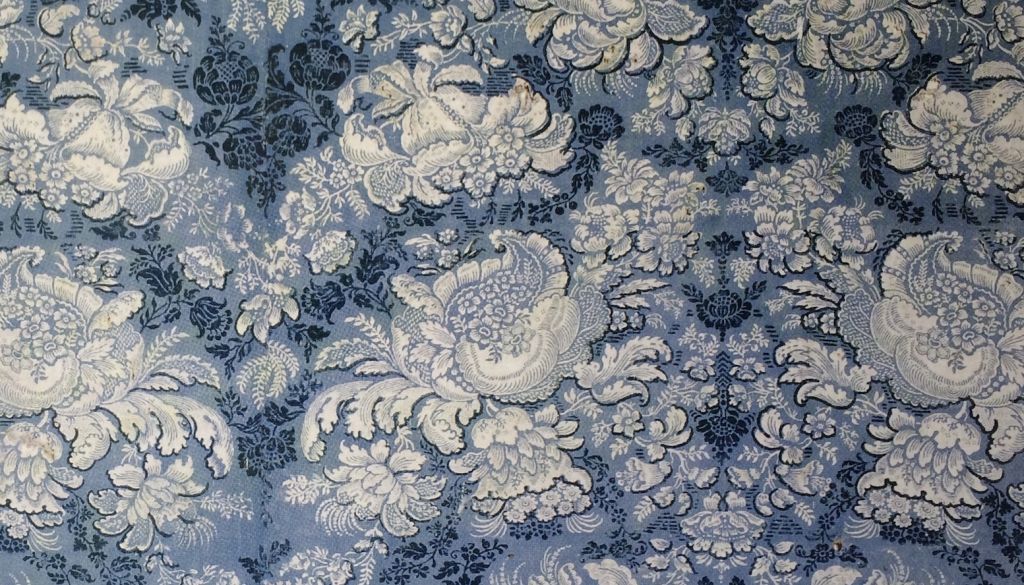 This beautiful block-print on linen from the 1740s is still preserved on the first floor at Christinehof manor house. It is maybe the same wall covering listed in the 1758 Inventory, which at this time decorated Countess’ Påhl’s Chamber on the second floor: reading ’The room is covered with blue and white printed linen’. (Christinehof manor house). Photo: V. Hansen, The IK Foundation, London.
 For the Yellow Bed Chamber on the second floor, one of the most expensive fabrics was listed: ‘The room is covered in yellow East India Furnishing Damask’. At the same time as bed-curtains and upholstering on chairs matched the walls in materials as well as colours, which seem to have been quite common and desired in 18th century Swedish aristocratic homes. A letter from the son Carl Gustaf Piper to his father Carl Fredrik in 1763 also gives some enlightening facts about prices at an auction in Stockholm of similar exquisite silk fabrics. He wrote: ‘…purchased the soft yellow furnishing damask for my dear father’s account which included 21 lengths in total 89 1/4 aln (1 aln = c. 60cm) á 23 Daler Copper coin per aln, and two pair of yellow damask curtains of 42 1/2 aln for 21 Daler Copper coin, together with a yellow damask canapé for [1072?] which in my opinion as well as others became too expensive.’
One room only had silk damask for the walls, so such material was probably regarded as a costly alternative, while linen of various designs was more common. For example, in the Cabinet on the second floor, the walls had a striped linen fabric from the well-established Flor’s Linen Manufacturer in the province of Helsingland (central Sweden). Furthermore, the textile interior of the entire room was designed accordingly.
‘The room is covered in white and red striped Helsinge Linen.
- 1 pair of Curtains for the windows of the same fabric.
- 2 Armchairs were stained yellow and covered in the same fabric.
- 2 Yellow Stools covered with Helsinge unbleached linen.’
This linen manufacturer also had a linen shop (Flors Linnebod) at the marketplace Riddarhustorget in Stockholm.
The 1758 Inventory lists linen for several other rooms at the manor house, besides these striped qualities – ’wave’ patterns, ‘marbling’ design and various painted linen in a total of eight rooms. For instance, the Count’s Bedroom listed ‘yellow and wave-like linen’ on the walls, whilst the Hall on the second floor was stretched with linen of ‘marbled painted decoration’. On this representative floor, five further rooms had linen wall decorations but with printed patterns. Primarily described via their colour combinations: blue and white, dark blue and white, with yellow flowers on a green ground and in two rooms as green and white. Furthermore, a couple of such lengths of linen had been stored away in the Vault, listed as ‘six pieces of green and white quality’ and ‘one yellow and green striped wave patterned’. From another contemporary inventory list of the Piper Family’s manor houses – Krageholm – situated some 30 kilometres from Christinehof in the southernmost part of the country, one detail gives additional information about the geographical origin of such work. At Krageholm, it was listed that wall-linings were of ‘painted linen made in Stockholm’, that is to say, about 600 kilometres in a northerly direction, where the family had had one of their other residences since 1692.
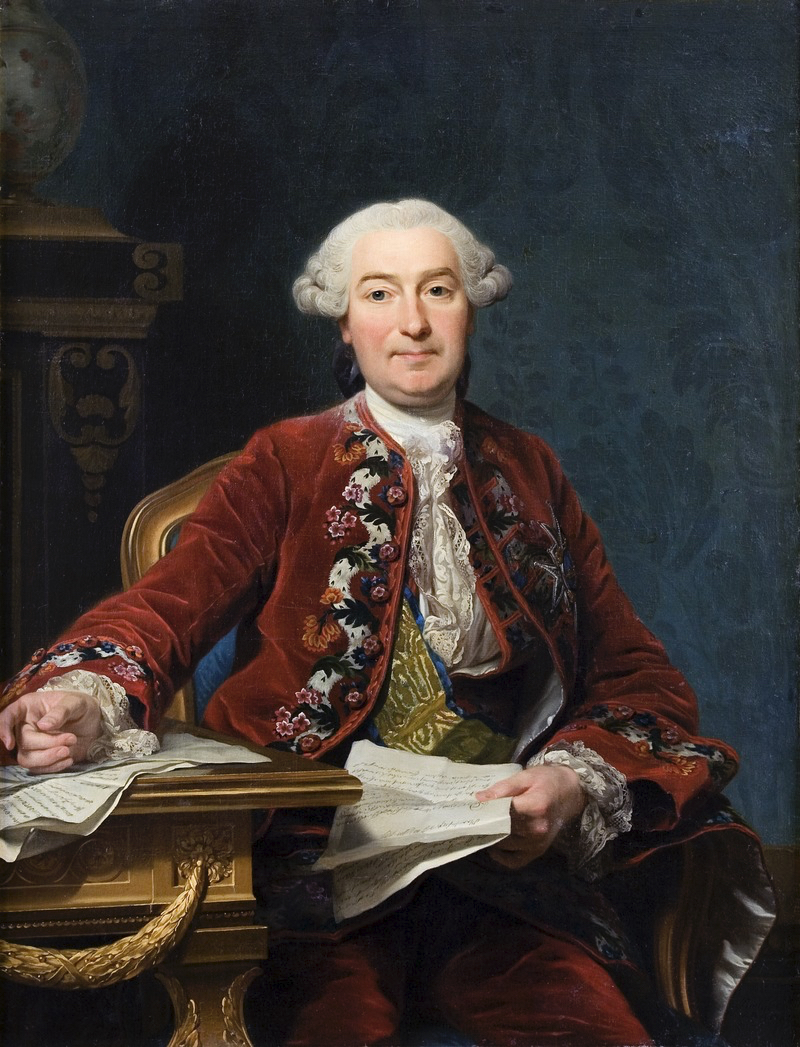 The dark blue wall covering in this portrait of baron Ulric Scheffer (1716–1799) may be compared to some of the choices listed for the walls in the 1758 Inventory, but there is some uncertainty if the depicted quality was a woven fabric, painted on linen cloth or of paper quality. Even if the portrait was made during Scheffer’s time as ambassador in Paris 1763, by the artist Alexander Roslin, connections to the Swedish nobility in general and the Piper family in particular can be traced from more than one perspective. Most importantly they belonged to the same social circles of the most wealthy nobility in Sweden. Furthermore Scheffer somewhat later in time married Christina Charlotta Piper (1734–1800) in 1773, the daughter of Carl Fredrik Piper and Ulrika Christina Mörner of Morlanda who had Christinehof manor house as one of their residences. (Courtesy of: Skokloster Castle, Sweden. SKO 2300. Wikimedia Commons).
Wool was not only used in the weft for colourful tapestries (described in the previous essay) or for velvet imitations, but equally as ’Green broadcloth above the doors’ in two representative rooms on the first floor. The fine woollen cloths must have been carefully stretched on the wall, probably most useful for minor areas due to its soft structure. In the Blue Wing Chamber on the second floor however, an entire room was decorated with cloth – ‘the room is covered with blue Cassian’. That is to say, a sturdier woollen fabric suitable for walls, heavy bed curtains or similar textile furnishing. In the Green Hall on the same floor, an oilcloth was further listed as ‘covered with green oilcloth wallpapers and gold border’. This type of wall decoration had a linen fabric as a base, prepared with glue, followed by hot wax mixed with linseed oil. This preparation was a ground for either a painted or printed pattern in an oil-based colouring, which made it more durable/washable and, therefore, a popular choice in well-to-do aristocratic and bourgeois homes.
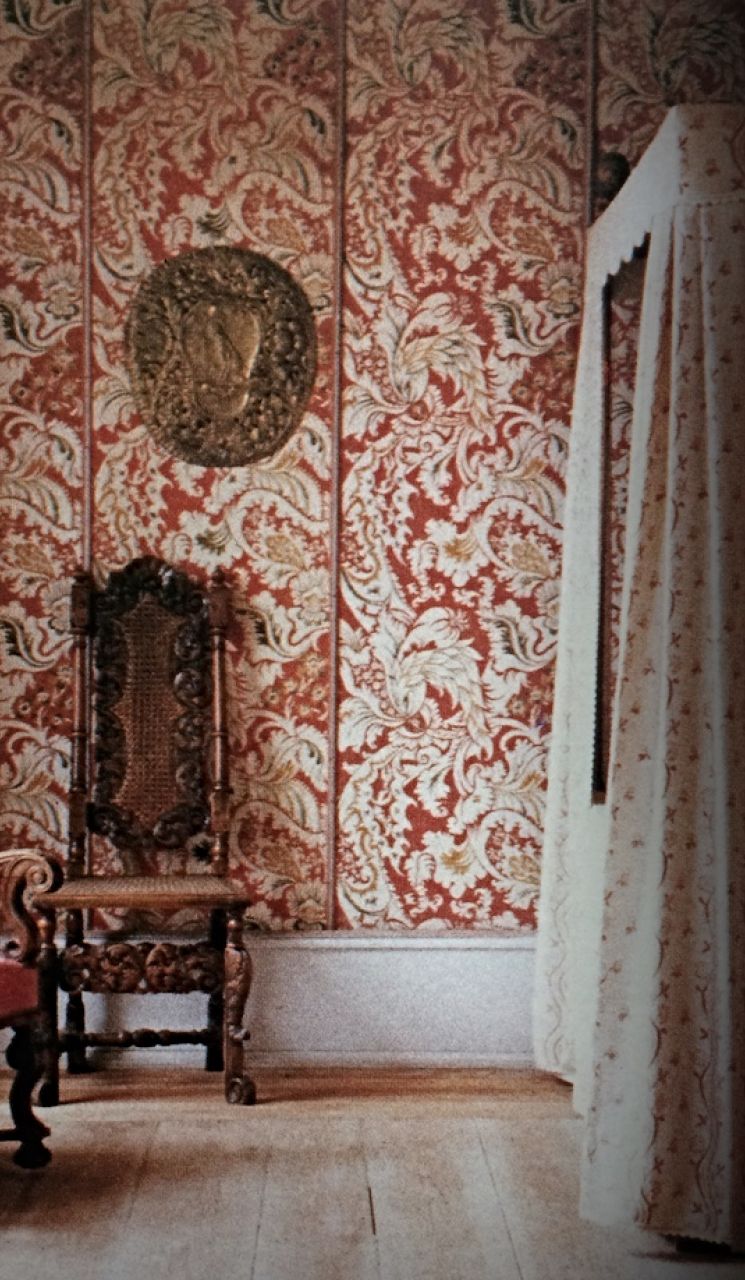 Concluding on the subject of wall coverings at a manor house in 1758. There is some uncertainty linked to this room situated to the right of the Hall on the second floor, which according to the Inventory had a ‘linen wall cover with printed yellow flowers on a green ground’. At an unknown date however, this must have been altered to this well-preserved ornamented velvet flocked wall covering – probably being even older than the manor house itself (built around 1740). Flock of wool was fixed with a type of glue on plain woven ground fabric in the desired motifs, to imitate an expensive cut-velvet fabric. A style that was in vogue already in the late 17th century. (Christinehof manor house). Photo: V. Hansen, The IK Foundation, London.
 This is the eighth essay based on the Inventory dated 1758 at Christinehof Manor House. Quotes from the documents are translated from Swedish to English.
Sources:
- Christinehof Manor House, Sweden (research visits, from the late 1980s to 2016).
- Hansen, Viveka, Inventariüm uppå meübler och allehanda hüüsgeråd vid Christinehofs Herregård upprättade åhr 1758, Piperska Handlingar No. 2, London & Whitby 2004 (pp. 20-24 & 38-62).
- Hansen, Viveka, Katalog över Högestads & Christinehofs Fideikommiss, Historiska Arkiv, Piperska Handlingar No. 3, London & Christinehof 2016.
- Historical Archive of Högestad and Christinehof, (Piper Family Archive, no D/Ia, E/IIa 2 & G/VI 5).
Essays
ISSN 2631-4746
The iTEXTILIS is a division of The IK Workshop Society – a global and unique forum for all those interested in Natural & Cultural History.
Open Access Essays by Textile Historian Viveka Hansen
Textile historian Viveka Hansen offers a collection of open-access essays, published under Creative Commons licenses and freely available to all. These essays weave together her latest research, previously published monographs, and earlier projects dating back to the late 1980s. Some essays include rare archival material — originally published in other languages — now translated into English for the first time. These texts reveal little-known aspects of textile history, previously accessible mainly to audiences in Northern Europe. Hansen’s work spans a rich range of topics: the global textile trade, material culture, cloth manufacturing, fashion history, natural dyeing techniques, and the fascinating world of early travelling naturalists — notably the “Linnaean network” — all examined through a global historical lens.
Help secure the future of open access at iTEXTILIS essays! Your donation will keep knowledge open, connected, and growing on this textile history resource.
For regular updates and to fully utilise iTEXTILIS' features, we recommend subscribing to our newsletter, iMESSENGER.
The iTEXTILIS is a division of The IK Workshop Society – a global and unique forum for all those interested in Natural & Cultural History.
Open Access Essays by Textile Historian Viveka Hansen
Textile historian Viveka Hansen offers a collection of open-access essays, published under Creative Commons licenses and freely available to all. These essays weave together her latest research, previously published monographs, and earlier projects dating back to the late 1980s. Some essays include rare archival material — originally published in other languages — now translated into English for the first time. These texts reveal little-known aspects of textile history, previously accessible mainly to audiences in Northern Europe. Hansen’s work spans a rich range of topics: the global textile trade, material culture, cloth manufacturing, fashion history, natural dyeing techniques, and the fascinating world of early travelling naturalists — notably the “Linnaean network” — all examined through a global historical lens.
Help secure the future of open access at iTEXTILIS essays! Your donation will keep knowledge open, connected, and growing on this textile history resource.
For regular updates and to fully utilise iTEXTILIS' features, we recommend subscribing to our newsletter, iMESSENGER.
The IK Foundation & Company Promoting Natural & Cultural History
|
Subscribe to our Newsletter | IK Global iMessenger |
Translate Page |



|
© The IK Foundation & Company 2026 - a truly European organisation since 1988 |
The IK
Workshop Society
Workshop Society
The Field
Station Lab
Station Lab
How to cite & Creative Commons
You are welcome to use the information and knowledge from
The IK Workshop Society, as long as you follow a few simple rules.
LEARN MORE & I AGREE
You are welcome to use the information and knowledge from
The IK Workshop Society, as long as you follow a few simple rules.
LEARN MORE & I AGREE
